

1. What Is the 3Cs Framework (Company, Customer, Competitor – Ohmae)?
The 3Cs Framework is a classic strategic and marketing tool that helps leaders diagnose their market position and craft go-to-market choices by analyzing three critical lenses: Company, Customer, and Competitor. It is sometimes called the “strategic triangle.” The premise is straightforward: sustainable advantage emerges where a company’s distinctive capabilities meet well-defined customer needs better than competitors can.
As an acronym, the three Cs stand for:
- Company: Your assets, capabilities, cost structure, brand, channels, and operating model.
- Customer: The needs, segments, behaviors, willingness to pay, and decision journeys of the target market.
- Competitor: Current and potential rivals, their strategies, cost positions, and likely responses.
It is a foundational marketing and strategy framework used widely by consultants and executives to focus analysis, articulate positioning, prioritize investments, and align cross-functional teams. The 3Cs are intentionally simple—yet powerful when applied with rigor—to identify the “strategic sweet spot” where you can win.
2. Origin and Background
The 3Cs Framework was popularized by Kenichi Ohmae, a former McKinsey & Company partner, notably in his book “The Mind of the Strategist” (1982). Ohmae introduced the strategic triangle to help strategists move beyond internally focused planning and consider the triangulation among a firm’s capabilities, customer value, and competitors’ moves.
It gained prominence through business school curricula, consulting engagements, and executive usage as a pragmatic, jargon-light way to structure market thinking. The framework addressed a common problem: teams optimized within silos—marketing, sales, product—without a unified view of where and how the company could create distinctive value relative to competitors for specific customers.
3. How the 3Cs Framework Works
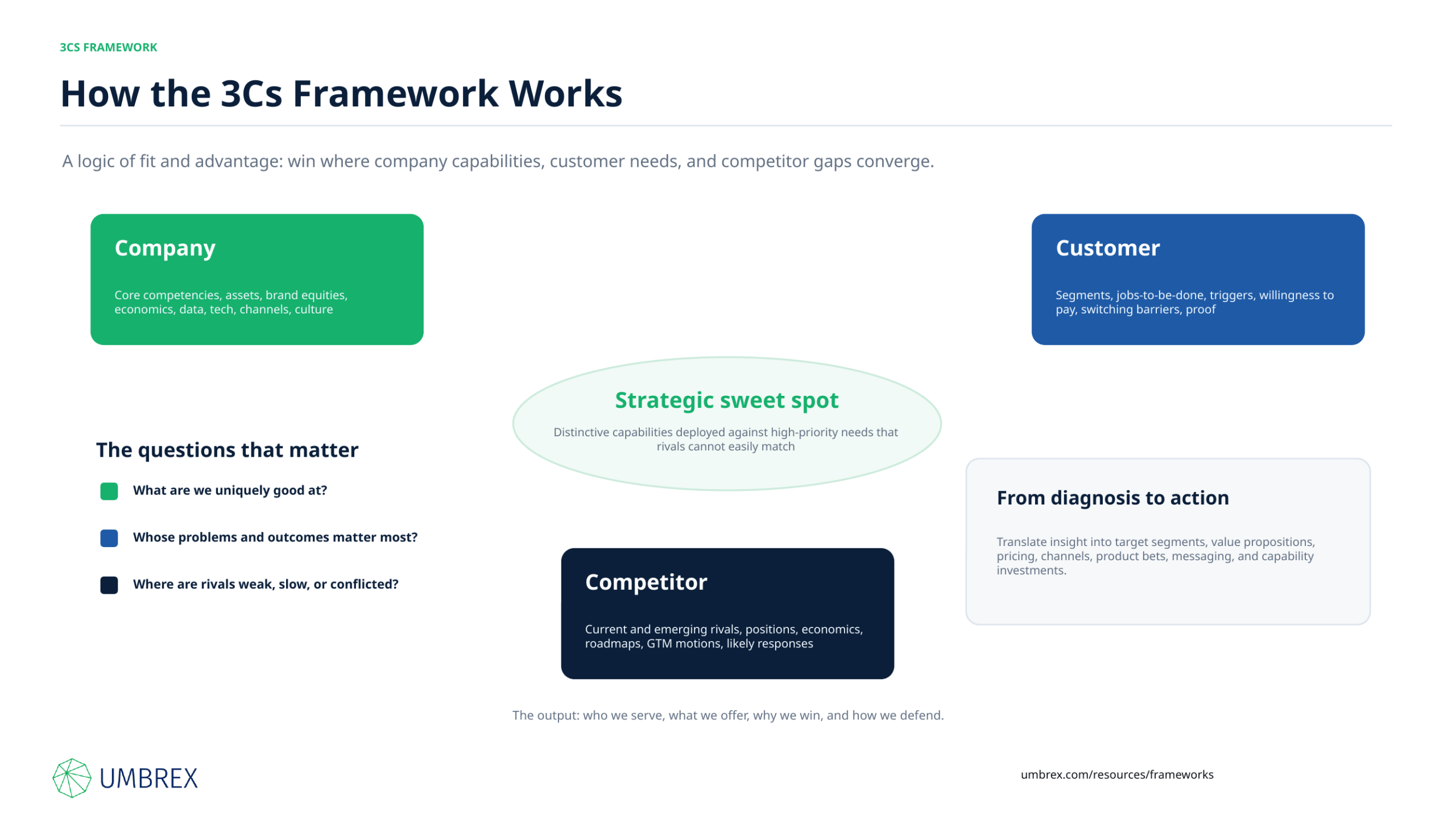
The 3Cs is a logic of fit and advantage. The core idea is to identify where your Company can deliver superior value to a specific Customer segment in ways that rivals (Competitors) cannot easily match. This is the intersection where strategy becomes actionable: distinctive capabilities deployed against well-understood needs with a clear view of competitive dynamics.
The three lenses
- Company: Assess core competencies, assets, brand equities, cost structure, supply chain reliability, data and technology, channel partnerships, sales coverage, and culture. The critical question: what are you uniquely good at (or could be), and where do you have an economic or capability edge?
- Customer: Define and prioritize segments, understand jobs-to-be-done, triggers and decision journeys, willingness to pay, switching barriers, and satisfaction drivers. The core question: whose problems are you solving, what outcomes matter most to them, and what proof moves them to buy?
- Competitor: Map current and emerging rivals, their strategic positions (cost, differentiation, focus), economics, product roadmaps, go-to-market motions, and likely responses. The question: where are they strong or weak, and how will they react to your moves?
The strategic triangle
Ohmae’s triangle emphasizes that strategy choices should be made where these three analyses converge. The “sweet spot” sits where:
- Your company’s distinctive capabilities align with
- High-priority customer needs for a chosen segment, and
- Competitors are either unable or unlikely to match quickly without eroding their own economics.
In practice, the 3Cs becomes a disciplined way to make trade-offs: choosing which customers to target, which needs to win, what advantages to reinforce, and which competitor responses to neutralize or avoid provoking.
From diagnosis to action
While conceptually simple, the framework pushes for specificity. It results in concrete choices: target segments, value propositions, pricing approaches, channel strategies, product bets, messaging, and capability investments. The best applications translate insights into a focused go-to-market narrative—who we serve, what we offer, why we win, and how we defend.
4. When to Use the 3Cs Framework
Situations where it excels:
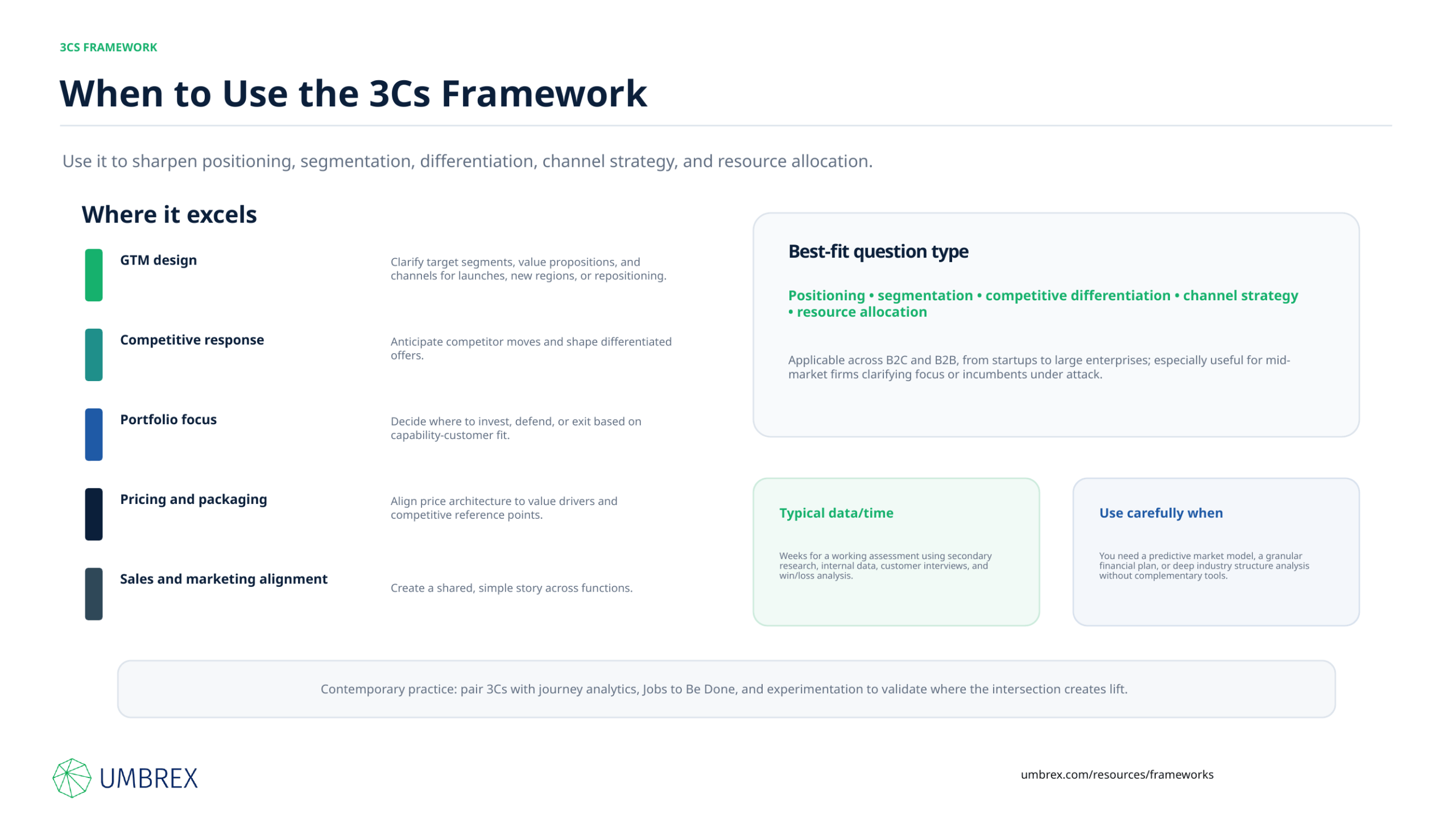
- Go-to-market design and refresh: Clarifying target segments, value propositions, and channels for launches, new regions, or repositioning.
- Competitive response planning: Anticipating competitor moves and shaping differentiated offers.
- Portfolio focus: Deciding where to invest, where to defend, and where to exit based on capability-customer fit.
- Pricing and packaging: Aligning price architecture to value drivers and competitive reference points.
- Sales and marketing alignment: Creating a shared, simple story across functions.
Company types: Applicable across B2C and B2B, startups to large enterprises. Especially useful for mid-market firms clarifying focus, or for incumbents under attack who need to sharpen differentiation.
Type of question: Positioning, segmentation, competitive differentiation, channel strategy, and resource allocation. Less suited for deep industry structure analysis (where Porter’s Five Forces helps) or corporate portfolio decisions (e.g., M&A synergies) without complementary tools.
Data and time requirements: A working 3Cs assessment can be built in weeks using secondary research, internal data, customer interviews, and win/loss analysis. Deeper quantification (e.g., willingness-to-pay studies, conjoint, cost benchmarking) takes additional time.
When it’s less useful: If you need a predictive market model or a granular financial plan, the 3Cs is only a starting point. It can also mislead if treated as a checklist without sharp segmentation or if “customer” is generalized to “everyone.”
Contemporary practice: Today, teams often pair the 3Cs with journey analytics, Jobs to Be Done, and experimentation to validate where the triangle’s intersection truly creates lift.
5. How to Apply the 3Cs Framework: Step-by-Step
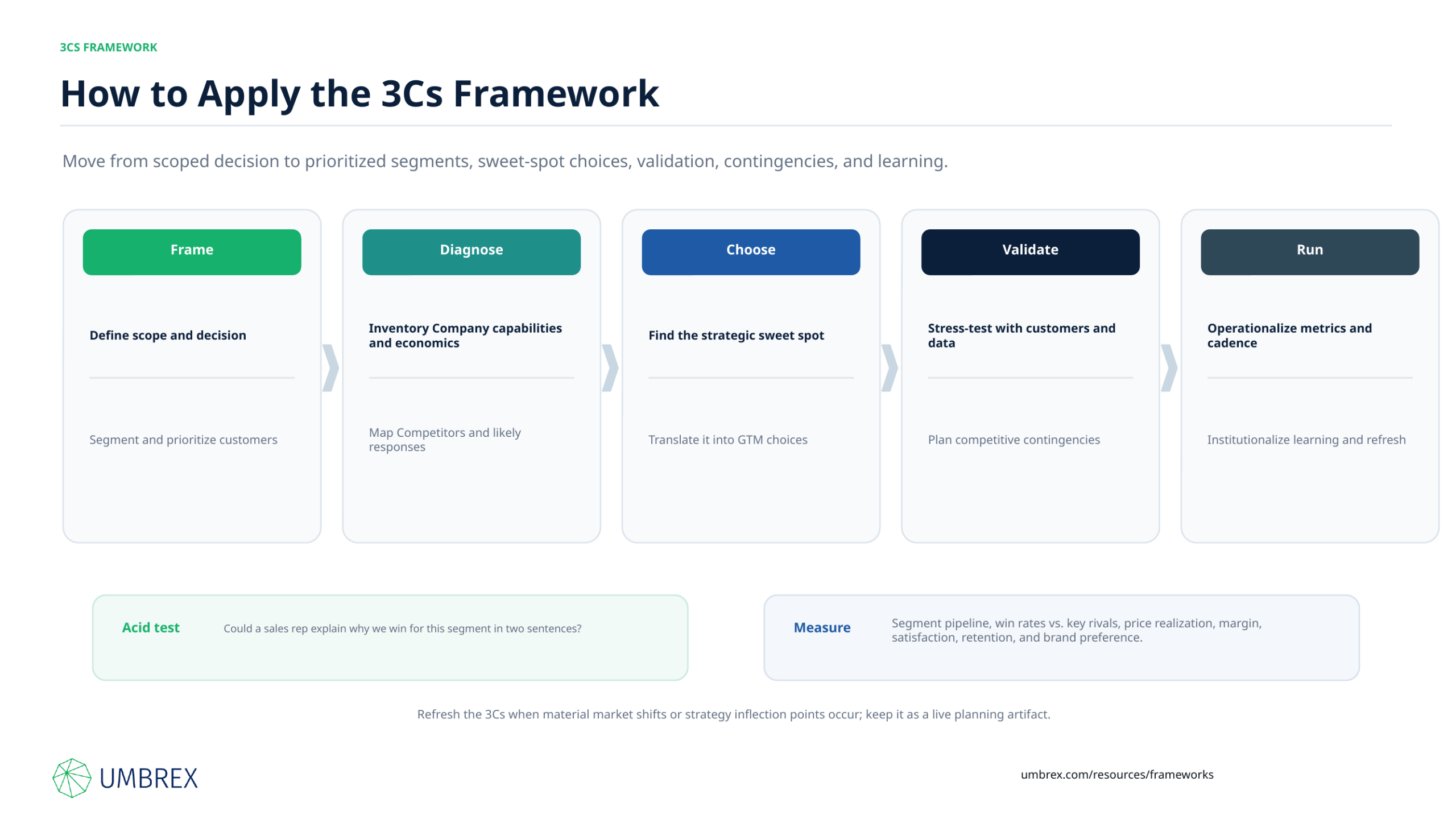
- Define scope and decision.
Clarify what you are solving: a product launch, repositioning a brand, entering a new segment, or defending share. Choose the geographic scope and the time horizon. Decide whether the unit of analysis is a product, business line, or the entire company.
- Segment and prioritize customers.
Identify candidate segments using behavior, needs, profitability, and growth. For each, outline jobs-to-be-done, buying criteria, decision journeys, and switching triggers. Prioritize 2–3 segments that are both attractive and winnable given your capabilities.
- Diagnose Company capabilities and economics.
Inventory strengths and gaps: product features, IP, data assets, brand equity, go-to-market reach, partnerships, cost position, supply chain resilience, customer success, and support. Quantify unit economics by segment (CAC, LTV, gross margin, payback). Identify two to three capabilities that are truly distinctive.
- Analyze Competitors and likely responses.
Map current and emerging competitors for your target segments. Capture their positioning, pricing, channel coverage, product roadmap, and economics. Conduct win/loss analysis, track review sites and analyst reports, and analyze messaging. Anticipate how they would respond to your moves (price cuts, bundling, partnerships).
- Find the strategic sweet spot.
Overlay the three lenses. For each prioritized segment, ask: where does our capability map directly to the outcomes customers value most, and where rivals are weak, slow, or conflicted? Articulate a draft value proposition and proof points for each target segment.
- Translate into go-to-market choices.
Make explicit decisions on positioning, product roadmap priorities, price architecture, packaging, channels, and messages. Assign owners and milestones. The acid test: could a sales rep explain why we win for this segment in two sentences?
- Stress-test with customers and data.
Run concept tests, A/B ads, pricing experiments, and win/loss interviews to validate the value proposition and messaging. Adjust based on evidence. Confirm that unit economics improve for the targeted segments.
- Plan competitive contingencies.
Pre-plan responses to likely competitor actions (e.g., defensive pricing, feature parity, channel exclusives). Define thresholds for reaction, preferred levers, and no-go zones to avoid value destruction.
- Operationalize and measure.
Build a metrics framework tied to the 3Cs: segment-level pipeline, win rates against key rivals, price realization, gross margin by segment, customer satisfaction/retention, and brand preference. Establish a monthly and quarterly cadence to review results and iterate.
- Institutionalize learning.
Document assumptions, what worked, and what didn’t. Refresh the 3Cs when there are material market shifts or strategy inflection points. Keep it as a live artifact in planning cycles.
6. Example: The 3Cs in Action
Context: A $350M B2B cybersecurity company sells to mid-market enterprises but is losing deals to two fast-growing rivals in the SMB segment. Leadership is considering a push into SMB with a lighter product and self-serve motion.
Applying the 3Cs:
- Customer: Research reveals two distinct SMB segments: “compliance-driven” firms needing audit-ready basics at predictable cost, and “risk-driven” tech firms wanting advanced detection. The buying journey is short; buyers heavily reference peer forums and MSP (managed service provider) recommendations. Top outcomes: ease of setup, audit reporting, and predictable pricing.
- Company: Strengths include proven detection models, strong reporting, and a small but capable MSP partner channel. Weaknesses: complex setup and an enterprise sales-heavy cost structure. Unit economics show SMB deals via enterprise sales are unprofitable; MSP referrals and self-serve trials have positive paybacks.
- Competitor: Rival A wins on low price and simple onboarding but weak reporting. Rival B has strong features but poor MSP support and frequent price promotions. Both are vulnerable on audit-grade reporting and on MSP enablement.
Strategic choices: The team targets the “compliance-driven” SMB segment, positions around “audit-ready in a day,” builds a guided setup wizard, and launches a transparent, tiered price with usage caps. They invest in MSP enablement (training, MDF) and shift direct sales out of the SMB motion.
Outcomes: In two quarters, win rate against Rival A rises by 12 points, SMB CAC falls 30% via self-serve and MSP-led acquisition, gross margin improves 6 points with standardized onboarding, and NPS climbs as audit cycles shorten. The company avoids commodity price wars by leaning into reporting and MSP success—its distinctive edge in the triangle’s intersection.
7. Strengths and Limitations
Strengths
- Clarity and focus: Simple structure that aligns executives across functions around where and how to win.
- Customer-centric differentiation: Forces explicit linkage from capability to customer value and proof points.
- Competitive realism: Encourages anticipating rival responses and avoiding head-to-head traps you can’t win.
- Actionable translation: Naturally converts insights into positioning, pricing, channel, and product choices.
- Versatile and fast: Works at product, business unit, or enterprise level; can be built quickly and refined over time.
Limitations
- Static snapshot risk: Without periodic refresh, it can miss rapid shifts in customer behavior or competitive entry.
- Industry structure blind spot: Does not on its own address bargaining power, regulatory shifts, or ecosystem dynamics.
- Execution gap: The framework highlights choices but does not ensure organizational ability to execute them.
- Checklist misuse: Superficial treatment of the Cs yields generic insights and me-too strategies.
- Over-broad “Customer” definition: If segments aren’t sharply defined, the analysis becomes muddled and decisions diffuse.
8. Common Pitfalls (and How to Avoid Them)
- Boiling the ocean on analysis.
What goes wrong: Teams collect data endlessly without sharpening decisions.
How to avoid: Start with the key decisions (who to target, how to win) and only gather data that informs those choices.
- Vague customer segmentation.
What goes wrong: “Our customer is everyone,” leading to diluted value propositions.
How to avoid: Define 2–3 priority segments by needs and economics; write a one-paragraph “who/what/why” for each.
- Competitor myopia.
What goes wrong: Focusing only on current rivals; missing disruptors or substitutes.
How to avoid: Include adjacent categories, new entrants, and substitutes; update the map quarterly.
- Confusing strengths with advantages.
What goes wrong: Listing assets without proving they change customer choice or economics.
How to avoid: Tie each “strength” to a measurable customer outcome or a cost/economic edge.
- Overreacting to competitors.
What goes wrong: Price-matching or feature-chasing erodes margins and focus.
How to avoid: Predefine response principles; differentiate on chosen axes and ignore noise elsewhere.
- No link to unit economics.
What goes wrong: Strategies that win volume but destroy value.
How to avoid: Build segment-level CAC, LTV, and margin views; require economics to validate prioritization.
- “One and done” artifact.
What goes wrong: The 3Cs deck goes stale; decisions drift.
How to avoid: Bake the 3Cs into quarterly business reviews with explicit refresh triggers.
9. How the 3Cs Relates to Other Frameworks
- Porter’s Five Forces: Five Forces analyzes industry structure and profit pools. Use it to understand external pressures, then use the 3Cs to choose where and how to compete within that structure.
- STP (Segmentation, Targeting, Positioning): STP is a natural complement; the 3Cs provides the strategic diagnostics that inform STP choices and the evidence for positioning statements.
- 4Ps/7Ps (Marketing Mix): Once the 3Cs clarifies the value proposition and competitive angle, the 4Ps translate this into product, price, place, and promotion plans.
- SWOT: SWOT inventories internal and external factors. The 3Cs is more directional and action-oriented; use SWOT for breadth, then the 3Cs to sharpen strategic choices.
- Jobs to Be Done (JTBD) and Value Proposition Canvas: These deepen the “Customer” C by articulating outcomes and pains/gains; integrate them to specify what value you deliver and why it beats alternatives.
- Blue Ocean Strategy: Blue Ocean seeks uncontested space. The 3Cs helps identify which customer outcomes to emphasize and which competitor norms to ignore to create that space.
- BCG Matrix and Ansoff Matrix: Use these for portfolio-level growth choices; apply the 3Cs at the segment/product level to determine how to execute within chosen arenas.
- Consumer Decision Journey (CDJ): CDJ maps how customers decide over time; the 3Cs defines what promise you make and how you outcompete at key moments.
10. Key Takeaways
- The 3Cs Framework (Company, Customer, Competitor) focuses strategy on the intersection where you can deliver distinctive value for specific segments versus rivals.
- It’s a fast, foundational tool for go-to-market design—clarifying positioning, segmentation, and competitive responses.
- The power is in specificity: sharp segments, quantified economics, and concrete capability advantages.
- Pair 3Cs with complementary frameworks (Five Forces, STP, 4Ps, JTBD) for a complete market-to-execution view.
- Refresh regularly; markets, customer behavior, and competitor moves shift faster than most plans anticipate.
- Avoid checklist thinking—translate insights into explicit choices, metrics, and owner-led actions.
11. FAQs About the 3Cs Framework (Company, Customer, Competitor – Ohmae)
Is the 3Cs Framework still relevant today?
Yes. Its simplicity and focus on customer value versus competitor alternatives make it enduring. Modern teams augment it with journey analytics, experimentation, and financial modeling to validate the intersection where advantage is real.
How is the 3Cs different from Porter’s Five Forces?
Five Forces analyzes industry attractiveness and structural pressures; the 3Cs helps you decide where and how to compete within that structure by aligning capabilities, customer needs, and competitor dynamics. They are complementary, not substitutes.
Can small or early-stage companies use the 3Cs?
Absolutely. In startups, the 3Cs sharpens focus on the most promising segment and the one or two capabilities that truly differentiate. Keep it lightweight, test assumptions quickly, and iterate as evidence accumulates.
How long does a solid 3Cs assessment take?
A practical version can be built in 2–4 weeks with existing data, interviews, and competitive scans. Deeper quantification (e.g., pricing research, cost benchmarking) often extends the effort to 6–10 weeks.
What outputs should we expect from a 3Cs exercise?
Expect a clear target segment definition, a crisp value proposition and messaging, priority product and channel choices, a competitor response plan, and a metrics dashboard tied to segment-level economics and win rates.
