

1. What Is 7Ps / Extended Marketing Mix?
The 7Ps (Extended Marketing Mix) is a foundational marketing and go‑to‑market framework that expands the classic 4Ps to address how services and experiences are designed and delivered. It organizes seven interdependent levers—Product, Price, Place, Promotion, People, Process, and Physical evidence—that marketers and operators can control to shape demand, deliver value, and realize economics.
In plain terms, it helps you answer: What we offer (Product), what it costs and how we charge (Price), where and how customers access it (Place), how we communicate value (Promotion), who delivers the experience (People), how the experience is executed end-to-end (Process), and what tangible cues prove quality and build trust (Physical evidence).
This framework sits in the marketing strategy and execution toolkit. Consultants and executives use it to translate segmentation and positioning into coherent, cross-functional choices—especially where human delivery and service design are central. It is widely used in services, subscriptions, complex B2B sales, omnichannel retail, and any category where experience, not just product features, drives outcomes.
2. Origin and Background
The “extended marketing mix” builds on the classic 4Ps introduced by E. Jerome McCarthy in 1960 and popularized by Philip Kotler. Recognizing that services differ from goods (intangibility, inseparability, variability, perishability), Bernard H. Booms and Mary J. Bitner articulated an expanded mix in 1981 by adding three elements—People, Process, and Physical evidence—to better manage service quality and delivery.
It was created to solve a practical problem: managers needed a structured way to design and control service experiences, not just product attributes and promotions. The additional Ps bring talent, operational choreography, and cues of quality into the marketing design, closing the gap between promise and delivery.
The 7Ps became widely known through the services marketing literature, business school curricula, and adoption by consulting firms advising services-heavy industries. It remains a mainstay for organizations where the human and operational elements of delivery materially shape customer outcomes.
3. How 7Ps / Extended Marketing Mix Works
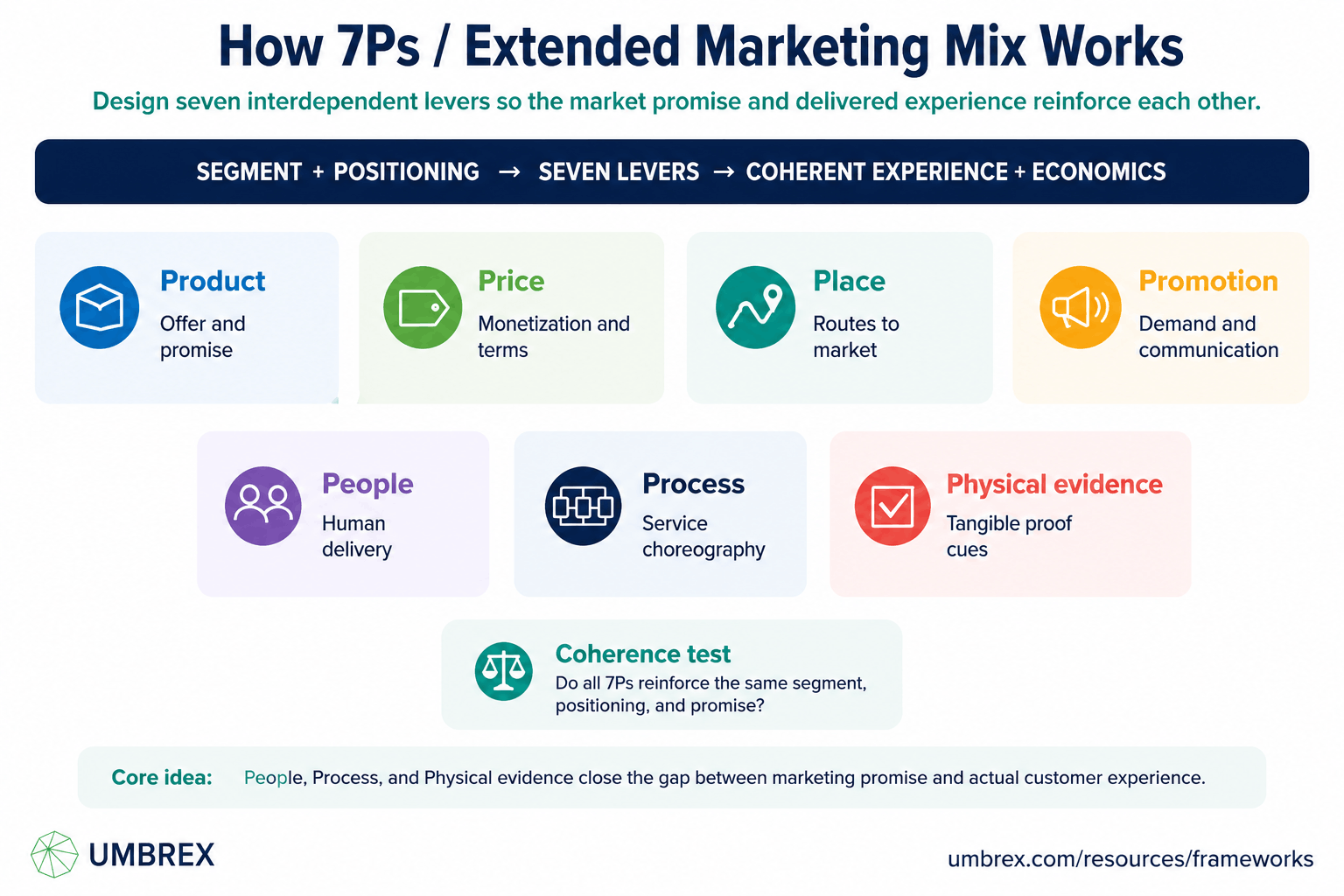
The logic of the 7Ps is integrative: design each element for a chosen segment and positioning, then ensure the seven reinforce each other. Misalignment—say, premium pricing with discount channels and under-trained frontline teams—erodes trust and economics. Below are the seven elements and what to consider for each.
Product
- Definition: The offer—features, design, service components, packaging, and brand promise.
- Role: Solve the target customer’s job-to-be-done better than alternatives; encode your positioning in the experience.
- Considerations: Portfolio roles (build/defend/harvest/exit), tiering (good–better–best), bundling (product + services), integrations, guarantees, and lifecycle management.
Price
- Definition: Monetization and terms—list price, discounts, subscriptions, usage-based fees, financing, and price fences.
- Role: Signal value, segment demand ethically, and deliver target margins and cash flow.
- Considerations: Willingness-to-pay by segment, value metrics, competitive benchmarks, psychological thresholds, deal governance, and price realization (waterfall, leakage controls).
Place
- Definition: Routes to market and access points—channels, partners, e-commerce, marketplaces, field/inside sales, logistics, and service coverage.
- Role: Make buying and using easy and reliable for target customers.
- Considerations: Direct vs. indirect, omnichannel journeys, coverage model, partner economics and rules of engagement, fulfillment, returns, and service SLAs.
Promotion
- Definition: Communications and demand generation—brand, creative, media mix, content, PR, events, offers, and sales enablement.
- Role: Create awareness, shape consideration, and drive conversion and loyalty.
- Considerations: Audience targeting, message hierarchy, funnel orchestration, experimentation, and measurement (e.g., MMM, MTA, lift tests).
People
- Definition: The human element that designs, sells, delivers, and supports—employees, partners, influencers, and communities.
- Role: Build trust, reduce friction, and deliver outcomes consistently.
- Considerations: Capability profiles, staffing, training and certification, incentives/OKRs, culture and behavior standards, partner selection/enablement, and customer success.
Process
- Definition: The end-to-end sequence of activities and handoffs that deliver the experience.
- Role: Ensure consistent, efficient, and reliable delivery at scale; reduce variability.
- Considerations: Service blueprinting, SLA design, queue and capacity management, automation/self-serve, escalation paths, quality checks, and continuous improvement loops.
Physical evidence
- Definition: Tangible cues and artifacts that signal quality and reassure customers—environments, packaging, uniforms, collateral, certifications, and digital UX/UI.
- Role: Make the intangible tangible; reduce perceived risk and ambiguity.
- Considerations: Environment design, signage, visual identity, sample outputs or dashboards, case studies, testimonials, and third-party validations.
Taken together, the 7Ps form a blueprint for a coherent go‑to‑market and service delivery system. Product sets the promise; Price monetizes it; Place provides access; Promotion shapes perception; People and Process deliver the reality; Physical evidence proves it.
4. When to Use 7Ps / Extended Marketing Mix
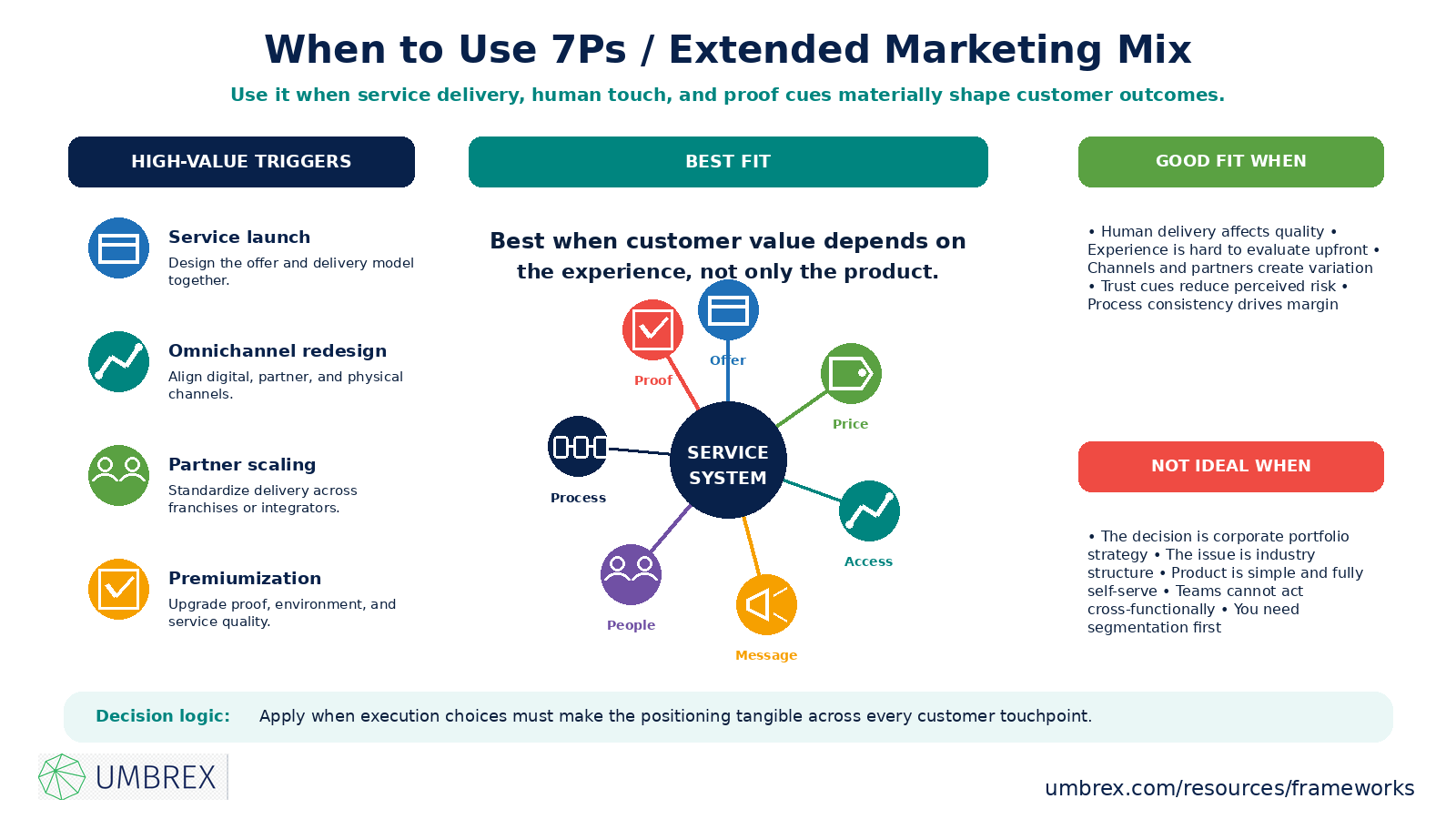
Use 7Ps when turning strategy into execution in contexts where the experience and human delivery meaningfully affect outcomes.
- Use cases:
- Launching or repositioning services or service-rich products (e.g., SaaS with onboarding and customer success)
- Omnichannel redesign across retail, e-commerce, and service centers
- Scaling a partner-delivered model (franchise, VARs, integrators)
- Standardizing delivery across geographies or acquisitions
- Premiumization strategies requiring proof, environment, and service upgrades
- Company types: Highly applicable to services (healthcare, hospitality, financial services, logistics), subscriptions/SaaS, complex B2B, and experience-driven consumer categories. Also useful for product companies adding services.
- Data/time requirements: A rapid tune-up (using existing insight) can be done in 1–2 weeks. A full redesign with research, service blueprinting, partner evaluation, pricing studies, and enablement plans typically takes 4–8 weeks depending on scope and complexity.
Especially powerful when: customer outcomes hinge on frontline capability and process discipline, or when inconsistent delivery is undermining brand promises and price realization.
Less suitable when: your questions are corporate-level (portfolio allocation, industry attractiveness) or primarily about competitive structure (start with tools like the BCG Matrix or Five Forces). For multi-sided platforms, apply 7Ps separately for each side (e.g., consumers and providers), and add network-effect considerations.
How it’s used today: Practitioners pair 7Ps with Segmentation–Targeting–Positioning (STP), Journey Mapping, Service Blueprinting, and pricing science. “Physical evidence” now includes digital cues (UX, dashboards, trust badges). “Process” often incorporates automation and self-serve to improve cost-to-serve and experience.
5. How to Apply 7Ps / Extended Marketing Mix: Step-by-Step
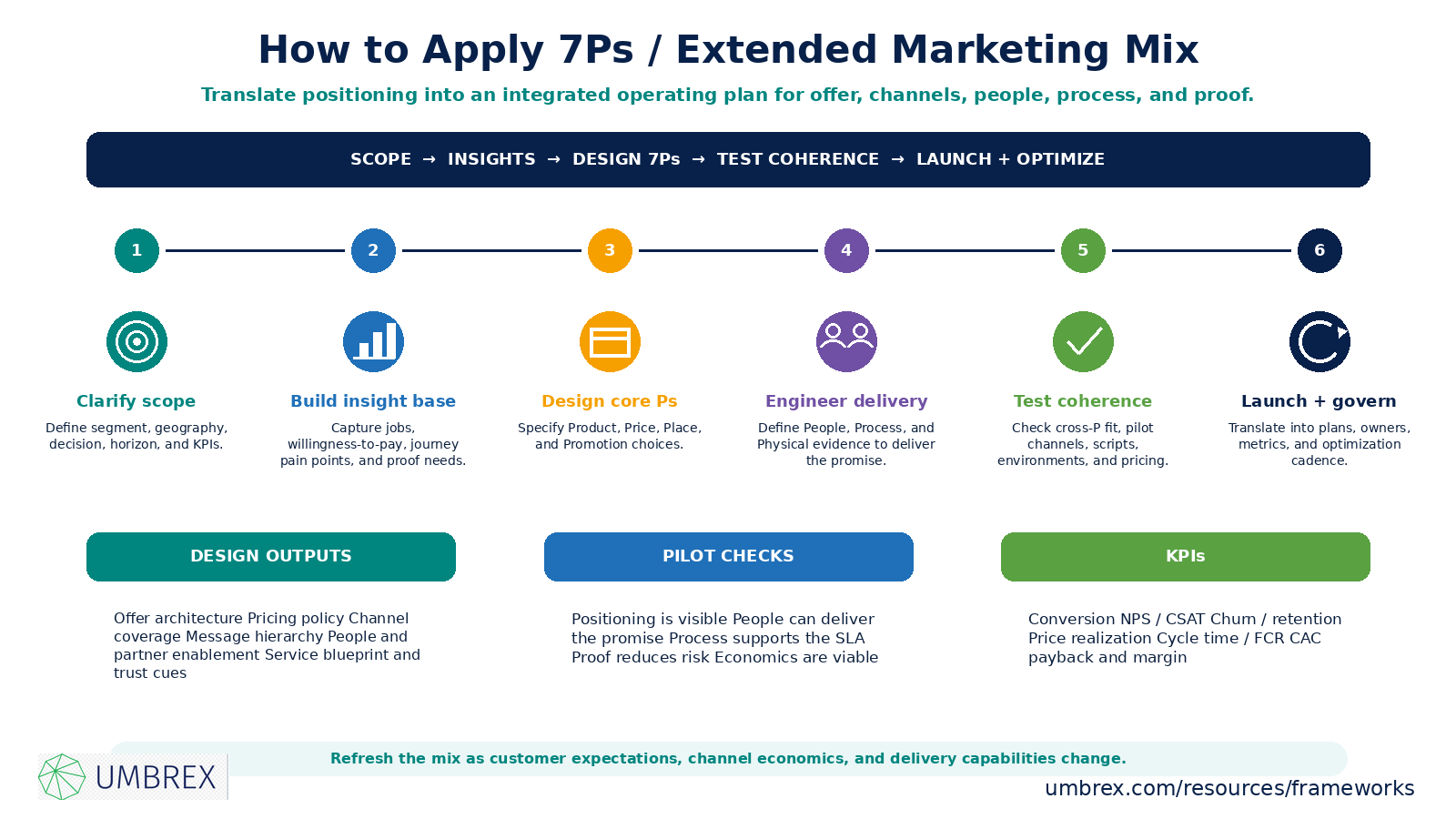
- Clarify the decision and scope
Define the business problem (launch, reposition, scale, or turn-around), the scope (segments, geographies, channels), the time horizon, and success metrics (growth, margin, CLV/CAC, NPS/CSAT, churn, SLA adherence). Agree on decision rights and cadence.
- Ground the work in customer and market insight
Gather evidence: customer jobs-to-be-done, willingness-to-pay, buying group roles, journey pain points, and proof drivers. Use interviews, ethnography/shop-alongs, win–loss analysis, conjoint or Van Westendorp for pricing, and channel/partner benchmarking. Capture operational data (cycle time, FCR, defect rates) to inform Process design.
- Define target segments and positioning (STP)
Prioritize segments and articulate a crisp positioning statement. Document value drivers and proof points. Your positioning becomes the litmus test: each P must reinforce it or be rethought.
- Design the Product
Specify the offer: features and service components; tiering (good–better–best); bundles; integrations; guarantees. Define evidence (demos, trials, reference customers). Set portfolio roles and migration paths for legacy customers.
- Set the Price
Select a pricing model aligned to value metrics and procurement norms (subscription, usage, hybrid, one-off + maintenance, performance-based). Establish list prices, fences, discounts, and terms by segment and channel. Model economics and sensitivity; validate via research or controlled pilots. Build a price realization plan (approval gates, deal desks, channel margins).
- Design Place (routes-to-market)
Map buying and usage journeys and identify “moments of truth.” Choose channels (direct, partners, retail, marketplaces, e-commerce) and coverage model. Define partner economics (margins, incentives, MDF), rules of engagement, enablement, and service logistics. Ensure fulfillment, returns, and service SLAs match the promise.
- Plan Promotion (communications and demand)
Develop a message hierarchy linked to positioning and proof. Build an integrated plan across paid, owned, earned, and shared channels. Define full-funnel tactics, content, offers, sales enablement assets, and events. Establish measurement (MMM/MTA, pipeline attribution), experimentation, and optimization loops.
- Engineer People (capabilities, staffing, partners)
Identify critical roles (e.g., solution consultants, customer success, front-line associates, field service). Define capability profiles, headcount plans, training and certification. Align incentives/OKRs with desired behaviors (value-selling, first-contact resolution, renewal). Select partners and build enablement and quality controls.
- Design Process (service blueprint and controls)
Blueprint the end-to-end experience, including front-stage and back-stage activities, handoffs, SLAs, and escalation paths. Standardize where possible, build self-serve/automation to reduce friction and cost, and define quality checks (audits, checklists, mystery shopping). Instrument processes with telemetry for continuous improvement.
- Define Physical evidence (trust cues and environment)
Identify tangible signals that reduce perceived risk: environment design (stores, clinics, offices), packaging, uniforms, equipment, digital UX/UI, dashboards, certifications, case studies, and testimonials. Ensure they are consistent with brand and positioning.
- Test coherence and run pilots
Stress-test cross-P alignment. Does the Product merit the Price? Do Place and Process support the sales cycle and service promise? Are People trained to deliver? Do Physical cues reassure? Pilot offers, channels, scripts, and environments; track leading indicators (conversion, cycle time, FCR, NPS) and iterate.
- Translate into operating plans and economics
Convert design into execution: roadmap, pricing policy and approvals, channel coverage targets, media plan, staffing plan, training schedule, service SLAs, and environment upgrades. Build a P&L view, CAC payback model, price waterfall, capacity model, and capex/opex for Physical evidence.
- Align stakeholders and launch
Socialize the 7Ps plan with product, marketing, sales, operations, finance, HR, and partners. Sequence launch (beta/soft launch/GA), define go/no-go gates, and set governance for ongoing optimization. Post-launch, monitor KPIs and intervene quickly where signals drift.
6. Example: 7Ps in Action
Company: Meridian Mobility, a $800M regional mobility services provider (vehicle subscriptions, maintenance, roadside assistance) expanding nationally with an app-driven premium tier.
Problem: Meridian’s premium tier underperformed in pilots: high CAC, inconsistent service times across cities, and low conversion from trial to paid due to trust concerns about vehicle condition and service reliability.
Applying the 7Ps:
- Product: Two premium packages—“Premium Flex” (monthly swap, maintenance included) and “Premium Plus” (concierge pickup/drop-off, luxury models). Both include an app dashboard showing vehicle health and service schedule.
- Price: Value-based pricing anchored to convenience and vehicle class. Introduced price fences (off-peak swap discounts, loyalty credits) and transparent damage waivers. Multi-month commitments lowered monthly rates to improve retention and cash flow.
- Place: Direct via app in major metros; partner-operated hubs in secondary cities with strict SLAs. Added airport concierge kiosks in three hubs to capture business travelers.
- Promotion: Messaging focused on “time back to you” and verified vehicle quality. Ran targeted digital campaigns, corporate partnerships, and executive trials. Equipped sales with ROI calculators comparing lease/ownership vs. subscription.
- People: Certified concierge teams trained in service etiquette and issue triage. Partner hub staff underwent Meridian certification with quarterly audits. Customer success agents were incentivized on time-to-resolution and renewal.
- Process: Standardized the swap workflow: pre-swap inspection checklist, 24-hour confirmation window, 60-minute on-site SLA, and escalation to a mobile mechanic if a defect is detected. Implemented telematics-based scheduling to smooth peaks.
- Physical evidence: Branded, well-lit hubs; uniformed concierges; sealed “vehicle health” cards showing inspection results; in-app badges for “certified hub” status; and third-party certifications displayed on kiosks and the app.
Insights and outcomes: The pilots revealed that inconsistent Process and weak Physical evidence were the main conversion barriers. After standardizing SLAs and adding tangible proof (inspection cards, certifications), trial-to-paid conversion rose by 11 points. NPS improved by 13 points as time-to-resolution fell by 28%. With clearer price fences and partner economics, gross margin per subscriber increased by 4 percentage points. The national rollout exceeded plan by 19% in the first two quarters.
7. Strengths and Limitations
Strengths
- Comprehensive and service-ready: Integrates human and operational elements with classic marketing levers—ideal where experience drives outcomes.
- Alignment tool: Creates a shared language across marketing, sales, operations, and partners; reduces profit leaks and mixed signals.
- Execution-focused: Bridges the gap from strategy to delivery with explicit design of People, Process, and Physical cues.
- Scalable: Works for startups through global enterprises; adaptable across B2C and B2B contexts.
Limitations
- Risk of complexity: Can become bureaucratic or checklist-driven without clear priorities and governance.
- Static if misused: A one-time design won’t keep pace with changing customer behavior and operations; requires continuous optimization.
- Not a strategy substitute: Doesn’t decide where to play or industry attractiveness; needs STP and competitive analysis as inputs.
- Platform nuances: Multi-sided models require separate 7Ps per side and network-effect considerations the framework doesn’t natively cover.
8. Common Pitfalls (and How to Avoid Them)
- Treating 7Ps as seven silos
What goes wrong: Local optimizations (e.g., discounting to hit volume) harm system performance (brand, margins, partner economics).
How to avoid: Assign a single mix owner; run cross-functional “signal checks” to test coherence; model P&L and experience impacts end-to-end.
- Vague People plans
What goes wrong: Under-trained frontline teams and partners deliver inconsistent experiences; promises outpace delivery.
How to avoid: Define capability profiles, training/certification, and incentives upfront; monitor FCR, NPS, and quality audits; coach continuously.
- Process not blueprinting the back-stage
What goes wrong: Smooth front-stage with chaotic back-stage handoffs; delays and rework.
How to avoid: Use service blueprinting to map front/back-stage, SLAs, and escalations; instrument with telemetry; set routines for improvement.
- Ignoring Physical evidence
What goes wrong: Intangible services feel risky; customers churn during consideration or onboarding.
How to avoid: Add tangible proof—environment cues, certifications, demos, dashboards, testimonials—and make them visible at decision points.
- Copycat pricing and weak realization
What goes wrong: Races to the bottom or margin leakage through unmanaged discounts.
How to avoid: Set value-based pricing and clear fences; implement deal governance and a price waterfall; align partner margins with desired behavior.
- Over-engineering before validation
What goes wrong: Complex processes and environments built without evidence; high costs with little impact.
How to avoid: Pilot lean versions; measure leading indicators; scale only what moves conversion, retention, and cost-to-serve.
9. How 7Ps Relates to Other Frameworks
- STP (Segmentation–Targeting–Positioning): Use STP to decide whom to serve and how to position. Then use 7Ps to operationalize that strategy through offer design, pricing, channels, communications, and service delivery.
- 5Cs (Company, Customers, Competitors, Collaborators, Context): Apply 5Cs to analyze the environment and constraints; 7Ps translates insight into integrated choices and operating plans.
- 4Ps and 5Ps vs. 7Ps: 4Ps is the original core; 5Ps adds People; 7Ps further adds Process and Physical evidence—most useful when delivery design and trust cues are central to value.
- Service Blueprinting and Journey Mapping: Complement the People and Process elements by detailing touchpoints, handoffs, and backstage activities; often used in the design phase before piloting the 7Ps.
- Pricing science (value-based pricing, price waterfalls): Deepens the Price element by quantifying value and managing realization through the deal lifecycle.
- Funnel frameworks (AIDA, full-funnel, RACE) and attribution (MMM/MTA): Inform Promotion planning and optimization.
- Operating model and governance frameworks: Help embed the 7Ps into decision rights, metrics, and cadences so the mix stays dynamic rather than static.
10. Key Takeaways
- The 7Ps (Extended Marketing Mix) expands the classic 4Ps to include People, Process, and Physical evidence—essential where service and experience drive outcomes.
- Its power lies in integration: all seven elements must reinforce your chosen segments and positioning, from promise to proof.
- Use it for services, subscriptions, complex B2B, and omnichannel contexts; pair with STP, Journey Mapping, and Service Blueprinting.
- Avoid treating it as a checklist—govern it as a system, pilot changes, and continuously optimize with evidence.
- For multi-sided platforms, design a 7Ps for each side and incorporate network-effect dynamics.
11. FAQs About 7Ps / Extended Marketing Mix
Is the 7Ps framework still relevant today?
Yes. As categories become more service- and experience-led, adding People, Process, and Physical evidence to the classic mix is critical. Modern practice integrates 7Ps with journey analytics, experimentation, and continuous improvement.
How does 7Ps differ from 4Ps and 5Ps?
4Ps covers Product, Price, Place, Promotion. 5Ps adds People to emphasize human delivery. 7Ps further adds Process and Physical evidence to manage end-to-end service quality and trust cues—most valuable when delivery design is central to value.
Can product-centric companies use 7Ps?
Yes. Product businesses that differentiate on service, onboarding, support, or retail experience benefit from the extended mix. Use 7Ps when experience and operations materially influence conversion, retention, or price realization.
How long does it take to apply 7Ps in a real project?
A focused tune-up can be completed in 1–2 weeks using existing data. A robust redesign with research, blueprinting, partner assessments, pricing studies, and enablement typically requires 4–8 weeks, depending on scope and complexity.
How do we measure Process and Physical evidence effectively?
For Process: track cycle time, first-contact resolution, SLA adherence, defect/rework rates, and cost-to-serve. For Physical evidence: monitor trust/quality perceptions (NPS/CSAT), conversion uplift from proof assets, environment audits, and usage of demos/dashboards/certifications.
