

1. What Is the 5Ps of Marketing?
The 5Ps of Marketing is a foundational marketing and go‑to‑market framework that organizes the core levers a company can control to shape demand and deliver value. It extends the classic “marketing mix” by specifying five interdependent elements: Product, Price, Place, Promotion, and People.
In plain language, it helps you answer five questions: What are we selling (Product)? At what value exchange (Price)? Where and how can customers buy it (Place)? How will we create awareness and preference (Promotion)? And who delivers the experience and builds trust (People)?
As a framework, it sits within marketing strategy and execution. Consultants and executives use it to translate segmentation and positioning into coherent, operational choices—ensuring the offering, monetization, channels, communications, and human touchpoints reinforce each other. While variants exist (some define 5Ps slightly differently), this page uses the most common extension of the classic 4Ps by adding “People.”
2. Origin and Background
“5Ps” builds on the 4Ps introduced by E. Jerome McCarthy in 1960 and popularized by Philip Kotler. As services and experience-differentiated categories grew, practitioners recognized the outsized role of people in shaping customer outcomes and trust—especially in services, complex B2B, and omnichannel contexts. Adding “People” to the mix became a pragmatic way to integrate talent, partners, and customer-facing teams into marketing design.
Origin: Unknown; in use since at least the 1980s as an extension of McCarthy’s 4Ps and alongside the services marketing literature. The broader “extended marketing mix” (7Ps—adding People, Process, and Physical evidence) was articulated by Booms and Bitner in 1981; 5Ps is best viewed as a managerial midpoint emphasizing People without adopting the full services extension.
The 5Ps gained traction through business schools, consulting practices, and the operational needs of modern marketing organizations, where talent, partners, and advocacy communities materially impact performance.
3. How the 5Ps of Marketing Works
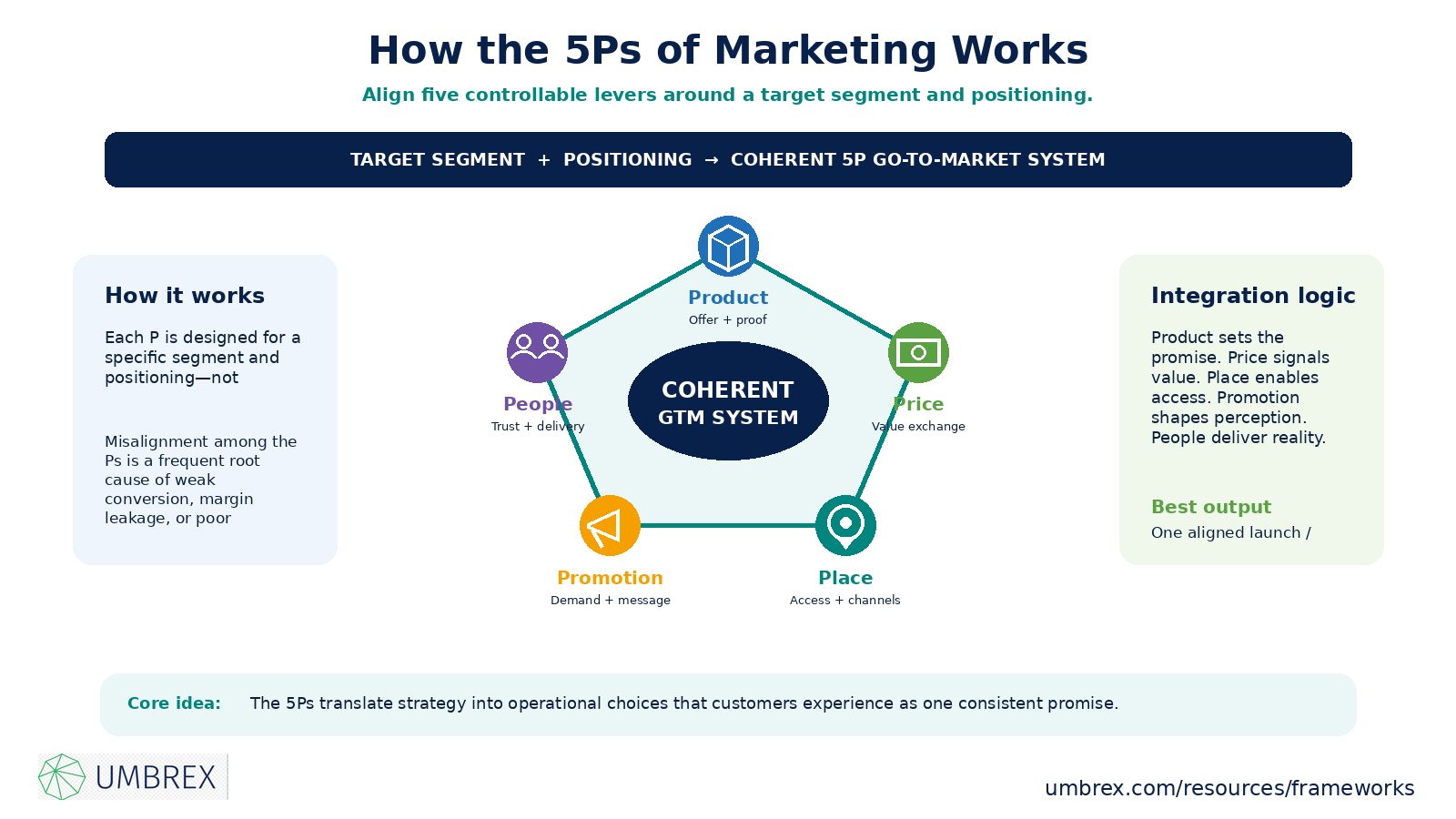
The core logic is straightforward: design each “P” for a specific target segment and positioning, and ensure the five pieces form a coherent system. The power lies in integration—misalignment among the Ps is a frequent root cause of underperformance.
Product
- Definition: The offer—features, quality, design, packaging, brand, and associated services (onboarding, support, warranties, SLAs).
- Role: Solve the target customer’s problem better than alternatives; encode the positioning in the experience.
- Considerations: Portfolio roles (hero/defend/retire), tiering (good-better-best), bundling, integrations, proof points (demos, trials, case studies), and lifecycle management.
Price
- Definition: The value exchange—list price, discounts, terms, subscriptions, usage-based fees, financing, promotions, and price fences.
- Role: Monetize perceived value while supporting growth and margin goals; segment ethically via packaging and fences.
- Considerations: Willingness-to-pay, value metrics, competitive benchmarks, psychological thresholds, and realization mechanics (deal desks, approvals, channel margins).
Place
- Definition: Routes to market and access points—channels, partners, e-commerce, marketplaces, field/inside sales, logistics, and service coverage.
- Role: Make buying and using easy for the target customer; ensure reach, convenience, and reliability.
- Considerations: Direct vs. indirect, omnichannel journeys, channel conflict and rules of engagement, partner enablement, SLAs, and last-mile experience.
Promotion
- Definition: Communication and demand generation—brand, creative, media mix, content, PR, events, sales enablement, and offers.
- Role: Create awareness, shape consideration, and convert demand; reinforce positioning consistently across the funnel.
- Considerations: Targeting, messaging hierarchy, funnel orchestration, measurement (MMM, MTA), experimentation, and sales–marketing alignment.
People
- Definition: The human element that designs, sells, delivers, and supports the experience—employees, partners, influencers/advocates, and community members.
- Role: Build trust, reduce friction, and deliver outcomes. In services and complex B2B, People is often the decisive differentiator.
- Considerations: Capability profiles, training and certification, staffing models, incentives, culture/behavioral standards, partner selection, customer success, community programs, and advocacy.
Think of the 5Ps as a blueprint for a coherent go‑to‑market system. Product sets the promise; Price signals value; Place determines access; Promotion shapes perception; People deliver the reality. Inconsistent signals—say, premium pricing with discount channels and under-trained frontline teams—erode credibility and economics.
4. When to Use the 5Ps
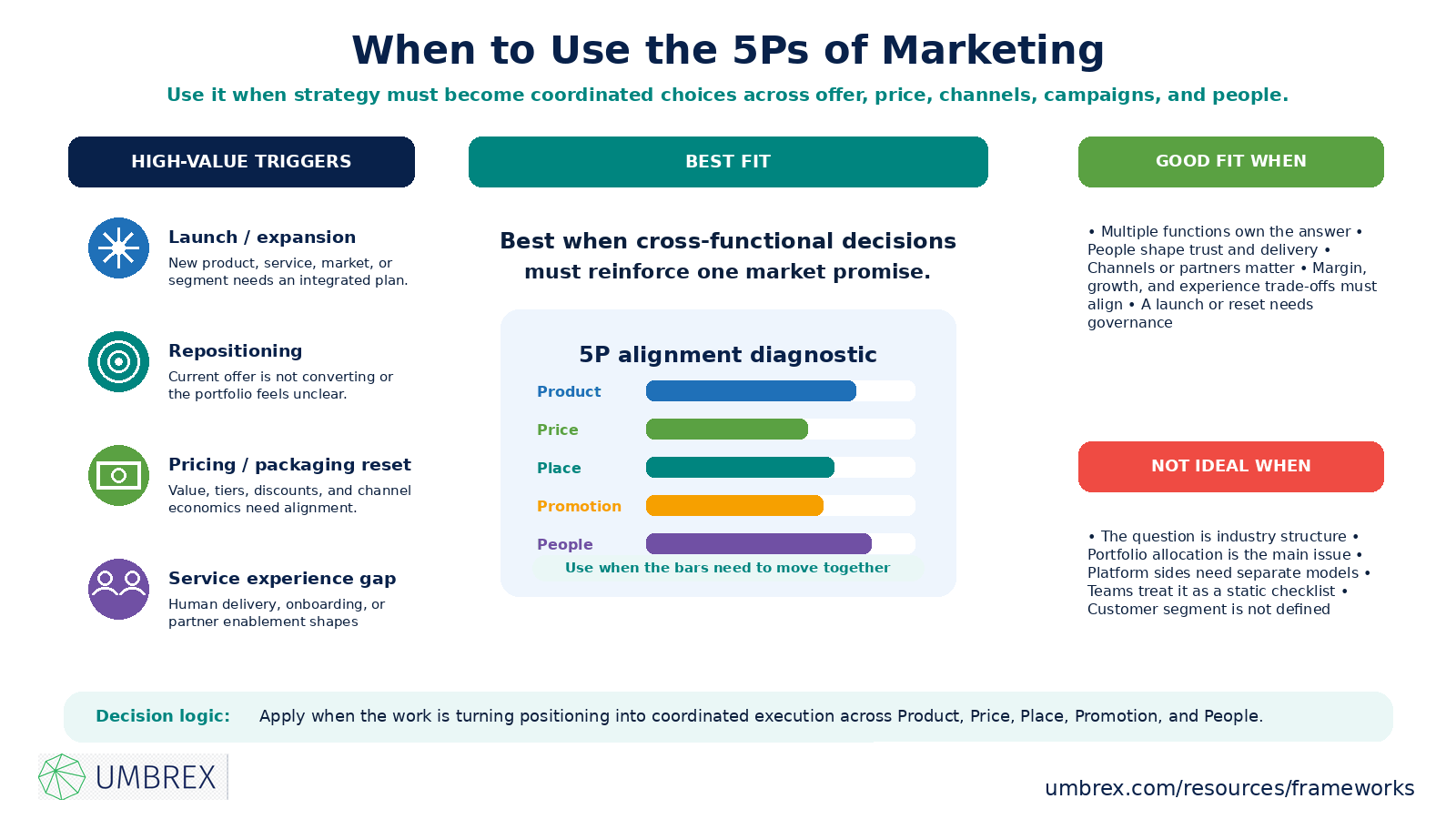
The 5Ps is especially useful when you must turn strategy into execution across multiple functions and human touchpoints.
- Use cases:
- Launching new products or services (B2C, B2B, and B2B2C)
- Repositioning and portfolio rationalization
- Designing or overhauling pricing and packaging
- Building or reconfiguring channel and partner strategies
- Designing integrated campaigns tied to sales motions
- Service-model redesign where frontline capability is pivotal
- Company types: Works for startups through global enterprises; especially powerful in services, SaaS/subscriptions, healthcare, financial services, retail, and complex B2B sales where people shape outcomes.
- Data/time requirements: A pragmatic tune-up can be done in 1–2 weeks using existing data; a full redesign with research, pricing studies, partner evaluations, and enablement planning often spans 4–8 weeks.
Especially powerful when: customer experience hinges on human delivery (e.g., onboarding, field service, customer success), and when cross-functional misalignment has created profit leaks (e.g., discounting that conflicts with brand positioning, or channels lacking enablement).
Less suitable when: you’re addressing corporate portfolio allocation or industry structure (start with tools like the BCG Matrix or Five Forces), or when managing multi-sided platforms where distinct value propositions, prices, and routes-to-market must be designed for each side—5Ps still helps, but requires tailoring per participant group.
Current practice: Most teams combine 5Ps with Segmentation–Targeting–Positioning (STP), Journey Mapping, Service Blueprinting, and pricing science. “People” is increasingly expanded to include partners, creators/influencers, and user communities—reflecting modern trust dynamics.
5. How to Apply the 5Ps: Step-by-Step
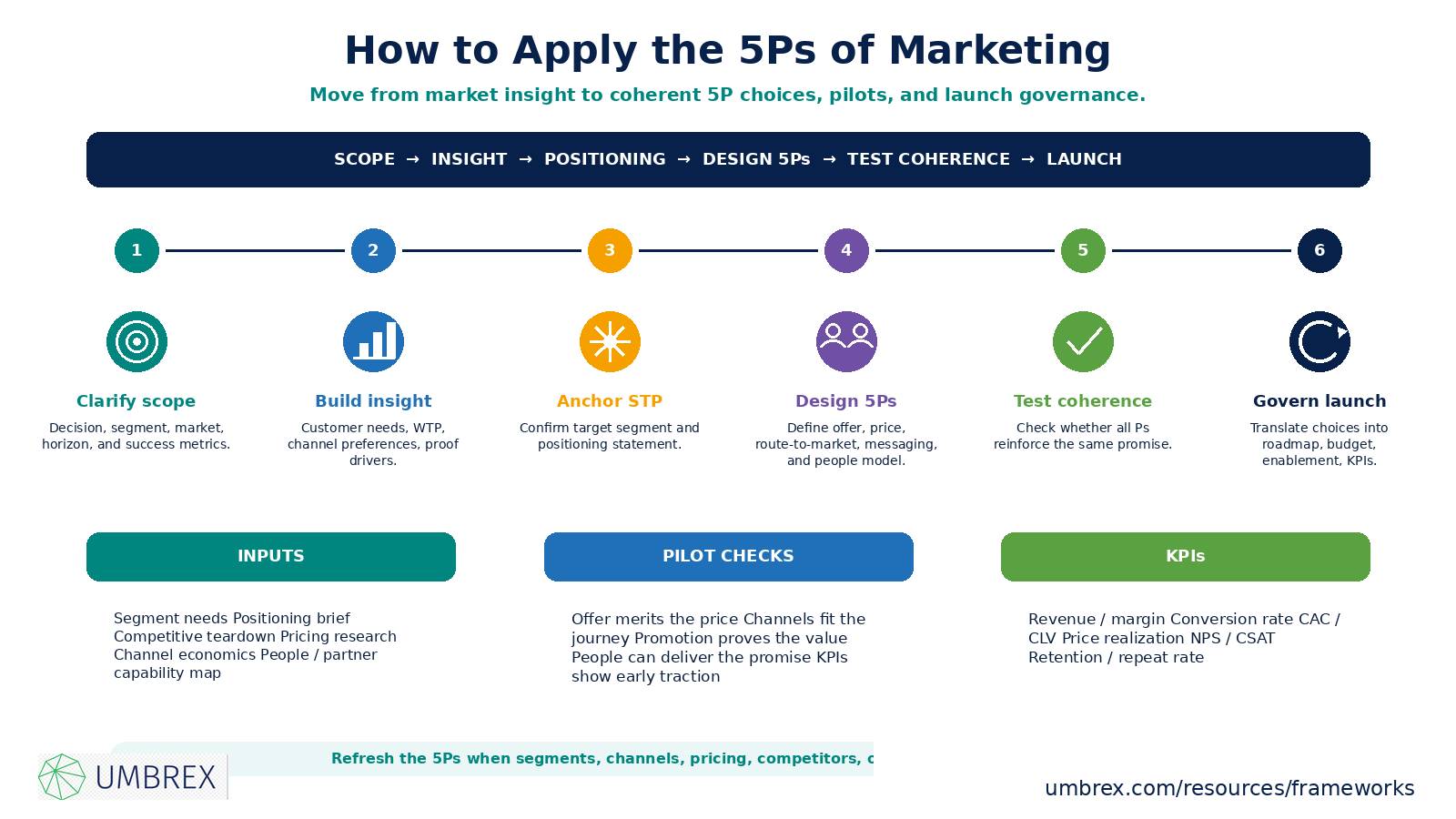
- Clarify the decision and scope
Define the business question (e.g., launch, reposition, market entry) and the scope (segments, geographies, channels, time horizon). Align on success metrics—revenue, margin, share, CAC/CLV, retention, NPS/CSAT, and service-level targets (e.g., response time, first-contact resolution).
- Ground the work in insight
Collect customer, competitor, and channel insights: jobs-to-be-done, willingness-to-pay, buying group roles, channel preferences, and proof drivers. Use qualitative interviews, win–loss analysis, conjoint or Van Westendorp for pricing, and channel/partner benchmarking. For services, map moments of truth where humans impact outcomes.
- Define target segments and positioning (STP)
Agree on prioritized segments and a crisp positioning statement. This becomes the filter for every choice. Document key value drivers and proof points that the Product, Promotion, and People must deliver.
- Design the Product
Specify the offer: features, service elements, and packaging (tiers/bundles). Clarify must-haves vs. differentiators. Define evidence (demos, trials, guarantees). For portfolios, assign roles (build/harvest/defend/exit) and set migration paths for legacy customers.
- Set the Price
Select a pricing model that matches value delivery and procurement norms—subscription, usage, hybrid, one-off with maintenance, or performance-based. Establish list price, fences, and discount guidance by segment/channel. Model unit economics and sensitivity; validate with research or controlled tests. Align terms (billing, renewals, SLAs) with growth and cash needs.
- Design Place (routes-to-market)
Map the buying and usage journey. Choose channel mix—direct, partners, retail, marketplaces, e-commerce—and coverage model. Set partner economics (margins, incentives, MDF), conflict rules, and enablement requirements. Confirm logistics/service capabilities meet the promise, including last-mile and returns where relevant.
- Plan Promotion (communications and demand)
Craft a message hierarchy grounded in positioning and proof. Build an integrated program across paid, owned, earned, and shared channels. Define full-funnel tactics, creative platform, content calendar, offers, and sales enablement assets. Establish measurement (MMM/MTA, pipeline attribution) and test-and-learn loops.
- Engineer People (capabilities, partners, community)
Define critical roles (e.g., solution consultants, customer success, field service, retail associates). Set capability profiles, headcount plans, and training/certification paths. Align incentives/OKRs with desired behaviors (value-selling, retention, cross-sell). Select and enable partners; create communities or advocate programs where relevant. Codify standards via playbooks and coaching.
- Test coherence and run pilots
Stress-test cross-P alignment: Does the product merit the price? Do channels fit the sales cycle and service needs? Do people have the tools to deliver the promise? Pilot offers, prices, channels, and messaging; capture leading indicators (conversion, early churn, NPS) and refine.
- Translate into operating plans and economics
Build a cohesive execution plan: product roadmap, pricing policy and approvals, channel coverage and partner targets, media plan, enablement schedule. Create a P&L and cash flow view, a price realization/discount waterfall, and service staffing model. Establish governance (cadence, decision rights) and dashboards.
- Align stakeholders and launch
Socialize the 5Ps plan with product, sales, marketing, finance, operations, HR, and partners. Sequence launch phases (beta/soft launch/GA) with go/no-go gates. Post-launch, track KPIs against plan and adjust quickly; treat the mix as a living system, not a one-off decision.
6. Example: The 5Ps in Action
Company: NorthStar Diagnostics, a $350M regional healthcare diagnostics provider expanding nationwide with at-home testing kits and telehealth physician reviews.
Problem: Growth had plateaued in clinic-based testing. Consumer interest in at-home diagnostics was rising, but past pilots underperformed due to pricing confusion, retail channel returns, and inconsistent telehealth experiences.
Applying the 5Ps:
- Product: NorthStar defined two kits: “Core” (common panels) and “Plus” (expanded analytics) with physician review included. They added an app for results, guidance, and re-test reminders, plus a satisfaction guarantee to reduce perceived risk.
- Price: Research showed strong willingness-to-pay for bundled physician consultations. NorthStar priced “Core” at a competitive cash price with HSA/FSA eligibility and “Plus” at a premium. They set price fences (multi-kit discounts, subscription for chronic monitoring) and standardized terms to reduce retailer markdowns.
- Place: Distribution combined e-commerce (owned site and a major marketplace) with select retail pharmacies. Pharmacies received co-branded displays and cold-chain logistics support. E-commerce emphasized two-day shipping and discreet packaging. A partner lab network expanded processing capacity.
- Promotion: Messaging focused on accuracy, physician oversight, and convenience. The team ran targeted digital campaigns, partnered with health content creators, and executed in-pharmacy promotions. They produced educational webinars for employers and primary care networks to stimulate referrals.
- People: They trained a nationwide telehealth physician panel on consistent protocols and bedside manner, established service standards (response times, follow-up), and implemented QA audits. Pharmacy associates received enablement kits to explain the product. Customer support agents were trained to navigate insurance/HSA questions, and a patient community forum was launched for peer support.
Insights and outcomes: The 5Ps surfaced that “People” was the bottleneck: inconsistent telehealth consultations undermined trust and NPS. After standardizing scripts and adding physician coaching, NPS rose by 14 points. Clarifying price fences cut retail markdowns by 40%. Within nine months, the nationwide launch exceeded plan by 22% with improved repeat rates driven by the subscription model.
7. Strengths and Limitations
Strengths
- Integration: Forces coherence across offer, monetization, access, communications, and human delivery—reducing profit leaks and mixed signals.
- Actionability: Translates strategy into operational choices and governance that functions can execute.
- Service-readiness: Elevates People—critical in services, complex B2B, and omnichannel experiences—into the design, not just implementation.
- Common language: Creates a shared vocabulary for cross-functional teams and partners to align quickly.
Limitations
- Static if misused: Can become a one-time checklist rather than a continuously optimized system.
- Not prescriptive on organization: Offers limited guidance on incentives, structure, and change management beyond the “People” lens.
- Platform complexity: Multi-sided platforms require separate 5Ps per side, plus network-effect considerations the framework doesn’t natively capture.
- Varied definitions: Because 5Ps is not as canonically defined as 4Ps or 7Ps, teams must align on what “People” encompasses to avoid gaps.
8. Common Pitfalls (and How to Avoid Them)
- Treating People as HR, not a marketing lever
What goes wrong: Hiring and training are deferred, leading to poor onboarding, inconsistent service, and lost referrals.
How to avoid: Define critical capabilities, certification paths, and behavioral standards upfront. Tie frontline metrics (NPS, first-response time, attach rate) to goals and incentives.
- Misaligned signals among the Ps
What goes wrong: Premium price but discount channels and generic messaging; customers sense mismatch and balk.
How to avoid: Use a one-page positioning brief as a litmus test; run a cross-P “signal check” before launch.
- Ignoring channel and partner economics
What goes wrong: Under-incentivized partners, channel conflict, and eroded margins.
How to avoid: Design clear economics (margins, MDF, SPIFFs), rules of engagement, and enablement; model a price waterfall to track realization.
- Copycat pricing
What goes wrong: Commoditization or value left on the table.
How to avoid: Anchor price to differentiated value and segment-specific willingness-to-pay; use packaging and fences to segment demand.
- Over-indexing on acquisition, underinvesting in experience
What goes wrong: Leaky bucket—high CAC with weak retention and advocacy.
How to avoid: Balance Promotion spend with Product, Place, and People investments that drive retention and referrals; monitor CLV/CAC.
- Vague definitions of “People”
What goes wrong: Missing critical stakeholders (e.g., partners, creators, community), causing friction and inconsistent experiences.
How to avoid: Explicitly list all human touchpoints—employees, partners, influencers, community—and design roles, standards, and enablement for each.
9. How the 5Ps Relates to Other Frameworks
- STP (Segmentation–Targeting–Positioning): Use STP to decide whom you will serve and how you want to be perceived; the 5Ps operationalize that strategy through concrete choices.
- 5Cs (Company, Customers, Competitors, Collaborators, Context): Use 5Cs to analyze the environment and constraints; the 5Ps translate insights into the marketing mix and operating plans.
- 4Ps vs. 5Ps vs. 7Ps: 4Ps is the original core; 5Ps adds People to emphasize human delivery; 7Ps further adds Process and Physical evidence, useful for services where delivery design and cues of quality matter. Choose based on how central service design is to value.
- Service Blueprinting and Journey Mapping: These tools detail how People, Process, and systems deliver experiences across touchpoints—often used alongside the 5Ps to design and improve service delivery.
- Pricing frameworks (value-based pricing, price waterfalls): Deepen the Price element by quantifying value and ensuring realization through the deal lifecycle.
- Funnel frameworks (AIDA, full-funnel, RACE) and attribution (MMM/MTA): Guide Promotion planning and measurement; the 5Ps define what you take to market; funnel tools optimize how you take it.
- Channel design frameworks: Complement Place by structuring coverage, economics, and partner roles for reach and profitability.
10. Key Takeaways
- The 5Ps of Marketing organizes Product, Price, Place, Promotion, and People into an integrated marketing mix for execution.
- Use it to convert strategy and customer insights into coherent, cross-functional go‑to‑market plans—especially where human delivery shapes outcomes.
- Its power is systemic: each P must reinforce the target segment and positioning; misalignment is costly.
- “People” includes employees, partners, influencers, and communities—design capabilities, incentives, and standards deliberately.
- Combine with STP, Journey Mapping, Service Blueprinting, and pricing science; treat the mix as a living system with continuous testing.
- For services-heavy contexts, consider extending to 7Ps to capture Process and Physical evidence.
11. FAQs About the 5Ps of Marketing
Is the 5Ps framework still relevant today?
Yes. As categories become more service- and experience-led, elevating People alongside Product, Price, Place, and Promotion is essential. Modern teams use 5Ps with data-driven experimentation and lifecycle metrics to keep the mix dynamic.
How does 5Ps differ from 4Ps and 7Ps?
4Ps is the classic core. 5Ps adds People to emphasize human delivery and trust-building. 7Ps further adds Process and Physical evidence, which is valuable when the service operation and proof cues are central to value (e.g., healthcare, hospitality).
Can small or early-stage companies use 5Ps?
Absolutely. Startups can use 5Ps to structure hypotheses about product–market fit, monetization, channels, messaging, and the roles/capabilities needed to deliver. Keep it lightweight; test and iterate quickly.
How long does it take to apply 5Ps in a real project?
A tactical tune-up can be completed in 1–2 weeks using existing insight. A full redesign—with research, pricing studies, partner selection, and enablement—typically requires 4–8 weeks, depending on scope and market complexity.
What metrics should we use for the “People” element?
Track leading and lagging indicators tied to experience and outcomes: NPS/CSAT, first-response time, first-contact resolution, onboarding time-to-value, churn/retention, upsell rates, partner certification/activation, and quality audits or mystery shopping.
