
Goal of the analysis:
To evaluate the effectiveness of cross-selling and up-selling efforts, identify which products and services are successfully being sold to existing customers, and determine opportunities to increase revenue per customer through better-targeted sales strategies.
Data required:
- Customer account details, including product ownership (e.g., loans, credit cards, savings accounts).
- Transaction data showing product usage and purchase patterns.
- Sales data related to cross-sold and up-sold products (e.g., campaigns and success rates).
- Customer demographics and segmentation information.
- Marketing and outreach data, including response and conversion rates for offers.
Detailed step-by-step instruction on how to conduct the analysis:
- Define Key Metrics
- Calculate cross-sell ratio:
Cross-Sell Ratio = (Number of Products Owned / Number of Customers) - Measure up-sell success rate:
Up-Sell Success Rate = (Number of Successful Up-Sells / Number of Up-Sell Offers Made) x 100
- Calculate cross-sell ratio:
- Data Collection
- Gather customer data to identify products each customer owns and services they’ve added after initial acquisition.
- Collect campaign data to measure the outcomes of cross-sell and up-sell efforts.
- Customer Segmentation
- Segment customers by demographics, behaviors, and product ownership to understand preferences and opportunities.
- Examples: High-net-worth individuals, young professionals, or customers with a single product.
- Product Pairing Analysis
- Identify common product pairings (e.g., savings accounts with credit cards, mortgages with insurance).
- Use association rule mining (e.g., market basket analysis) to uncover patterns in product combinations.
- Sales Channel Performance
- Evaluate the effectiveness of sales channels (branch, online, mobile, call centers) for cross-sell and up-sell initiatives.
- Identify high-performing channels and underutilized opportunities.
- Campaign Effectiveness Analysis
- Track response rates, conversion rates, and revenue from cross-sell and up-sell campaigns.
- Use A/B testing results to identify which offers and messages resonate most with target segments.
- Opportunity Identification
- Highlight customer segments with low product ownership but high potential for additional products.
- For example, customers with a checking account but no credit card.
Format of the output of analysis:
- Cross-sell ratio and up-sell success rates presented in a table by customer segment.
- Heatmap showing product pairings and cross-sell opportunities.
- Charts summarizing campaign response and conversion rates.
- Recommendations for targeted strategies in a report.
How to interpret results:
- A high cross-sell ratio indicates successful product bundling and customer relationship management.
- Low up-sell success rates may indicate misaligned offers, ineffective channels, or lack of customer awareness.
- Analysis of product pairings helps identify natural bundling opportunities to boost sales.
- Channel performance insights reveal where to focus efforts to improve conversion rates.
Steps a company can take to improve on this measure:
- Leverage predictive analytics to recommend relevant products based on customer data and behavior.
- Train relationship managers and sales teams to identify and pitch up-sell opportunities effectively.
- Offer incentives or rewards for customers to adopt additional products (e.g., bundled discounts).
- Personalize marketing campaigns based on customer preferences and past behaviors.
- Invest in digital sales channels to improve accessibility and convenience for cross-selling and up-selling.
Request the PDF Download of How to Analyze a Retail Bank
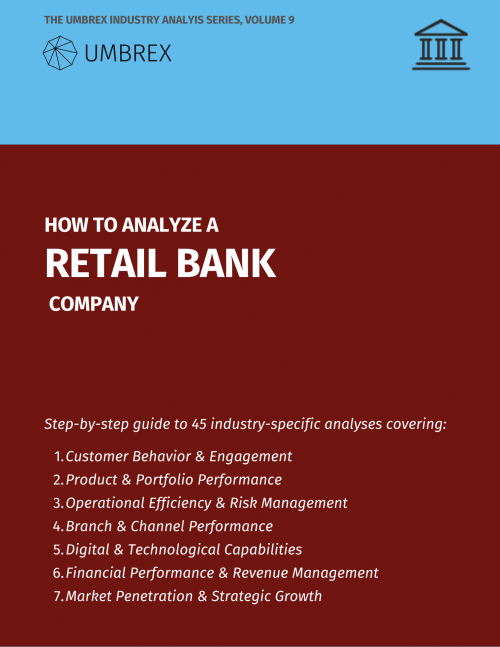
Menu of 45 analyses:
Table of Contents
A. Customer Behavior and Engagement
- Customer Segmentation and Product Penetration Opportunities
- Customer Satisfaction and Net Promoter Score (NPS)
- Cross-Selling and Up-Selling Effectiveness
- Customer Lifetime Value (CLV) and Acquisition Cost
- Customer Journey Mapping and Experience Optimization
- Customer Demographics and Financial Behavior
- Personal Financial Management Tool Engagement
- Customer Financial Health and Credit Utilization
- Customer Segment Profitability and Risk Assessment
- Customer Retention and Dormant Account Reactivation Strategy
- Debit and Credit Card Rewards Program Engagement
- Customer Support and Resolution Time Efficiency
B. Product and Portfolio Performance
- Retail Deposit and Loan Portfolio Performance
- Mortgage Portfolio Risk and Valuation
- Savings and Investment Account Tenure
- Loan Portfolio Diversification and Sectoral Risk Exposure
- Mortgage Loan-to-Value (LTV) and Debt-to-Income (DTI) Ratio
- Debt Consolidation Product Demand and Risk
- Loan Repayment Behavior and Default Management Strategy
C. Operational Efficiency and Risk Management
- Risk and Compliance Adherence for Retail Banking Operations
- Credit Quality and Loan Loss Provisioning
- Fraud Detection and Prevention Effectiveness
- Loan Origination and Underwriting Efficiency
- Operational Efficiency and Cost-to-Income Ratio
- Regulatory Compliance Cost
- Regulatory Capital Adequacy and Stress Testing
D. Branch and Channel Performance
E. Digital and Technological Capabilities
F. Financial Performance and Revenue Management
G. Market Penetration and Strategic Growth Opportunities
- Financial Inclusion and Market Penetration
- Deposit Growth and Stability
- Wealth Management and Investment Product Penetration
- Fee Income and Revenue Dependency
- Payment Services Usage and Revenue
- Personalized Banking Services Uptake and Impact
- Household-Level Financial Product Cross-Holdings
- Retail Banking Product Lifecycle and Attrition
- Loan Prepayment and Refinance Behavior
- Household Wealth Accumulation Trends
- Strategic Growth and Market Expansion Planning
