
Goal of the analysis:
To evaluate the security and authentication measures of the mobile banking platform, identify potential vulnerabilities, and ensure a robust system that protects user data while maintaining usability.
Data required:
- User authentication data (e.g., successful logins, failed login attempts).
- Security incident logs (e.g., account breaches, fraud attempts).
- Feedback on user experience with authentication processes (e.g., ease of use, satisfaction).
- Data on multi-factor authentication (MFA) adoption and usage.
- Metrics on mobile app security (e.g., penetration testing results, vulnerability reports).
- Industry benchmarks for mobile banking security and authentication.
Detailed step-by-step instruction on how to conduct the analysis:
- Evaluate Authentication Success and Failure Rates
- Calculate the success rate for login attempts:
Authentication Success Rate = (Successful Logins / Total Login Attempts) x 100 - Analyze failed login attempts to identify potential usability or security issues.
- Calculate the success rate for login attempts:
- Assess Multi-Factor Authentication (MFA) Adoption
- Determine the percentage of users enrolled in MFA:
MFA Adoption Rate = (Number of Users with MFA Enabled / Total Users) x 100 - Evaluate MFA success rates and user feedback on the process.
- Determine the percentage of users enrolled in MFA:
- Monitor Security Incidents
- Track the number and severity of security breaches or fraud attempts.
- Categorize incidents by type (e.g., phishing, brute force attacks) and frequency.
- Conduct Vulnerability Analysis
- Review penetration testing results and vulnerability reports for the mobile app.
- Identify and prioritize areas requiring immediate attention (e.g., outdated encryption protocols).
- Analyze Customer Feedback on Authentication
- Gather customer feedback on the ease and perceived security of authentication processes.
- Categorize feedback into themes (e.g., complaints about MFA complexity, suggestions for biometric login).
- Benchmark Against Industry Standards
- Compare the bank’s security and authentication metrics with industry benchmarks.
- Identify areas where the bank’s measures lag behind or excel.
- Evaluate Usability and Security Balance
- Assess the trade-off between security measures and user experience.
- Identify opportunities to enhance security without compromising usability (e.g., biometric authentication).
- Develop Improvement Strategies
- Recommend enhancements to authentication methods (e.g., implementing stronger MFA options).
- Propose additional security layers to protect against emerging threats (e.g., behavioral analytics, tokenization).
Format of the output of analysis:
- Tables summarizing authentication success and failure rates, MFA adoption, and security incidents.
- Charts illustrating trends in security incidents and user feedback over time.
- Heatmaps of vulnerability assessment results highlighting high-risk areas.
- A summary report with actionable recommendations to enhance security and usability.
How to interpret results:
- High authentication success rates combined with low security incidents indicate effective and user-friendly security measures.
- Low MFA adoption rates suggest opportunities to educate users or simplify the enrollment process.
- Frequent security breaches or vulnerabilities highlight the need for immediate remediation.
- Negative feedback on authentication complexity signals areas for usability improvements.
Steps a company can take to improve on this measure:
- Promote MFA enrollment through awareness campaigns and simplified onboarding processes.
- Regularly conduct penetration testing and vulnerability assessments to identify and address weaknesses.
- Implement advanced security features such as biometric authentication and behavioral analytics.
- Optimize the balance between security and usability by continuously gathering and acting on user feedback.
- Stay updated on evolving security standards and threats to proactively adapt authentication protocols.
Request the PDF Download of How to Analyze a Retail Bank
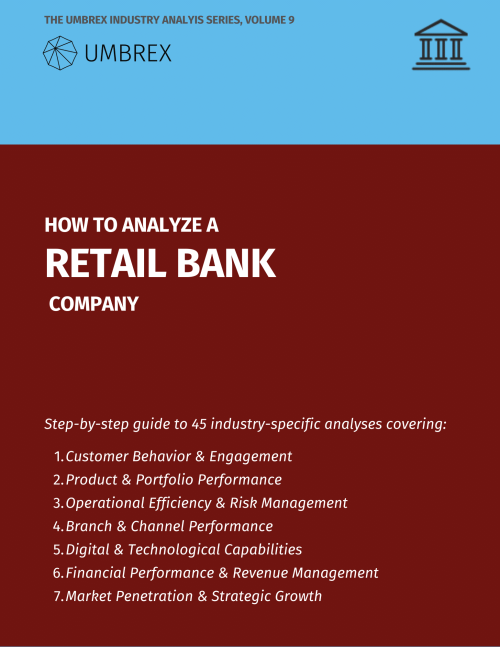
Menu of 45 analyses:
Table of Contents
A. Customer Behavior and Engagement
- Customer Segmentation and Product Penetration Opportunities
- Customer Satisfaction and Net Promoter Score (NPS)
- Cross-Selling and Up-Selling Effectiveness
- Customer Lifetime Value (CLV) and Acquisition Cost
- Customer Journey Mapping and Experience Optimization
- Customer Demographics and Financial Behavior
- Personal Financial Management Tool Engagement
- Customer Financial Health and Credit Utilization
- Customer Segment Profitability and Risk Assessment
- Customer Retention and Dormant Account Reactivation Strategy
- Debit and Credit Card Rewards Program Engagement
- Customer Support and Resolution Time Efficiency
B. Product and Portfolio Performance
- Retail Deposit and Loan Portfolio Performance
- Mortgage Portfolio Risk and Valuation
- Savings and Investment Account Tenure
- Loan Portfolio Diversification and Sectoral Risk Exposure
- Mortgage Loan-to-Value (LTV) and Debt-to-Income (DTI) Ratio
- Debt Consolidation Product Demand and Risk
- Loan Repayment Behavior and Default Management Strategy
C. Operational Efficiency and Risk Management
- Risk and Compliance Adherence for Retail Banking Operations
- Credit Quality and Loan Loss Provisioning
- Fraud Detection and Prevention Effectiveness
- Loan Origination and Underwriting Efficiency
- Operational Efficiency and Cost-to-Income Ratio
- Regulatory Compliance Cost
- Regulatory Capital Adequacy and Stress Testing
D. Branch and Channel Performance
E. Digital and Technological Capabilities
F. Financial Performance and Revenue Management
G. Market Penetration and Strategic Growth Opportunities
- Financial Inclusion and Market Penetration
- Deposit Growth and Stability
- Wealth Management and Investment Product Penetration
- Fee Income and Revenue Dependency
- Payment Services Usage and Revenue
- Personalized Banking Services Uptake and Impact
- Household-Level Financial Product Cross-Holdings
- Retail Banking Product Lifecycle and Attrition
- Loan Prepayment and Refinance Behavior
- Household Wealth Accumulation Trends
- Strategic Growth and Market Expansion Planning
