
Goal of the analysis:
To evaluate the bank’s reliance on fee-based income and assess the sustainability of revenue streams. This analysis identifies opportunities to diversify income sources and reduce dependency on volatile or less predictable fee revenues.
Data required:
- Breakdown of fee income by category (e.g., account maintenance, overdrafts, ATM fees, investment services).
- Total revenue and proportion contributed by fee income.
- Customer segmentation data (e.g., demographics, product usage).
- Historical trends in fee income and total revenue.
- Competitor benchmarks for fee income composition.
- Feedback from customers regarding fee satisfaction and perceived value.
Detailed step-by-step instruction on how to conduct the analysis:
1. Calculate Fee Income Contribution
a. Determine the percentage of total revenue derived from fees:
Fee Income Contribution = (Fee Income / Total Revenue) x 100
b. Segment the calculation by fee type to identify key contributors.
2. Analyze Fee Income Trends
a. Track fee income growth over time:
Fee Income Growth Rate = ((Current Period Fee Income – Previous Period Fee Income) / Previous Period Fee Income) x 100
b. Identify seasonal or cyclical patterns in fee income.
3. Assess Revenue Dependency
a. Evaluate dependency on fee income relative to other revenue streams:
Revenue Dependency Ratio = (Fee Income / Non-Fee Income) x 100
b. Highlight high-dependency areas that may be vulnerable to regulatory changes or customer dissatisfaction.
4. Segment Fee Income by Customer Groups
- Analyze fee income by customer segments (e.g., retail, business, high-net-worth individuals).
- Identify segments with the highest or lowest fee contribution.
5. Benchmark Against Competitors
- Compare the bank’s fee income ratios and growth rates with industry averages.
- Identify areas where the bank charges higher or lower fees compared to peers.
6. Evaluate Customer Perceptions of Fees
- Analyze customer feedback on fee satisfaction, including perceived fairness and transparency.
- Correlate high dissatisfaction with fee attrition trends or service changes.
7. Conduct Scenario Analysis
Model the impact of potential changes in fee structures or regulations on total revenue.
- Example scenarios:
- Reduction in overdraft fees due to regulatory caps.
- Introduction of new digital banking fees.
8. Develop Diversification Strategies
- Identify alternative revenue streams to reduce dependency on fee income (e.g., wealth management, lending).
- Recommend adjustments to fee structures to enhance fairness and alignment with market trends.
Format of the output of analysis:
- Tables summarizing fee income by category, segment, and total contribution.
- Charts illustrating trends in fee income and revenue dependency ratios over time.
- Benchmark comparisons highlighting deviations from industry norms.
- A summary report with actionable recommendations for revenue diversification and fee optimization.
How to interpret results:
- High dependency on specific fee types signals potential vulnerabilities, especially if those fees face regulatory or competitive pressures.
- Low or negative fee income growth rates suggest challenges in maintaining or expanding fee-based revenue streams.
- Customer dissatisfaction with fees highlights areas requiring review or adjustment to reduce attrition risks.
- Benchmark comparisons provide insights into the bank’s competitive position and opportunities for alignment or differentiation.
Steps a company can take to improve on this measure:
- Diversify revenue streams by expanding non-fee income sources, such as lending or investment services.
- Adjust fee structures to reflect customer preferences and market conditions while maintaining profitability.
- Enhance transparency around fees to improve customer satisfaction and reduce complaints.
- Introduce value-added services to justify premium fees, such as exclusive account benefits or financial planning tools.
- Monitor regulatory trends to proactively adapt fee strategies and minimize potential impacts.
Request the PDF Download of How to Analyze a Retail Bank
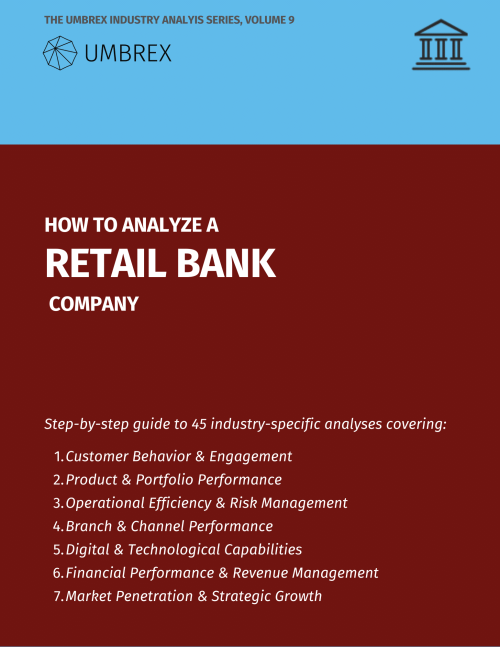
Menu of 45 analyses:
A. Customer Behavior and Engagement
- Customer Segmentation and Product Penetration Opportunities
- Customer Satisfaction and Net Promoter Score (NPS)
- Cross-Selling and Up-Selling Effectiveness
- Customer Lifetime Value (CLV) and Acquisition Cost
- Customer Journey Mapping and Experience Optimization
- Customer Demographics and Financial Behavior
- Personal Financial Management Tool Engagement
- Customer Financial Health and Credit Utilization
- Customer Segment Profitability and Risk Assessment
- Customer Retention and Dormant Account Reactivation Strategy
- Debit and Credit Card Rewards Program Engagement
- Customer Support and Resolution Time Efficiency
B. Product and Portfolio Performance
- Retail Deposit and Loan Portfolio Performance
- Mortgage Portfolio Risk and Valuation
- Savings and Investment Account Tenure
- Loan Portfolio Diversification and Sectoral Risk Exposure
- Mortgage Loan-to-Value (LTV) and Debt-to-Income (DTI) Ratio
- Debt Consolidation Product Demand and Risk
- Loan Repayment Behavior and Default Management Strategy
C. Operational Efficiency and Risk Management
- Risk and Compliance Adherence for Retail Banking Operations
- Credit Quality and Loan Loss Provisioning
- Fraud Detection and Prevention Effectiveness
- Loan Origination and Underwriting Efficiency
- Operational Efficiency and Cost-to-Income Ratio
- Regulatory Compliance Cost
- Regulatory Capital Adequacy and Stress Testing
D. Branch and Channel Performance
E. Digital and Technological Capabilities
F. Financial Performance and Revenue Management
G. Market Penetration and Strategic Growth Opportunities
- Financial Inclusion and Market Penetration
- Deposit Growth and Stability
- Wealth Management and Investment Product Penetration
- Fee Income and Revenue Dependency
- Payment Services Usage and Revenue
- Personalized Banking Services Uptake and Impact
- Household-Level Financial Product Cross-Holdings
- Retail Banking Product Lifecycle and Attrition
- Loan Prepayment and Refinance Behavior
- Household Wealth Accumulation Trends
- Strategic Growth and Market Expansion Planning
