
Goal of the analysis:
To analyze customer repayment behavior, identify patterns and risk factors associated with defaults, and develop strategies to mitigate defaults while improving overall portfolio health.
Data required:
- Loan portfolio data, including loan type, term, interest rate, and repayment schedules.
- Historical repayment records (e.g., payment frequency, overdue payments).
- Delinquency and default rates segmented by loan type and customer demographics.
- Customer financial data (e.g., income, credit score, debt-to-income ratio).
- Economic indicators impacting repayment capacity (e.g., unemployment rates, inflation).
Detailed step-by-step instruction on how to conduct the analysis:
1. Analyze Repayment Behavior
a. Categorize loans by repayment behavior:
- Regular payers (on-time payments).
- Irregular payers (occasional late payments).
- Chronic defaulters (consistent non-payment).
b. Calculate the percentage of loans in each category:
Repayment Category Percentage = (Number of Loans in Category / Total Loans) x 100
2. Identify Risk Factors for Defaults
- Examine correlations between borrower characteristics (e.g., low credit scores, high DTI ratios) and default rates.
- Highlight loan types with higher default rates (e.g., personal loans, subprime loans).
3. Calculate Key Metrics
a. Delinquency rate:
Delinquency Rate = (Delinquent Loans / Total Loans) x 100
b. Default rate:
Default Rate = (Defaulted Loans / Total Loans) x 100
c. Recovery rate:
Recovery Rate = (Recovered Amount from Defaults / Total Default Amount) x 100
4. Conduct Trend Analysis
- Track changes in repayment behavior and default rates over time to identify trends or seasonal variations.
- Assess the impact of external factors (e.g., economic downturns) on default patterns.
5. Evaluate Default Management Strategies
a. Review the effectiveness of existing default management measures, such as:
- Early warning systems to identify at-risk borrowers.
- Loan restructuring or refinancing options.
- Collection practices and recovery strategies.
b. Compare default rates before and after implementing specific interventions.
6. Segment the Portfolio by Risk Levels
- Use risk scoring to classify loans into risk categories (e.g., Low, Medium, High).
- Prioritize high-risk loans for proactive management or intervention.
7. Develop Actionable Insights
- Highlight segments or loan types requiring enhanced monitoring or tailored repayment options.
- Recommend operational or policy changes to reduce default risks.
Format of the output of analysis:
- Tables summarizing repayment behavior metrics, delinquency rates, and recovery rates.
- Charts illustrating repayment patterns and default trends over time.
- Risk heatmaps showing default likelihood across segments.
- A report with actionable insights and strategy recommendations for default management.
How to interpret results:
- High delinquency or default rates in specific segments indicate areas of elevated risk.
- Strong repayment patterns in certain loan types or demographics suggest opportunities for expansion.
- Low recovery rates highlight inefficiencies in collections and recovery processes.
- Trends over time provide insights into the effectiveness of existing strategies and external impacts.
Steps a company can take to improve on this measure:
- Implement advanced predictive analytics to identify at-risk borrowers early.
- Offer loan restructuring or payment holidays to borrowers in temporary financial distress.
- Enhance borrower education on the importance of timely repayments.
- Optimize collection processes with a focus on maintaining customer relationships.
- Continuously monitor repayment behavior and adjust credit policies to adapt to market conditions.
Request the PDF Download of How to Analyze a Retail Bank
Menu of 45 analyses:
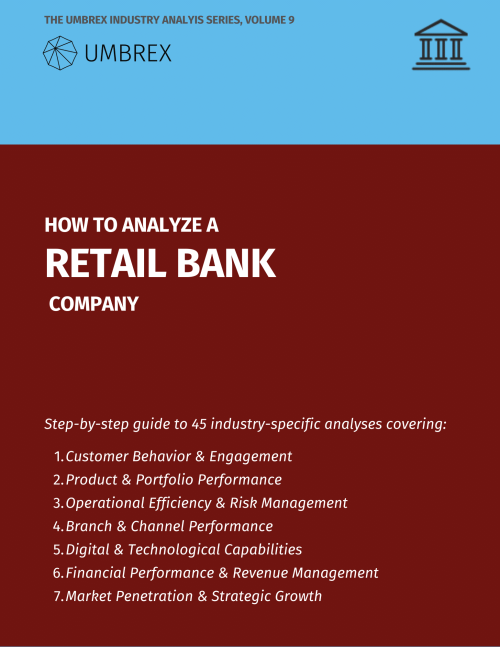
A. Customer Behavior and Engagement
- Customer Segmentation and Product Penetration Opportunities
- Customer Satisfaction and Net Promoter Score (NPS)
- Cross-Selling and Up-Selling Effectiveness
- Customer Lifetime Value (CLV) and Acquisition Cost
- Customer Journey Mapping and Experience Optimization
- Customer Demographics and Financial Behavior
- Personal Financial Management Tool Engagement
- Customer Financial Health and Credit Utilization
- Customer Segment Profitability and Risk Assessment
- Customer Retention and Dormant Account Reactivation Strategy
- Debit and Credit Card Rewards Program Engagement
- Customer Support and Resolution Time Efficiency
B. Product and Portfolio Performance
- Retail Deposit and Loan Portfolio Performance
- Mortgage Portfolio Risk and Valuation
- Savings and Investment Account Tenure
- Loan Portfolio Diversification and Sectoral Risk Exposure
- Mortgage Loan-to-Value (LTV) and Debt-to-Income (DTI) Ratio
- Debt Consolidation Product Demand and Risk
- Loan Repayment Behavior and Default Management Strategy
C. Operational Efficiency and Risk Management
- Risk and Compliance Adherence for Retail Banking Operations
- Credit Quality and Loan Loss Provisioning
- Fraud Detection and Prevention Effectiveness
- Loan Origination and Underwriting Efficiency
- Operational Efficiency and Cost-to-Income Ratio
- Regulatory Compliance Cost
- Regulatory Capital Adequacy and Stress Testing
D. Branch and Channel Performance
E. Digital and Technological Capabilities
F. Financial Performance and Revenue Management
G. Market Penetration and Strategic Growth Opportunities
- Financial Inclusion and Market Penetration
- Deposit Growth and Stability
- Wealth Management and Investment Product Penetration
- Fee Income and Revenue Dependency
- Payment Services Usage and Revenue
- Personalized Banking Services Uptake and Impact
- Household-Level Financial Product Cross-Holdings
- Retail Banking Product Lifecycle and Attrition
- Loan Prepayment and Refinance Behavior
- Household Wealth Accumulation Trends
- Strategic Growth and Market Expansion Planning
