
Goal of the analysis:
To evaluate the performance and financial health of the bank’s retail deposit and loan portfolios by analyzing growth trends, profitability, credit quality, and customer behavior. This analysis helps identify risks and opportunities to optimize portfolio management.
Data required:
- Portfolio balances for deposits and loans over time.
- Deposit product details (e.g., savings accounts, fixed deposits, current accounts).
- Loan product details (e.g., mortgages, personal loans, auto loans).
- Interest income from loans and interest expense on deposits.
- Non-interest income (fees, penalties).
- Credit quality metrics (delinquency rates, non-performing assets).
- Customer demographics and segmentation data.
- Historical trends in deposit and loan growth.
Detailed step-by-step instruction on how to conduct the analysis:
- Analyze Deposit Portfolio Performance
- Calculate deposit growth rate:
Deposit Growth Rate = ((Current Period Deposit Balance – Previous Period Deposit Balance) / Previous Period Deposit Balance) x 100 - Segment deposits by product type and customer demographics.
- Assess contribution of deposits to net interest margin (NIM):
NIM = (Net Interest Income / Average Earning Assets) x 100
- Calculate deposit growth rate:
- Assess Loan Portfolio Performance
- Calculate loan growth rate:
Loan Growth Rate = ((Current Period Loan Balance – Previous Period Loan Balance) / Previous Period Loan Balance) x 100 - Evaluate portfolio composition (e.g., percentage of mortgages vs. personal loans).
- Assess yield on loans:
Loan Yield = (Interest Income from Loans / Average Loan Balance) x 100
- Calculate loan growth rate:
- Evaluate Credit Quality
- Calculate delinquency rate:
Delinquency Rate = (Delinquent Loans / Total Loan Portfolio) x 100 - Measure non-performing assets (NPA) as a percentage of the total loan portfolio:
NPA Ratio = (Non-Performing Assets / Total Loan Portfolio) x 100
- Calculate delinquency rate:
- Analyze Profitability Metrics
- Assess net contribution of deposits and loans:
Net Contribution = (Interest Income – Interest Expense – Loan Loss Provisions) / Total Portfolio Balance - Compare profitability across product types and customer segments.
- Assess net contribution of deposits and loans:
- Trend Analysis
- Review historical trends in deposit and loan balances, growth rates, and credit quality.
- Identify patterns such as seasonal spikes or declines.
- Segment Analysis
- Segment performance by demographics, geography, or customer value tiers.
- Identify high-performing segments and underperforming areas for targeted strategies.
- Identify Risks and Opportunities
- Highlight risk areas such as increasing delinquencies or slowing deposit growth.
- Identify opportunities such as promoting higher-yield loan products or attracting long-term deposits.
Format of the output of analysis:
- Tables summarizing deposit and loan portfolio balances, growth rates, and profitability metrics by segment.
- Charts showing trends in portfolio performance and credit quality metrics.
- Heatmaps identifying risk areas (e.g., high delinquency regions or segments).
- A report with key findings and actionable recommendations for portfolio optimization.
How to interpret results:
- Strong growth rates and high profitability ratios indicate a healthy portfolio.
- High delinquency or NPA ratios highlight credit quality risks requiring immediate attention.
- Variations in product or segment performance suggest opportunities for tailored strategies.
- Trends in deposit and loan balances provide insights into customer preferences and market conditions.
Steps a company can take to improve on this measure:
- Strengthen risk management practices for loan products by refining credit criteria and monitoring high-risk segments.
- Develop targeted marketing campaigns to attract long-term, high-value deposits.
- Optimize pricing strategies for loan and deposit products to balance growth and profitability.
- Promote digital channels to increase convenience and attract tech-savvy customers.
- Regularly review and adjust product offerings to align with changing customer needs and market trends.
Request the PDF Download of How to Analyze a Retail Bank
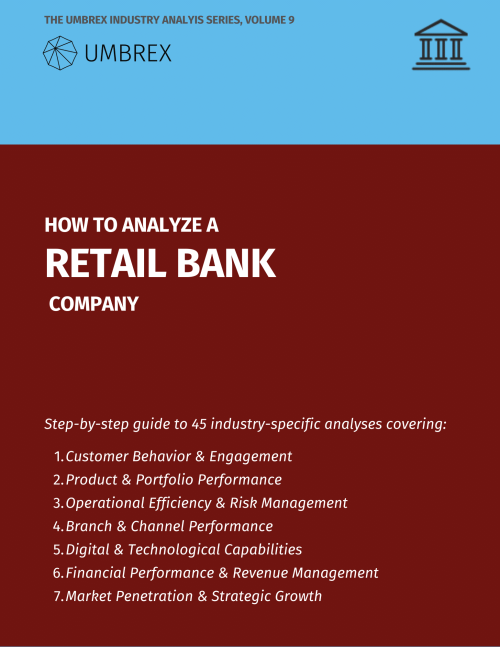
Menu of 45 analyses:
Table of Contents
A. Customer Behavior and Engagement
- Customer Segmentation and Product Penetration Opportunities
- Customer Satisfaction and Net Promoter Score (NPS)
- Cross-Selling and Up-Selling Effectiveness
- Customer Lifetime Value (CLV) and Acquisition Cost
- Customer Journey Mapping and Experience Optimization
- Customer Demographics and Financial Behavior
- Personal Financial Management Tool Engagement
- Customer Financial Health and Credit Utilization
- Customer Segment Profitability and Risk Assessment
- Customer Retention and Dormant Account Reactivation Strategy
- Debit and Credit Card Rewards Program Engagement
- Customer Support and Resolution Time Efficiency
B. Product and Portfolio Performance
- Retail Deposit and Loan Portfolio Performance
- Mortgage Portfolio Risk and Valuation
- Savings and Investment Account Tenure
- Loan Portfolio Diversification and Sectoral Risk Exposure
- Mortgage Loan-to-Value (LTV) and Debt-to-Income (DTI) Ratio
- Debt Consolidation Product Demand and Risk
- Loan Repayment Behavior and Default Management Strategy
C. Operational Efficiency and Risk Management
- Risk and Compliance Adherence for Retail Banking Operations
- Credit Quality and Loan Loss Provisioning
- Fraud Detection and Prevention Effectiveness
- Loan Origination and Underwriting Efficiency
- Operational Efficiency and Cost-to-Income Ratio
- Regulatory Compliance Cost
- Regulatory Capital Adequacy and Stress Testing
D. Branch and Channel Performance
E. Digital and Technological Capabilities
F. Financial Performance and Revenue Management
G. Market Penetration and Strategic Growth Opportunities
- Financial Inclusion and Market Penetration
- Deposit Growth and Stability
- Wealth Management and Investment Product Penetration
- Fee Income and Revenue Dependency
- Payment Services Usage and Revenue
- Personalized Banking Services Uptake and Impact
- Household-Level Financial Product Cross-Holdings
- Retail Banking Product Lifecycle and Attrition
- Loan Prepayment and Refinance Behavior
- Household Wealth Accumulation Trends
- Strategic Growth and Market Expansion Planning
