

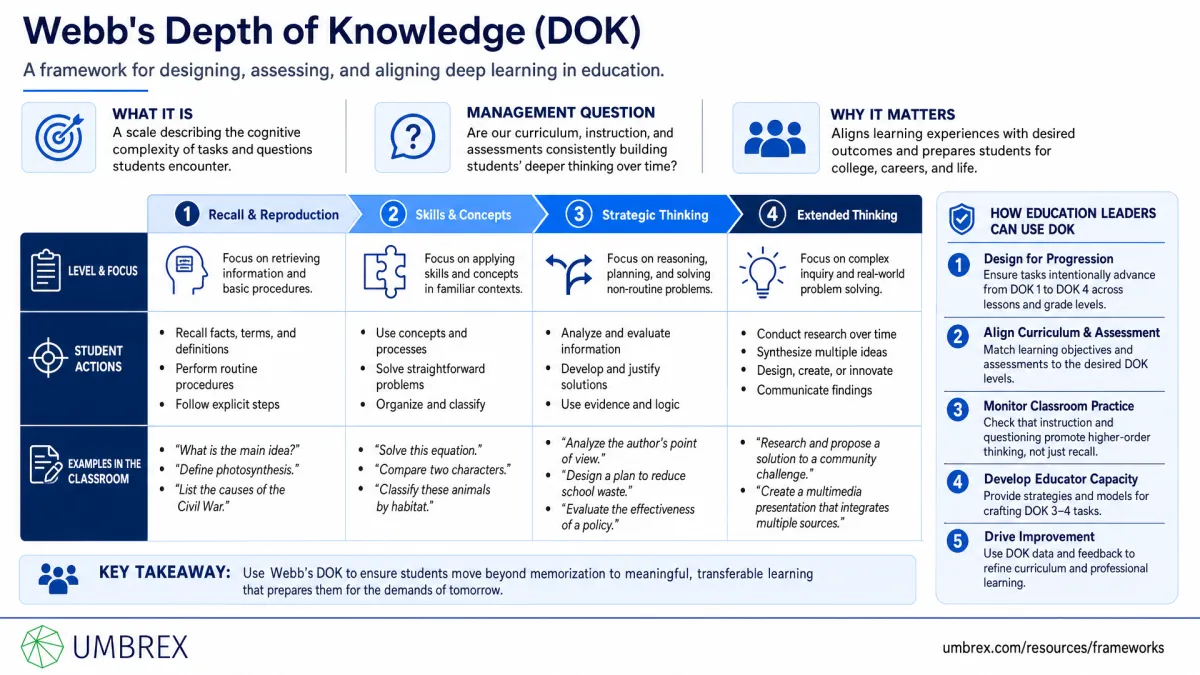
1. What Is Webb’s Depth of Knowledge (DOK)?
Webb’s Depth of Knowledge (DOK) is a curriculum and assessment alignment framework that classifies the cognitive complexity required to meet a learning expectation or complete a task. It examines what learners must do with knowledge, rather than simply whether a question is difficult. Curriculum specialists and education consultants can use it to compare intended learning with the thinking required by instructional activities and assessments.
For leaders in K–12 education, the practical question is whether students have opportunities to practice—and demonstrate—the reasoning expected by standards. DOK can help focus curriculum revisions, assessment development, and teacher support rather than treating “rigor” as an undefined aspiration.
2. Origin and Background
Norman L. Webb developed the original DOK definitions and alignment methodology in 1997 while working at the Wisconsin Center for Education Research. His April 1997 monograph, Criteria for Alignment of Expectations and Assessments in Mathematics and Science Education, addressed the need for explicit criteria to judge whether assessments matched educational expectations.
Webb’s 1999 study applied alignment criteria to mathematics and science standards and assessments in four states. DOK became established through this standards-and-assessment work; its application subsequently expanded to classroom curriculum, questions, and learning tasks. That extension preserves the original purpose: checking consistency of cognitive demand, not prescribing a universal teaching sequence.
3. How Webb’s Depth of Knowledge (DOK) Works
The core logic is comparison. First, determine the thinking required by a standard or learning objective. Then examine the thinking required by the corresponding task or assessment. Matching subject matter is insufficient: an assessment can address the right topic while requiring substantially less reasoning than the expectation.
The four levels
- DOK 1: Recall and reproduction. Learners retrieve information or execute a taught, well-defined procedure. Examples include naming cell structures or following specified steps to measure temperature.
- DOK 2: Skills and concepts. Learners use conceptual understanding, process information, or examine relationships. For example, students interpret a supplied graph and describe the relationship between two variables.
- DOK 3: Strategic thinking and reasoning. Learners address nonroutine problems, make justified judgments, or construct evidence-based arguments. For example, students evaluate competing explanations for an ecological change and defend their conclusion.
- DOK 4: Extended thinking. Learners undertake complex, iterative work requiring reflection and extended time. For example, they design an investigation, evaluate emerging evidence, revise their approach, and synthesize conclusions. Duration alone does not establish this level.
These are categories of cognitive demand, not four types of students or a mandatory learning ladder. A complex investigation can incorporate factual retrieval and routine measurements. Conversely, a lengthy assignment can remain low in complexity.
Interpretations must be discipline-specific. Reasoning about literary interpretation differs from reasoning about experimental controls. Review complete prompts, materials, expected responses, and scoring requirements—not isolated verbs such as “analyze” or “explain.”
4. When to Use Webb’s Depth of Knowledge (DOK)
DOK is especially useful when an organization needs to resolve questions such as:
- Do common assessments measure the reasoning promised by the curriculum?
- Does a proposed textbook or courseware package provide appropriate learning opportunities?
- Which units need redesigned tasks rather than additional content?
- Are different campuses interpreting the same learning expectations consistently?
For EdTech providers, review task libraries and automated hints separately from completion rates. Ask whether learners still need to select evidence or develop reasoning after support is provided.
Required inputs include learning expectations, representative tasks, scoring guides, and subject-specialist judgment. Student work and classroom observations help test whether planned cognitive demands survive implementation. Organize a focused review around calibration, independent coding, and reconciliation; larger programs require additional sampling and pilot cycles.
DOK is not a good fit for diagnosing motivation, estimating learning gains, or evaluating an entire institution. Nor should short tests be forced to include extended investigations simply to reach DOK 4. In higher education or vocational programs, use course outcomes as the reference point and validate the interpretation with disciplinary experts.
5. How to Apply Webb’s Depth of Knowledge (DOK): Step-by-Step
- Clarify the decision and scope.
Specify whether the review will inform assessment revision, curriculum adoption, or instructional improvement. Set boundaries by subject, grade band, course, campus, and implementation period. Identify the academic leader authorized to approve changes.
- Gather the inputs.
Collect standards or outcomes, unit plans, actual assignments, assessment items, rubrics, exemplar responses, and representative student work. Include adapted materials and digital hints—not just the original publisher version.
- Define the units of analysis.
Code individual learning expectations and meaningful task components. Do not assign one label to an entire textbook, school, or subject. Separate components when they require materially different cognitive work.
- Construct an alignment map.
Create rows for learning expectations and columns for intended DOK, instructional opportunities, assessment evidence, and rating rationale. Use trained subject reviewers to code independently before discussing disagreements.
- Interpret the gaps.
Look for expectations requiring reasoning that are assessed only through recall. Distinguish useful foundational practice from inadequate culminating evidence. Record uncertainty rather than forcing agreement unsupported by the task.
- Translate findings into action.
Prioritize consequential gaps. Specify revised prompts, evidence requirements, scoring guidance, teacher preparation, and owners. Account for lesson time, laboratory resources, accessibility, and marking workload before approving implementation.
- Test alternative assumptions.
Reassess tasks under different hints, worked examples, response formats, and scoring rules. Examine whether a seemingly complex task can be completed by reproducing a supplied answer or procedure.
- Align stakeholders and iterate.
Bring curriculum leaders, teachers, assessment specialists, and accessibility experts together. Pilot revised tasks, review student responses, and refine the map. Keep task classification separate from judgments about learner proficiency.
Where departments disagree on revision priorities, workshop facilitation can help translate the evidence into agreed decisions, owners, and resource commitments. Subject specialists should retain responsibility for educational judgments.
6. Example: Webb’s Depth of Knowledge (DOK) in Action
Fictional example: Cedar Vale School District wants its middle-school science curriculum to prepare students to evaluate evidence, but teachers report that students struggle to defend explanations. The chief academic officer commissions a DOK review before purchasing additional courseware.
The team compares learning expectations, laboratory activities, and common assessment items. It finds that an outcome requiring evaluation of competing ecological explanations calls for DOK 3 reasoning. However, corresponding assessments mainly ask students to label diagrams or describe supplied trends. A month-long “research project” involves repeated measurements and graphing, without evaluating alternatives; its length does not make it DOK 4.
The district retains necessary factual and procedural practice but introduces an assessment requiring students to judge competing explanations using water-quality data, consider confounding variables, and defend conclusions. Teachers pilot the task and refine its scoring guide after reviewing student responses.
The district pairs the redesign with training and adoption planning covering exemplar responses, teacher calibration, coaching, and implementation reviews. Success is judged through the quality of students’ reasoning—not merely the number of tasks carrying higher DOK labels.
7. Strengths and Limitations
Strengths
- Sharper alignment discussions: DOK provides language for distinguishing topic coverage from the thinking learners must demonstrate.
- Targeted improvement: An alignment map can direct scarce curriculum-development time toward specific gaps rather than wholesale replacement.
- Cross-team coherence: Documented rationales help teachers, publishers, assessment developers, and academic leaders discuss expectations consistently.
Limitations
- Only part of alignment: Comparable DOK levels do not establish adequate content coverage, breadth, or balance across learning expectations.
- Judgment-dependent categories: Classification requires interpretation. The four levels are useful distinctions, not four naturally discrete cognitive states or a precise numerical scale.
- Not proof of learning: A demanding task does not establish that students learned successfully. Accessibility barriers can also distort assessment evidence; removing irrelevant barriers need not reduce rigor.
For institutional leaders or investors evaluating curriculum businesses, DOK should therefore complement—not replace—evidence of implementation quality and learning outcomes.
8. Common Pitfalls and How to Avoid Them
- Coding by verbs: “Explain” can describe very different demands. Examine the complete task and required response rather than using a verb wheel.
- Promoting long projects: Repetition over several weeks is not extended thinking. Require meaningful synthesis, reflection, and iterative reasoning before assigning DOK 4.
- Sampling showcase lessons: Exceptional tasks can conceal routine underalignment. Sample everyday instruction, common assessments, and materials used by different learner groups.
- Removing the reasoning: Supports should remove irrelevant barriers, not supply the intellectual decisions being assessed. Check that scaffolding preserves the intended learning goal.
- Imposing numerical quotas: A fixed higher-DOK percentage can distort curriculum choices. Start with the learning expectations and justify the balance required.
- Stopping at classification: Labels do not change classrooms. Assign revision owners, protect preparation time, and review implementation evidence.
9. How Webb’s Depth of Knowledge (DOK) Relates to Other Frameworks
- Understanding by Design: Use backward design to establish desired learning, acceptable evidence, and learning experiences. Apply DOK within that process to check cognitive alignment. Prefer Understanding by Design when the question concerns complete unit or course architecture rather than task demand alone.
- Bloom’s Taxonomy and Hess’s Cognitive Rigor Matrix: Revised Bloom’s identifies cognitive processes, while DOK addresses their depth and complexity in context. Hess’s matrix combines these perspectives. Use it alongside DOK when a team needs to examine both the type and complexity of thinking across a curriculum.
- Universal Design for Learning: Use this alongside task design to anticipate learner variability and reduce barriers. DOK clarifies the intended cognitive demand; Universal Design for Learning helps ensure students can access and demonstrate it without changing the learning goal unnecessarily.
10. Key Takeaways
- DOK classifies cognitive demand—not learner ability or task difficulty.
- Compare learning expectations, instructional opportunities, and assessment evidence.
- Calibrate discipline-specific judgments before scaling the review.
- Aim for appropriate alignment, not maximum DOK everywhere.
- Convert identified gaps into revised tasks, teacher support, and classroom checks.
11. FAQs About Webb’s Depth of Knowledge (DOK)
Is DOK the same as difficulty?
No. Difficulty concerns how challenging a task is for a learner or population; DOK concerns the cognitive demand inherent in the expectation or task. Recalling an unfamiliar fact can be difficult without requiring complex reasoning.
Should every lesson include DOK 4?
No. Each level can serve important learning purposes. Extended inquiry belongs where the outcomes require it, not as a universal lesson requirement. DOK levels do not prescribe priority or instructional sequence.
Can smaller schools use DOK effectively?
Yes. Begin with one consequential unit and a manageable task sample. Have teachers compare judgments, document disagreements, and revise a few important gaps before expanding the process. A transparent spreadsheet is sufficient for an initial review.
What information is needed for a useful DOK review?
At minimum, assemble the learning expectations, complete tasks, and criteria for successful responses. Add instructional supports and representative student work to understand classroom implementation. Include subject expertise; labels without defensible rationales provide little decision value.
