

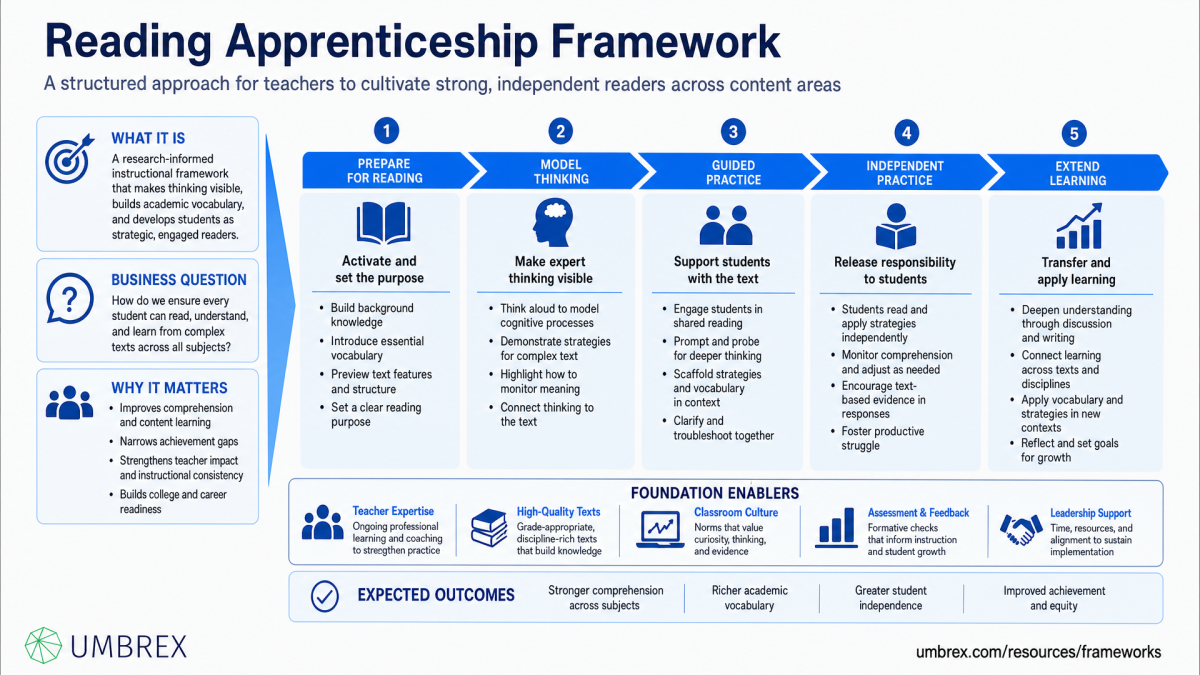
1. What Is Reading Apprenticeship Framework?
The Reading Apprenticeship Framework is an instructional and professional-learning framework that helps students become more capable, independent readers of demanding subject-area texts. Teachers make their own reading and reasoning processes visible, then help learners practice those processes collaboratively and independently. “Apprenticeship” refers to learning from an experienced reader, not employment training. The approach connects literacy development with learning disciplinary content.
For leaders in K–12 education, it provides a way to structure an important investment decision: how to strengthen students’ access to rigorous science, history, and other coursework without making literacy solely the responsibility of English teachers. Education consultants can use it to connect instructional diagnosis with teacher development, coaching, and implementation planning.
2. Origin and Background
Ruth Schoenbach and Cynthia Greenleaf developed Reading Apprenticeship with San Francisco secondary teachers during the 1990s, with further development at WestEd. They addressed a problem that conventional approaches often separated into different categories: students’ reading skills, motivation, classroom participation, and ability to understand disciplinary texts. The framework brought these concerns together around making reading processes visible.
The approach was disseminated through Reading for Understanding, including its 2012 and 2023 editions. Its application extends beyond the original secondary-school context to college classrooms. Importantly, it remains an instructional framework rather than a corporate strategy model or a prescribed sequence of reading exercises.
3. How Reading Apprenticeship Framework Works
The framework combines four interacting dimensions. They are not sequential stages: a well-designed lesson develops several dimensions simultaneously.
- Social dimension: Students learn through interaction with peers and teachers in an environment where reading difficulties can be discussed productively. For example, partners might compare how they interpreted a scientific explanation, rather than simply exchange answers.
- Personal dimension: Learners develop awareness of their reading identities, strengths, interests, and agency. Teachers build on students’ experiences instead of treating difficulty with academic English as evidence that they lack useful knowledge or intellectual resources.
- Cognitive dimension: Students develop ways to monitor comprehension and resolve difficulties. These include questioning, rereading, making inferences, and checking interpretations against evidence. The objective is purposeful problem-solving, not completing a strategy checklist regardless of what the text requires.
- Knowledge-building dimension: Readers connect existing knowledge with new disciplinary knowledge, vocabulary, and ways of organizing information. A history lesson might develop understanding of source context; a science lesson might connect prose, diagrams, and previously learned concepts.
Metacognitive conversation connects these dimensions. Teachers and students examine how they are making meaning, where understanding breaks down, and what helps them recover. This is different from discussing only the content: students explain both what they understand and how they reached that understanding.
The framework also emphasizes extensive reading: substantial opportunities to practice reading during instruction. Conversation should support engagement with texts, not replace it. Teacher explanations alone do not provide the reading practice envisioned by the framework.
4. When to Use Reading Apprenticeship Framework
The framework is particularly relevant when secondary or college students struggle to learn independently from disciplinary texts. Appropriate applications include improving access to complex coursework, strengthening subject teachers’ literacy practices, and developing coherence across departments without requiring identical teaching methods in every subject.
For leaders in higher education, a useful starting point is a gateway course: how do faculty support students in interpreting a textbook chapter, research article, or technical explanation before expecting independent application?
It is not a sufficient standalone response to every reading difficulty. Students with substantial word-reading or fluency needs should receive targeted instruction alongside opportunities to engage with disciplinary content. Otherwise, leaders risk interpreting a foundational skill difficulty as a problem that discussion alone can solve.
Useful inputs include student work, reading assessments, classroom observations, learner interviews, and curriculum texts. Successful implementation also requires professional learning and sustained collegial support. Budget for repeated planning, practice, and review cycles—not merely an introductory workshop.
5. How to Apply Reading Apprenticeship Framework: Step-by-Step
The following is a recommended implementation process for an executive-sponsored initiative. It is not a set of prescribed stages within the original framework.
- Clarify the decision and scope.
Define the instructional problem, participating courses, learner population, and review horizon. For example, pilot improved reading support in ninth-grade science and history for one semester before deciding whether to expand.
- Gather evidence of reading and teaching.
Collect comparable comprehension tasks, student annotations, brief reading interviews, lesson materials, and observations. Examine word-reading and fluency needs separately. Ask teachers where they currently explain a text instead of helping students interpret it.
- Define the units of analysis.
Examine the relationship among learner, text, task, and classroom practice. Compare lessons or course sections with similar demands. Avoid treating a whole school’s average reading score as a sufficient instructional diagnosis.
- Construct an implementation worksheet.
For each lesson, document opportunities addressing the four dimensions, planned metacognitive prompts, and actual reading practice. This worksheet is a local planning artifact, not an official scoring instrument or a new component of the framework.
- Interpret patterns and competing explanations.
Triangulate observations with student work. Determine whether difficulties concern vocabulary, background knowledge, comprehension monitoring, participation, or foundational skills. Examine differences across learner groups without assuming that one explanation applies to everyone.
- Translate the diagnosis into action.
Develop training and adoption planning around subject-specific demonstrations, coaching, protected collaboration time, and clear ownership. Specify which practices teachers will test and which evidence will determine whether those practices are helping.
- Test sensitivities and alternatives.
Check whether conclusions change with different texts, attendance patterns, assessment tasks, or levels of teacher support. Distinguish improved performance on a familiar passage from improved independence with a new, comparable text.
- Align stakeholders and iterate.
Bring together subject teachers, literacy specialists, school leaders, language-support staff, and relevant student perspectives. Use recurring reviews of instruction and student work to refine implementation rather than treating initial training as completion.
6. Example: Reading Apprenticeship Framework in Action
Fictional example: Cedar Valley School District finds that ninth-grade students can repeat teachers’ explanations but struggle to interpret unfamiliar science and history passages. Its chief academic officer chooses Reading Apprenticeship to investigate the problem while preserving the existing curriculum.
A semester pilot covers two high schools. Teachers examine lesson–text–task combinations using student annotations, reading interviews, and classroom observations. The working assumption is that more supported reading could improve independence, but the team also checks whether some students need additional foundational instruction.
The four dimensions reveal different barriers. Students hesitate to disclose confusion in whole-class discussions, weakening the social environment. Some describe themselves as unsuccessful readers, highlighting the personal dimension. Others reread repeatedly without changing approach, indicating a cognitive need. Science lessons also assume vocabulary and conceptual knowledge that students have not yet developed.
Teachers introduce partner conversations, model how they resolve genuine reading difficulties, and connect new concepts with learners’ existing knowledge. History teachers emphasize source perspective; science teachers model movement between explanations and diagrams. Coaches review whether students—not just teachers—are doing the interpretive work.
At the review point, the district examines independent comprehension alongside participation and strategy use. It treats encouraging classroom evidence as grounds for further testing, not proof of causality. Expansion requires program management support to coordinate coaching assignments, release time, materials, and evidence-review milestones.
7. Strengths and Limitations
Strengths
- Connects literacy with content: Students practice reading as part of learning a subject rather than encountering comprehension strategies only in isolation.
- Makes expertise visible: Teachers can expose reasoning processes that students might otherwise be expected to discover themselves.
- Integrates participation and capability: Confidence, classroom relationships, comprehension, and knowledge-building are treated as connected instructional concerns.
Limitations
- Implementation demands matter: Professional learning, collaboration, and leadership support require resources. A rollout without sustained support risks becoming a collection of superficial routines.
- It is not a complete intervention system: The framework does not eliminate the need to identify and address specific decoding, fluency, or other learning needs.
- Effects should not be overstated: The What Works Clearinghouse review reports potentially positive effects on grade point average but uncertain effects on reading comprehension and several other outcomes. This differs from WestEd’s broader positive characterization of the research base; leaders should distinguish particular study findings from guaranteed local results.
8. Common Pitfalls and How to Avoid Them
- Reducing the framework to strategies: Annotation worksheets alone neglect relationships, identity, and knowledge. Plan across all four dimensions rather than counting techniques used.
- Replacing reading with explanation: Teachers may clarify every difficulty themselves. Preserve substantial student reading and require learners to explain their own meaning-making processes.
- Making disclosure feel punitive: As a practical safeguard, avoid rewarding only immediate correctness. Establish norms that treat confusion as information for learning, while maintaining expectations for evidence-based reasoning.
- Standardizing across disciplines: Do not mandate identical annotations everywhere. Ask subject experts to identify what credible interpretation requires for the particular text and task.
- Measuring attendance instead of learning: Workshop participation is an implementation input. Pair it with observation, student work, and independent comprehension evidence before making expansion decisions.
9. How Reading Apprenticeship Framework Relates to Other Frameworks
Cognitive Apprenticeship
Cognitive Apprenticeship provides a broader model of making expert thinking visible through modeling, coaching, scaffolding, articulation, reflection, and exploration. Reading Apprenticeship focuses that general instructional logic on reading and disciplinary learning. Prefer the broader model when the problem extends to laboratory procedures or other complex performances.
Universal Design for Learning
Universal Design for Learning, or UDL, addresses barriers through multiple means of engagement, representation, and action and expression. Use it alongside Reading Apprenticeship to plan accessible materials and participation options. The distinction is useful: access to a text and development of independent reading processes are related but different design questions.
Multi-Tiered System of Supports
A Multi-Tiered System of Supports, or MTSS, organizes support by intensity and uses assessment to inform instructional decisions. Begin with identifying learner needs, then determine how Reading Apprenticeship should complement core teaching and additional interventions. MTSS structures the support system; Reading Apprenticeship guides particular classroom learning practices.
10. Key Takeaways
- Reading Apprenticeship connects independent reading development with learning demanding disciplinary content.
- Four interacting dimensions are connected through metacognitive conversation and extensive reading.
- Translate instructional diagnosis into coaching, collaboration time, ownership, and a practical implementation plan.
- Evaluate independent comprehension—not merely participation, completed annotations, or training attendance.
- Supplement the approach for specific reading needs and avoid promising universal achievement gains.
11. FAQs About Reading Apprenticeship Framework
Does Reading Apprenticeship replace phonics or decoding instruction?
No. Its disciplinary literacy focus should not be treated as a substitute for targeted word-reading instruction. Identify foundational needs and address them alongside access to meaningful subject-area learning.
How should it differ between science and history?
Keep the framework consistent but adapt the reading work. Science may require connecting explanations with diagrams and concepts; history may require examining authorship and perspective. Teachers should model the reasoning appropriate to their discipline.
Can a small school use the framework?
Yes, a practical starting point is a small teacher team, selected curriculum texts, student work, and protected review time. Keep the pilot manageable, obtain appropriate professional-learning support, and avoid building an elaborate reporting system before instructional needs are clear.
How long should leaders allow for implementation?
Do not assume a fixed completion period. An introductory session can establish vocabulary, but plan repeated classroom practice and review across a semester or other meaningful instructional cycle. Expansion should depend on teacher readiness and student evidence, not the training calendar alone.
