

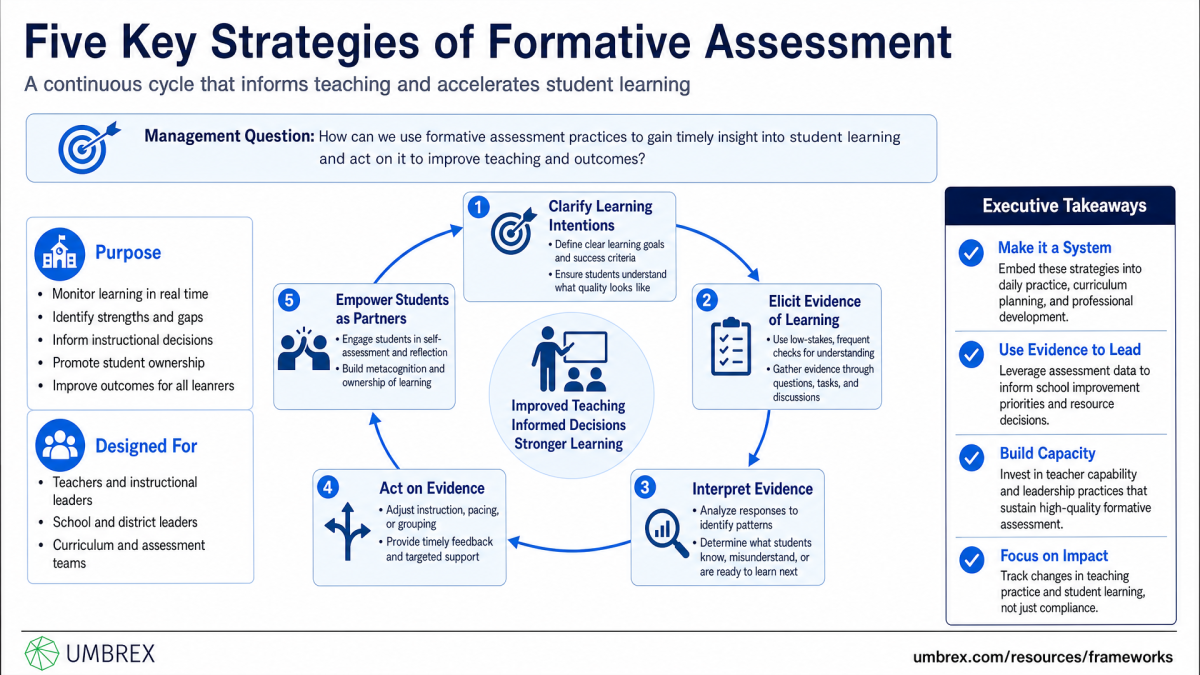
1. What Is Five Key Strategies of Formative Assessment?
The Five Key Strategies of Formative Assessment is an instructional decision-making framework for using evidence of learning to improve what teachers and students do next. It connects clear learning goals, diagnostic evidence, actionable feedback, peer support, and learner ownership. Assessment becomes formative through how its evidence is used—not simply because a quiz is short or ungraded.
In K-12 education, the central question is whether students understand the intended concepts and how instruction should respond. Education leaders and consultants can use the framework to diagnose weaknesses in assessment practices and prioritize teacher development, rather than defaulting to additional testing.
2. Origin and Background
The framework emerged from Dylan Wiliam’s work with colleagues, including Marnie Thompson. Siobhan Leahy, Christine Lyon, Thompson, and Wiliam published the five strategies in November 2005. Wiliam and Thompson articulated their organizing model in a 2007 chapter, “Integrating Assessment with Instruction: What Will It Take to Make It Work?”
The work built on Paul Black and Wiliam’s research on classroom assessment, including their influential 1998 review. It addressed the gap between collecting evidence and using it to improve learning. Wiliam’s 2011 book, Embedded Formative Assessment, translated the strategies into practical classroom techniques. This is an education-native framework, not a corporate management model adapted for schools.
3. How Five Key Strategies of Formative Assessment Works
The framework combines three questions: Where is the learner going? Where is the learner now? How can the learner get there? It considers the contributions of the teacher, peers, and the learner. These relationships produce five interconnected strategies—not five sequential stages or a prescribed lesson format.
The distinction between a strategy and a technique matters. An exit ticket, discussion, or rubric is only a technique. Its value depends on whether it reveals useful evidence and informs the next teaching or learning decision.
| Strategy | Meaning and education-specific application |
|---|---|
| Clarifying, sharing, and understanding learning intentions and success criteria | Students understand the intended learning and what successful work demonstrates. “Support a claim with relevant evidence” is a learning intention; “finish the essay” is an activity. Use contrasting examples to make quality visible. |
| Engineering discussions, questions, and tasks that elicit evidence of learning | Design opportunities that reveal students’ reasoning, not just correct answers. A carefully chosen question answered by everyone can expose misconceptions that volunteer responses miss. |
| Providing feedback that moves learning forward | Identify a useful next action and provide an opportunity to act. A student might strengthen an explanation, correct a misconception, or try another problem. Producing comments is not the same as improving learning. |
| Activating learners as instructional resources for one another | Students help peers understand and improve. Teach them to apply criteria, explain reasoning, and offer constructive feedback. Peer support requires modeling and teacher oversight; it is not merely exchanging grades. |
| Activating learners as owners of their own learning | Students evaluate their work, identify gaps, choose next steps, and check progress. Self-assessment should involve evidence against learning criteria, rather than an unsupported declaration of confidence. |
A practical unit of analysis is a specific learner’s understanding of a defined concept or skill. School-level averages can inform leadership decisions, but classroom action requires more precise evidence.
4. When to Use Five Key Strategies of Formative Assessment
The framework is especially useful when teachers must decide whether to advance, reteach, change an explanation, or provide targeted support. It also helps academic leaders examine why frequent assessment is not producing useful instructional responses. Its central assumption is that evidence arrives while teachers or learners still have an opportunity to act.
In higher education, the same logic can inform lecture questions, draft assignments, laboratory explanations, and seminar discussions. The relevant boundaries become course outcomes, concepts, and sections rather than grade-level units. Evidence must still influence teaching or students’ subsequent work.
Useful inputs include curriculum objectives, student work, diagnostic responses, observations, and student explanations. Teachers and subject leaders supply essential interpretation. Planning a limited pilot is different from embedding consistent practice across campuses, which requires sustained professional learning. The framework is not a substitute for credentialing, standardized accountability assessment, or rigorous programme evaluation.
5. How to Apply Five Key Strategies of Formative Assessment: Step-by-Step
- Clarify the decision and scope.
Select an instructional problem, such as identifying misconceptions before an algebra unit advances. Define the subject, learner group, curriculum objectives, and period in which the findings can influence teaching.
- Gather relevant evidence.
Review existing assignments, assessment questions, feedback, and subsequent revisions. Interview teachers and students about what happens after misunderstandings are identified. Include preparation time and marking workload in the baseline.
- Define the units of analysis.
Assess learner understanding against specific concepts or skills. For institutional diagnosis, compare routines across course sections or grade-subject teams without confusing differences in student intake with differences in teaching quality.
- Build an assessment-response map.
Create a working document linking each learning intention to success criteria, an evidence-gathering task, likely misconceptions, possible instructional responses, and opportunities for peer support and self-assessment. This map is an implementation aid, not an additional framework component.
- Interpret the evidence.
Examine reasoning alongside answers. Distinguish conceptual misunderstanding from missing prerequisite knowledge or difficulty accessing the task. Compare multiple examples before treating one response as a reliable diagnosis.
- Translate findings into action.
Specify who will reteach, revise an explanation, provide additional practice, or offer extension. Give students time to use feedback, then gather fresh evidence to determine whether understanding has changed.
- Test alternative interpretations.
Check whether conclusions change with another question, response format, or delayed task. Challenge assumptions about whether apparent success reflects independent understanding, memorization, or assistance.
- Align stakeholders and iterate.
Bring teachers, instructional coaches, subject leaders, and student-support specialists together to review evidence. Preserve common principles while allowing discipline-specific techniques. Refine the approach through repeated classroom use.
For a multi-campus rollout, program management support can coordinate coaching cohorts, release time, milestones, and unresolved implementation issues. Academic leaders should retain responsibility for instructional judgments.
6. Example: Five Key Strategies of Formative Assessment in Action
Illustrative scenario: Riverbend Learning Network, a fictional school operator, finds that sixth-grade students complete fraction exercises successfully but struggle to explain fraction comparisons. Its academic director selects the framework to investigate whether classroom assessment is revealing genuine understanding.
Teachers clarify that success means comparing fractions and justifying the comparison using equal-sized wholes. They examine contrasting explanations with students, then ask everyone a diagnostic question designed to reveal the misconception that a larger denominator means a larger fraction. Written explanations become the evidence—not merely the selected answer.
Teachers provide a focused next step: use a diagram to test the reasoning. Students review a partner’s explanation against shared criteria, while teachers check the accuracy of peer feedback. Each learner then identifies an error or strength in their own reasoning and completes a different comparison independently.
The exercise reveals that procedural success had concealed conceptual gaps. Riverbend changes the next lesson, creates temporary support groups, and checks transfer through later tasks rather than immediately repeating the original question.
Scaling the approach requires training and adoption planning: subject-specific coaching, supported peer observation, and realistic expectations for staff. The network funds collaborative planning rather than purchasing another quiz platform.
7. Strengths and Limitations
Strengths
- Connects assessment with action. It makes the next teaching or learning decision central, rather than the production of scores.
- Creates shared language. Teachers and leaders can discuss common strategies while selecting techniques appropriate to their subjects and students.
- Includes learner participation. Peer feedback and self-assessment make students contributors to improvement, not simply recipients of judgments.
A 2018 randomized evaluation of a whole-school implementation programme in English secondary schools found improved overall attainment, but no demonstrated improvement in English or mathematics attainment specifically. This supports the evaluated programme, not a guaranteed effect from every isolated technique or in every setting.
Limitations
The framework does not supply subject-specific diagnostic questions, validate every inference about understanding, or establish causation from a local pilot. Immediate performance also needs checking against later, independent application. Accessible assessment design remains essential: an irrelevant response barrier can obscure the intended learning.
Implementation depends on professional judgment and time. Feedback can be ineffective or harmful, and excessive marking can consume resources without improving students’ next actions.
8. Common Pitfalls and How to Avoid Them
- Calling every quiz formative. Collecting responses without using them leaves the learning loop incomplete. Plan the possible instructional responses before administering the task.
- Sampling only confident students. Volunteer answers can leave other students’ understanding unexamined. Use an all-student response method, followed by selected explanations.
- Giving feedback without response time. Comments cannot help if students have no opportunity to use them. Build revision or further practice into the learning sequence.
- Confusing access with understanding. Unnecessary language or response demands can distort evidence. Remove barriers unrelated to the learning goal without changing the intended standard.
- Delegating assessment to unprepared peers. Unsupported peer review can produce weak advice. Model useful feedback, calibrate judgments with examples, and monitor discussions.
- Managing by technique counts. Avoid equating more exit tickets or rubric entries with better implementation. Review what the evidence changed and what students subsequently demonstrated.
9. How Five Key Strategies of Formative Assessment Relates to Other Frameworks
Understanding by Design: Use backward design first when learning outcomes and acceptable evidence are unclear. It establishes desired results, assessment evidence, and learning experiences. The five strategies then help teachers and students use evidence during instruction. Prefer backward design for curriculum architecture; combine the approaches for responsive delivery.
Universal Design for Learning: Apply this alongside formative assessment to reduce barriers to participation and expression. Universal Design for Learning addresses access and learner variability; the five strategies address how evidence informs improvement. Flexible response options must remain aligned with the intended skill.
Plan-Do-Study-Act: Use this improvement cycle to test implementation across classrooms or campuses. Plan a change, try it, study evidence, and decide what to adapt. It structures organizational learning but does not replace the instructional content of the five strategies.
10. Key Takeaways
- Formative assessment is a use of evidence, not a particular test format.
- The five strategies connect goals, diagnosis, feedback, peer support, and learner ownership.
- Analyze specific understanding—not just completion, participation, or average scores.
- Make the next action explicit and check whether it improved learning.
- Scale through supported professional practice, not compliance counts or technology alone.
11. FAQs About Five Key Strategies of Formative Assessment
Can a graded assessment also be used formatively?
Yes. Its results can inform reteaching, revision, or further practice. The formative function comes from using evidence to guide subsequent learning; the grade itself does not provide that function.
What data is needed to apply the framework?
Start with a clear learning intention, criteria for success, and evidence of students’ reasoning or performance. Large datasets are unnecessary for classroom use. Multiple tasks and later checks strengthen interpretation.
Does formative assessment require technology?
No. Discussions, written explanations, paper exit tickets, and student work can provide useful evidence. Digital tools should be selected for how they support evidence gathering and response, not merely because they automate scoring.
How long does institution-wide implementation take?
There is no universal timetable. Consistent adoption requires recurring professional learning, classroom experimentation, and review. Timing depends on staff experience, curriculum alignment, protected collaboration time, and the number of sites—not simply the length of an introductory workshop.
