

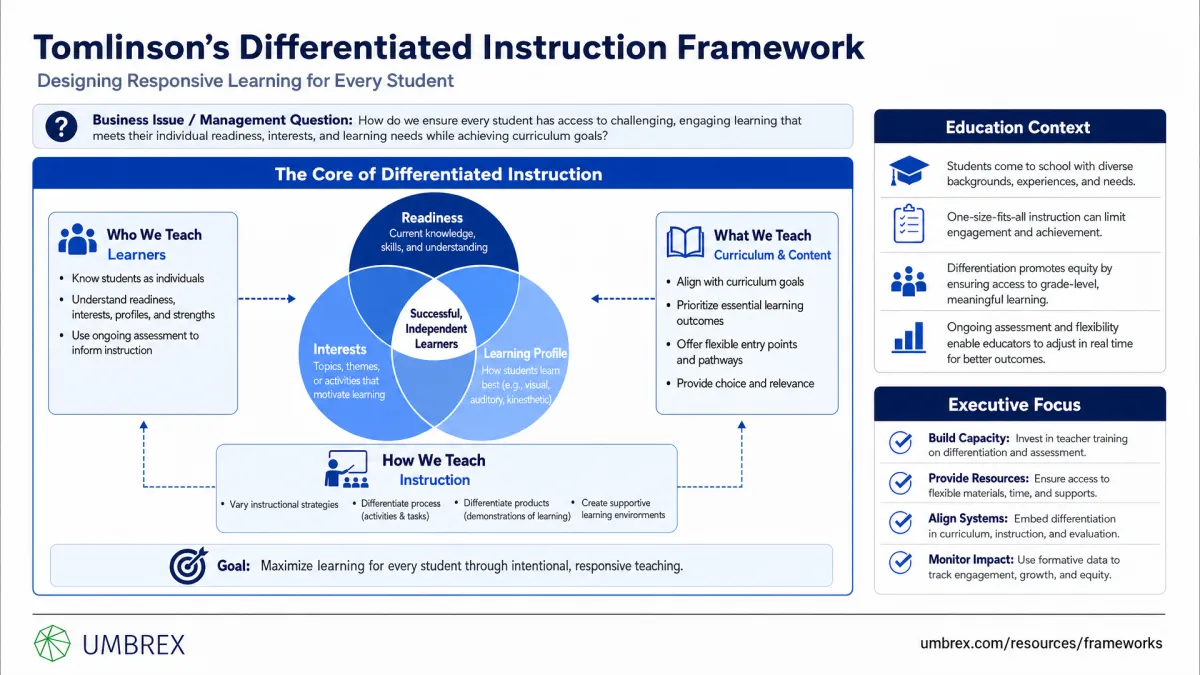
1. What Is Tomlinson’s Differentiated Instruction Framework?
Tomlinson’s Differentiated Instruction Framework is an instructional design and classroom-management approach that helps teachers respond to differences among learners. Teachers adjust how students encounter content, make sense of it, and demonstrate understanding, using evidence about their needs. It is a flexible framework, not a packaged intervention or a requirement to create a separate lesson for every student.
For education leaders, it structures a practical question: how can an institution provide appropriate challenge and support without fragmenting its curriculum or overwhelming teachers? In K-12 education, the executive task is to connect responsive classroom practice with curriculum expectations, assessment, professional development, and workable planning routines. For consultants, this is an instructional improvement tool rather than a corporate strategy framework.
2. Origin and Background
Carol Ann Tomlinson developed and popularized this formulation of differentiated instruction through publications including How to Differentiate Instruction in Mixed-Ability Classrooms, first published in 1995, and The Differentiated Classroom: Responding to the Needs of All Learners, published in 1999. These works helped establish a coherent approach to teaching academically diverse classrooms.
Her contribution was not the invention of adapting teaching to learners. It was a systematic explanation of how curriculum, assessment, grouping, and classroom practice could work together. Early applications explicitly included advanced learners alongside students needing additional support. Unlike many management frameworks adapted from business, its original context is directly relevant to education today.
3. How Tomlinson’s Differentiated Instruction Framework Works
The core logic is a continuing cycle: establish worthwhile learning goals, understand learners’ starting points, plan suitable learning experiences, assess progress, and adjust. Differentiation combines whole-class, small-group, and individual instruction; it does not eliminate direct teaching or shared classroom experiences.
Understand three learner characteristics
- Readiness: A student’s current knowledge, understanding, and skills relative to a particular learning target—not a permanent measure of ability.
- Interest: Topics, questions, or activities that attract curiosity and can make learning meaningful.
- Learning profile: Preferences and conditions associated with learning, including working independently or collaboratively and environmental considerations.
These characteristics inform planning rather than create fixed student categories. A learner may need substantial support in one topic and advanced challenge in another.
Adjust the instructional response
- Content: What students learn and the resources through which they access it. Teachers might provide vocabulary support or extend material already mastered.
- Process: Activities through which students develop understanding, such as guided practice, investigation, discussion, or increasingly independent application.
- Product: How students demonstrate learning, with formats selected to provide valid evidence of the intended knowledge or skill.
- Learning environment: The classroom’s organization and atmosphere, including quiet workspaces, collaboration arrangements, and procedures for obtaining help.
Ongoing assessment, flexible grouping, and respectful tasks connect these elements. Groups change with the instructional purpose and new evidence. Every group receives meaningful, appropriately challenging work—not repetitive exercises for some and substantive thinking for others.
Tomlinson’s broader classroom model also emphasizes students’ emotional experience and the interdependence of environment, curriculum, assessment, instruction, and classroom leadership. Importantly, learning-profile considerations should not become fixed “visual,” “auditory,” or “kinesthetic” labels: evidence does not justify prescribing instruction through learning-style matching.
4. When to Use Tomlinson’s Differentiated Instruction Framework
Use the framework when students pursuing related learning goals have materially different starting points or support needs. It is especially useful for planning mixed-readiness classes, extending learning beyond demonstrated mastery, and deciding which scaffolds should accompany demanding tasks. Its value depends on clear goals and evidence that teachers can use to change instruction.
In higher education, an introductory statistics team could use the same logic to vary worked examples and practice support while preserving course outcomes. Large lectures would require a different delivery design from small seminars—for example, differentiation through tutorials, practice sessions, or structured feedback rather than simultaneous classroom stations.
Minimum inputs include curriculum targets, recent student work, short diagnostic assessments, observations, and learner feedback. Planning should involve classroom educators and, where relevant, language-development and specialist staff. Begin within an existing unit-planning cycle; broader implementation requires repeated design, teaching, and review rather than a single workshop.
The framework is not a substitute for a strong curriculum or specialist intervention. It can mislead when teams mistake language proficiency for subject understanding, use stale assessment results, or change a task so extensively that it no longer measures the intended skill. Treat these as explicit design risks.
5. How to Apply Tomlinson’s Differentiated Instruction Framework: Step-by-Step
The following implementation sequence translates the framework into an executive-sponsored pilot; it is not a prescribed set of stages authored by Tomlinson.
- Clarify the decision and scope.
Select a specific instructional problem, subject, learner cohort, and unit. Define what students should know, understand, and do, and which expectations must remain consistent.
- Gather useful evidence.
Combine a brief pre-assessment with work samples, observations, and student conversations. Identify misconceptions separately from difficulties accessing instructions or expressing answers. Avoid relying on an overall grade alone.
- Define the units of analysis.
Assess student needs against particular learning targets. Create temporary instructional groupings around those needs—not permanent “high,” “middle,” and “low” classifications. Include students ready for extension.
- Build a differentiated unit plan.
Use a planning table linking each learning target to learner evidence, proposed content or process adjustments, acceptable products, and assessment checkpoints. This is a practical artifact, not a canonical Tomlinson matrix.
- Test the instructional logic.
Ask whether each adjustment addresses an observed need and preserves meaningful challenge. Check that different products demonstrate comparable understanding. Do not replace a writing assessment with an oral presentation when writing itself is the target.
- Assign implementation responsibilities.
Specify who prepares materials, leads small groups, reviews evidence, and coordinates specialist support. Establish help-seeking and transition routines so that teachers can work with one group while others learn productively.
- Test alternative assumptions.
Consider whether apparent low readiness reflects unfamiliar vocabulary, missed instruction, or an assessment barrier. Recheck uncertain judgments. Test whether the design remains feasible without additional adults or reliable device access.
- Align stakeholders and iterate.
Review the plan with educators and support staff, explain its purpose to learners and families, and revise after teaching. Evaluate student progress alongside preparation time and classroom manageability.
For implementation across several sites, independent workshop facilitation can help curriculum leaders and teachers resolve disagreements about shared expectations, assessment evidence, and feasible routines. Educators should retain ownership of the pedagogical decisions.
6. Example: Tomlinson’s Differentiated Instruction Framework in Action
Fictional example: Brookfield Learning Network operates three middle schools. Its academic director notices that sixth-grade mathematics classes move through fractions at a common pace, although student work reveals different misconceptions. Teachers report both disengagement among students who have mastered the material and persistent confusion among others.
The network selects differentiated instruction because it wants responsive teaching within a shared curriculum—not separate courses or a new software purchase. A pilot focuses on explaining fraction equivalence. The units of analysis are students’ understanding of that specific concept, rather than their overall mathematics grades.
A short diagnostic combines representations, calculations, and explanations. Teachers identify students needing concrete models, students needing help connecting models with symbols, and students ready to generalize. They also discover that several multilingual learners explain the concept accurately in discussion but struggle with written directions.
Teachers provide a shared introduction, followed by temporary groups using manipulatives, worked examples, or more demanding reasoning tasks. Students choose contexts such as recipes or sports, but all must explain equivalence. Vocabulary support addresses access rather than reducing mathematical demand.
Exit responses trigger regrouping during the unit. A common final reasoning task provides comparable evidence, with appropriate access support. Leaders authorize shared planning time and a reusable task bank, then review explanations, group movement, and teacher workload. Any improvement is treated as preliminary evidence, not proof that the framework caused the result.
7. Strengths and Limitations
Strengths
- Connects assessment with action: Evidence changes teaching rather than merely producing grades.
- Balances support and challenge: The approach explicitly includes learners needing scaffolding and those ready for greater complexity.
- Creates a common language: Readiness, interest, content, process, and product give educators a structured way to discuss instructional choices.
Limitations
- Implementation demands judgment: The framework does not calculate staffing, planning capacity, or which adaptation will work best.
- Assessment quality remains decisive: Weak evidence can produce inappropriate grouping or unnecessary support.
- Effectiveness is not guaranteed: A 2019 systematic review of secondary education found promising results but too few high-quality studies for conclusive judgments. Findings about particular practices should not be treated as validation of every implementation.
For governing boards and investors, the useful evaluation question is whether responsive instruction can be delivered consistently with available capabilities—not whether an institution uses the terminology.
8. Common Pitfalls and How to Avoid Them
- Permanent ability groups: Temporary readiness judgments become labels that restrict opportunity. Set reassessment points and explicit criteria for changing groups.
- More work mistaken for challenge: Additional problems can punish students who have mastered a skill. Offer greater complexity, transfer, or depth instead.
- Choice without purpose: An attractive menu of activities may not address learner needs. Require every option to connect to a learning target and produce useful evidence.
- Confusing preference with effectiveness: Students’ preferred formats are not proof of how they learn best. Use varied approaches and examine performance rather than assigning learning-style labels.
- Launching without classroom capacity: Elaborate plans can exceed available preparation time or supervision. Pilot a manageable unit and simplify transitions before expanding.
A districtwide rollout should connect these safeguards to training and adoption planning, with coaching, shared exemplars, protected collaboration time, and observable implementation milestones rather than attendance-only measures.
9. How Tomlinson’s Differentiated Instruction Framework Relates to Other Frameworks
Understanding by Design
Understanding by Design uses backward planning: establish desired results, determine acceptable evidence, then plan learning experiences. Use it first when goals or assessments are unclear; differentiation then helps determine suitable routes toward those goals for different learners.
Universal Design for Learning
Universal Design for Learning, or UDL, anticipates barriers through options for engagement, representation, and action and expression. Combine it with differentiation: accessible curriculum design establishes a stronger starting point, while learner evidence informs further adjustments. The approaches overlap; neither should be reduced to a checklist of delivery formats.
Multi-Tiered System of Supports
A Multi-Tiered System of Supports, or MTSS, organizes screening, progress monitoring, increasingly intensive support, and data-based decisions. Prefer Tomlinson’s framework for responsive lesson design; use MTSS when deciding whether students need additional intervention or greater intensity. Classroom differentiation and targeted intervention can operate together.
10. Key Takeaways
- Differentiate meaningful learning experiences—not simply workload.
- Use current evidence about readiness, interests, and learning conditions.
- Keep grouping flexible and tasks appropriately challenging.
- Protect assessment validity when offering alternative products.
- Scale through teacher capability and workable routines, not terminology or technology purchases.
11. FAQs About Tomlinson’s Differentiated Instruction Framework
Does differentiated instruction require an individual lesson for every student?
No. It blends whole-class teaching, temporary groups, and individual responses where appropriate. Teachers plan around relevant patterns of need rather than creating a completely separate curriculum for each learner.
Can smaller schools use the framework?
Yes. Start with one unit, a short diagnostic, a manageable set of adjustments, and common evidence of learning. Prioritize reusable materials and collaboration rather than a large implementation program.
Is adaptive learning software necessary?
No. Work samples, conversations, observation, and short assessments can provide useful inputs. Evaluate technology only after identifying an instructional need it would help address.
How should leaders measure success?
Look for stronger mastery, progress from students’ starting points, and access to meaningful challenge. Review these alongside teacher workload and implementation consistency. Use comparable assessments where possible, and avoid attributing every change in results to differentiation alone.
