

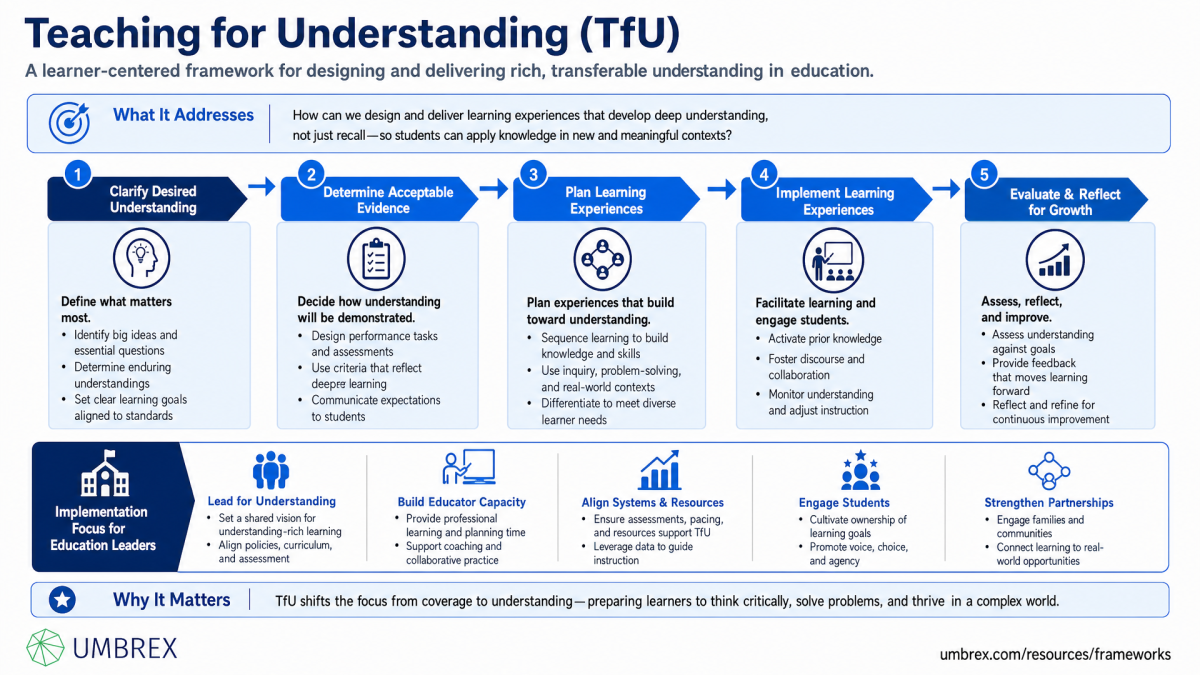
1. What Is Teaching for Understanding (TfU)?
Teaching for Understanding (TfU) is a curriculum, instruction, and assessment framework that defines understanding as the ability to use knowledge flexibly in unfamiliar situations. It shifts the planning question from “What content will we cover?” to “What should learners be able to explain, interpret, and apply?” Facts and skills remain essential; reproducing them is not sufficient evidence of understanding.
For leaders in K–12 education, TfU offers a way to evaluate whether curriculum, classroom tasks, and assessment actually support intended learning. Education consultants can use it to structure curriculum redesign without turning instructional quality into a checklist of activities completed.
2. Origin and Background
TfU emerged from collaborative research at Harvard Graduate School of Education and Project Zero. In 1988, Howard Gardner, David Perkins, and Vito Perrone convened educators and researchers to plan a five-year project. Its purpose was to develop a research-based, classroom-tested approach to teaching for understanding, grounded in students’ ability to generalize knowledge to new problems.
Teachers helped develop and refine the framework through classroom practice, observation, and discussion. Tina Blythe and associates’ The Teaching for Understanding Guide, published in 1998, helped make the approach accessible to practitioners. TfU was therefore an educational framework from the outset—not a corporate management model subsequently adapted for schools.
3. How Teaching for Understanding (TfU) Works
TfU connects four elements: worthwhile topics, explicit understanding goals, learning experiences that develop and demonstrate understanding, and assessment that improves learning throughout instruction. These elements reinforce one another; they are not a rigid sequence of planning stages.
Generative Topics
Generative topics are central to a discipline, interesting to teachers and students, accessible through multiple entry points, and connected to other ideas. For example, a mathematics team might organize proportional reasoning around “When are comparisons fair?” rather than treating ratios as isolated calculation procedures. The question should deepen disciplinary learning, not merely entertain students.
Understanding Goals
Understanding goals specify what learners should understand about the topic. Unit-level goals connect with longer-term goals, often called throughlines. “Complete a graphing worksheet” describes an activity. “Explain how different representations reveal or obscure a relationship” identifies an understanding that can be demonstrated across tasks.
Performances of Understanding
These are activities that both develop and reveal understanding—not simply final presentations. They typically progress from introductory exploration through guided inquiry to a culminating performance. Learners might explain an apparent contradiction, defend an interpretation, or apply a model to a new case. Instructional support should be adjusted as learners become more capable.
Ongoing Assessment
Assessment accompanies learning through explicit criteria, feedback, reflection, and opportunities to improve. Teachers, peers, and learners themselves can contribute. The operational question is not “How often do we grade?” but “What evidence will help learners and instructors decide what to do next?”
A useful institutional artifact is a unit map showing the topic, goals, sequenced performances, assessment criteria, and feedback opportunities. Later technology-focused TfU work also emphasizes reflective collaborative communities; distinguish this extension from the traditional four-element framework.
4. When to Use Teaching for Understanding (TfU)
Consider TfU when curriculum review reveals a gap between successful task completion and independent application. It is particularly useful for redesigning units, strengthening assessment alignment, reviewing purchased learning materials, or establishing common expectations across multiple classrooms. A productive starting question is: “What can students do with this knowledge when the familiar prompts disappear?”
In higher education, a useful application is connecting course-level understanding goals with program outcomes. A department can examine whether assignments require disciplinary reasoning or primarily reward reproduction of lecture material.
Gather curriculum requirements, existing assessments, representative student work, learner starting points, and instructor feedback. Include subject specialists, curriculum leaders, assessment staff, and colleagues responsible for learner accessibility.
TfU is not the right primary tool for enrollment forecasting, institutional financing, or scheduling optimization. It also becomes misleading when teams infer understanding from engagement alone. Useful application requires credible tasks, interpretable evidence, and time for feedback. Budget for co-planning and evaluation across a taught unit, rather than expecting a workshop alone to validate the redesign.
5. How to Apply Teaching for Understanding (TfU): Step-by-Step
- Clarify the decision and scope.
Specify whether the institution is redesigning a unit, reviewing a course, or preparing a wider curriculum rollout. Define the learner cohort, subject, delivery mode, teaching period, and required content that must remain.
- Gather learning evidence.
Review assignments, assessments, student explanations, and classroom observations. Identify where learners can reproduce a procedure but struggle to justify it. Add information about prerequisite knowledge, available resources, and existing learner supports.
- Define the units of analysis.
Start with a bounded instructional unit and its understanding goals. Examine individual tasks and learner responses within that unit. Do not compare entire schools using an undifferentiated “understanding score.”
- Construct the unit map.
Select a generative topic, articulate a manageable set of understanding goals, and connect each goal to performances and assessment criteria. Show where learners receive feedback and have an opportunity to revise their thinking.
- Challenge the alignment.
Ask whether each performance requires the intended reasoning. Remove activities that consume time without advancing a goal. Check whether reading difficulty, unfamiliar contexts, or presentation demands could obscure the understanding being assessed.
- Translate the design into delivery.
Assign responsibility for materials, instruction, feedback, and scoring. Prepare sample responses and arrange assessment moderation: instructors jointly reviewing work against shared criteria. Establish the planning and feedback time needed for the pilot.
- Test alternative assumptions.
Vary task context, available support, response format, and timing. Compare a familiar problem with a genuinely new application. Check whether apparent success depends on extensive prompting or assistance from other learners.
- Align stakeholders and iterate.
Review student work with instructors and academic leaders. Separate weaknesses in the design from gaps in implementation. Agree which goals and criteria remain common, where teacher discretion is appropriate, and what evidence justifies expansion.
Where academic leaders disagree about assessment expectations or rollout readiness, structured workshop facilitation can organize the decision around student evidence, explicit trade-offs, and agreed responsibilities—not preferences for particular teaching activities.
6. Example: Teaching for Understanding (TfU) in Action
Fictional example: Cedar Grove Schools, a middle-school network, finds that students perform well on ratio exercises but struggle to evaluate unfamiliar pricing comparisons. Its academic director selects TfU to redesign a six-week proportional reasoning unit before considering wider adoption.
The team uses the instructional unit as its planning boundary and individual student responses as its evidence. It reviews existing work, checks prerequisite calculation skills, and assumes that the redesign must fit the current timetable.
The generative topic is “When do comparisons become misleading?” Understanding goals require students to justify unit-rate comparisons and distinguish proportional relationships from situations involving fixed charges.
Introductory performances ask students to explain competing lunch-price claims. Guided inquiry combines worked examples, diagrams, discussion, and short written explanations. The culminating performance requires each student to evaluate an unfamiliar transport-pricing scenario and explain when a unit-rate comparison is appropriate.
Teachers share criteria covering mathematical accuracy, reasoning, and interpretation. Students receive feedback and revise explanations. Joint review reveals that many can calculate rates but overlook fixed charges. The team therefore adds contrasting examples and individual checkpoints rather than simply assigning more calculations.
Leaders fund co-planning time and retain short fluency checks. Before expansion, the follow-on work should include learning effectiveness measurement: equivalent transfer tasks, consistent scoring, and an evaluation design that distinguishes promising evidence from unsupported claims of causal improvement.
7. Strengths and Limitations
Strengths
- Sharper curriculum choices: Explicit goals provide a basis for deciding which activities deserve scarce instructional time.
- Visible learning evidence: Performances create opportunities to inspect reasoning rather than relying solely on completion.
- Connected instruction and assessment: Feedback becomes part of developing understanding, not merely reporting results.
- Shared professional language: Teams can discuss topics, goals, performances, and evidence while preserving subject-specific judgment.
Limitations
TfU is a design framework, not a complete curriculum, prescribed teaching method, or causal evaluation model. It does not independently determine appropriate content coverage, staffing, or implementation cost. Treat those as separate decisions.
Its effectiveness also depends on task quality and interpretation. A polished group product may conceal weak individual understanding; one successful application may not demonstrate broad transfer. For institutional expansion, supplement TfU with assessment moderation, accessibility review, and a credible evaluation plan.
8. Common Pitfalls and How to Avoid Them
- Confusing activity with understanding: An engaging investigation may miss the intended concept. Require every major task to connect to a specific understanding goal.
- Making topics too broad: “Sustainability” can generate disconnected activities. Narrow the topic around a disciplinary relationship learners can investigate and explain.
- Removing foundational instruction: Do not interpret TfU as a prohibition on explanation or practice. Include the knowledge-building and supported practice learners need before independent application.
- Scoring presentation instead of reasoning: Separate subject understanding from visual polish, language fluency, or production resources unless those are intended learning goals.
- Ignoring feedback capacity: Plan manageable checkpoints and revision opportunities. More assessment is not automatically more useful assessment.
- Scaling a template prematurely: Review actual learner responses and instructor workload before standardizing units across campuses or departments.
9. How Teaching for Understanding (TfU) Relates to Other Frameworks
Understanding by Design
Understanding by Design (UbD) emphasizes backward design: identify desired results, determine acceptable evidence, then plan instruction. Use it first when teams need a disciplined planning sequence. TfU adds a complementary lens on generative topics, performances that develop understanding, and assessment throughout learning. The approaches can be combined rather than treated as competing brands.
Universal Design for Learning
Universal Design for Learning (UDL) addresses barriers through options for engagement, representation, and action and expression. Apply it alongside TfU to examine how learners access a topic and demonstrate understanding. Preserve the learning goal while considering alternative routes to participation and expression.
Visible Thinking
Visible Thinking offers routines for making reasoning explicit. Use these within TfU performances—for example, asking learners what evidence supports an interpretation. A thinking routine supports an instructional moment; it does not replace the broader unit design.
10. Key Takeaways
- TfU targets flexible application, not content recall alone.
- Align generative topics, understanding goals, performances, and ongoing assessment.
- Start with a bounded unit and inspect individual learner evidence.
- Protect planning, feedback, and moderation time before expanding adoption.
- Do not mistake an attractive curriculum design for demonstrated learning impact.
11. FAQs About Teaching for Understanding (TfU)
Does TfU require project-based learning?
No. A performance of understanding can be a short explanation, an interpretation, or a problem solution. The requirement is meaningful thinking with knowledge, not an elaborate project or public exhibition.
Can smaller schools or departments use TfU?
Yes. Start with one unit, a few explicit goals, and existing student work. Keep documentation light and concentrate staff discussion on whether tasks reveal the intended reasoning.
What evidence should leaders request?
Request the goals, assessment criteria, representative learner responses, feedback, and revisions. Include an unfamiliar application and individual evidence. Completion rates alone do not answer whether learners can use their knowledge flexibly.
How long does it take to apply TfU?
Distinguish drafting from testing. A workshop can produce an initial design; evaluating it requires teaching the unit and reviewing learner evidence. Wider adoption should allow additional cycles for refinement, instructor development, and scoring consistency.
