

1. What Is the McKinsey Three Horizons / Horizon Model?
The McKinsey Three Horizons (often called the Horizon Model) is a growth and portfolio management framework that helps leaders balance investments across the short, medium, and longer term. It organizes initiatives into three “horizons” based on their maturity and time to impact: Horizon 1 (extend and defend the core), Horizon 2 (build emerging growth engines), and Horizon 3 (create viable options for the future). The intent is straightforward: avoid over-investing in today’s business while starving tomorrow’s.
Within the Organization function—specifically the Corporate‑Center, Portfolio & Parenting Advantage arena—the framework provides the corporate center a repeatable way to set ambition, allocate capital and talent, and govern initiatives at different stages of maturity. It creates a common language across the CEO, CFO, BU heads, and innovation leaders to discuss trade-offs and sequence bets without conflating fundamentally different types of work.
The Three Horizons is widely used by consultants and has become a staple of strategy and portfolio discussions in diversified enterprises and fast-growing companies alike.
2. Origin and Background
The Three Horizons model was popularized by McKinsey & Company consultants Mehrdad Baghai, Stephen Coley, and David White in the late 1990s. It was presented in their book “The Alchemy of Growth” (1999), which codified how companies can systematically manage for both performance today and growth tomorrow.
The framework responded to a common problem: successful incumbents tended to optimize the core business (Horizon 1) while underinvesting in emerging businesses (Horizon 2) and future options (Horizon 3). The Three Horizons offered a simple, teachable way to rebalance attention and resources. It spread quickly through McKinsey client work, executive education, and business school curricula, and is still frequently referenced in corporate planning and innovation programs.
3. How the McKinsey Three Horizons / Horizon Model Works
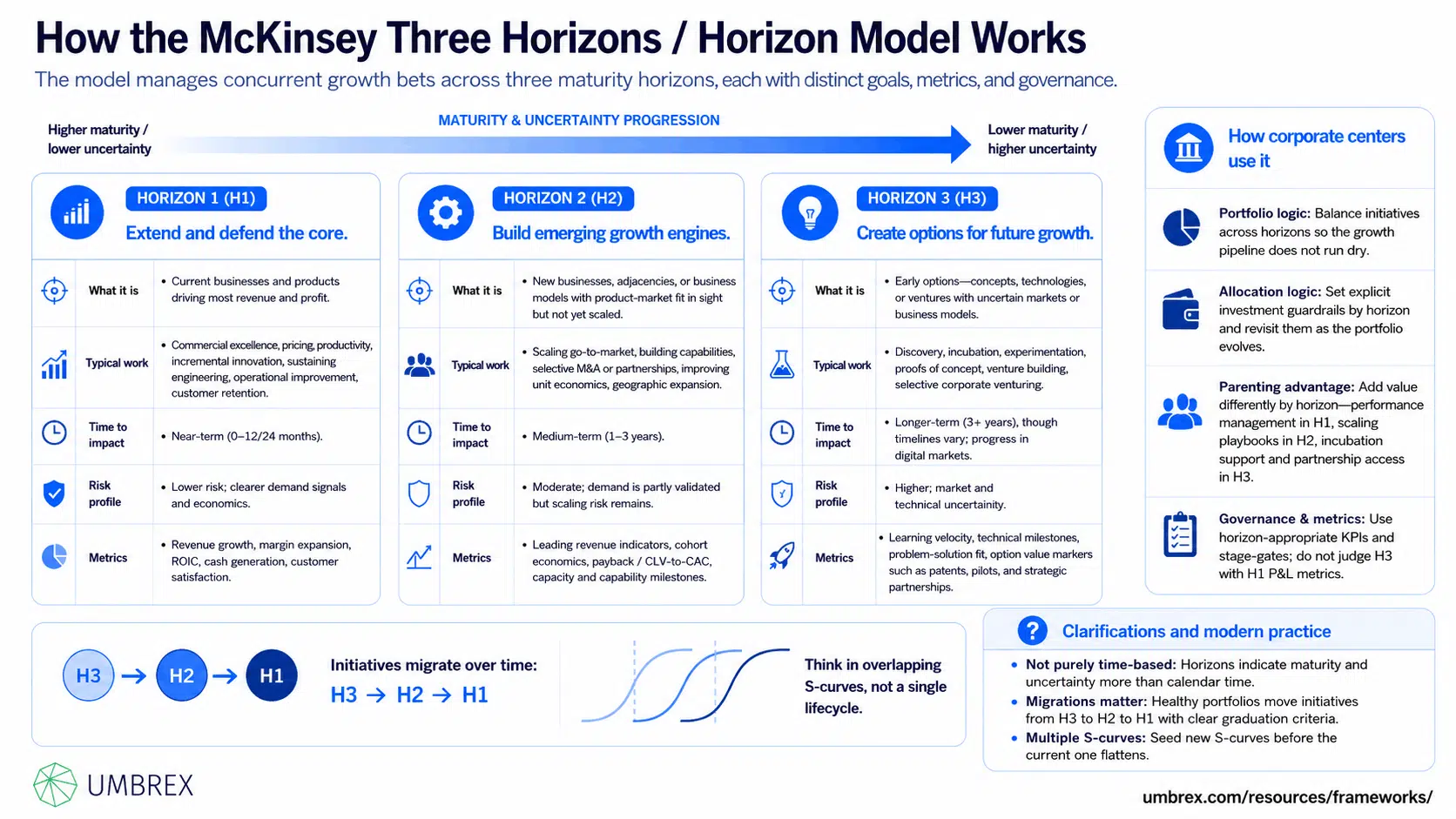
At its core, the model segments a company’s initiatives—not just businesses—by their maturity and the nature of work required. It is not a sequential “first H1, then H2, then H3” progression. In a healthy portfolio, all three horizons are active concurrently, governed differently, and funded deliberately.
The Three Horizons
- Horizon 1 (H1): Extend and defend the core.
- What it is: The current businesses and products that drive the majority of revenue and profit.
- Typical work: Commercial excellence, pricing, productivity, incremental innovation, sustaining engineering, operational improvements, customer retention.
- Time to impact: Near-term (0–12/24 months).
- Risk profile: Lower risk; clearer demand signals and economics.
- Metrics: Revenue growth, margin expansion, ROIC, cash generation, customer satisfaction.
- Horizon 2 (H2): Build emerging growth engines.
- What it is: New businesses, adjacencies, or business models that have product–market fit in sight but are not yet scaled.
- Typical work: Scaling go-to-market, building capabilities, selective M&A or partnerships, unit economics improvement, geographic expansion.
- Time to impact: Medium-term (1–3 years).
- Risk profile: Moderate; validated demand but execution and scaling risks remain.
- Metrics: Leading revenue indicators, cohort economics, payback/CLV-to-CAC, capacity and capability milestones.
- Horizon 3 (H3): Create options for future growth.
- What it is: Early options—concepts, technologies, or ventures with uncertain markets or business models.
- Typical work: Discovery, incubation, experimentation, proofs of concept, venture building, selective corporate venturing.
- Time to impact: Longer-term (3+ years), though in digital markets timelines can compress.
- Risk profile: Higher; market and technical uncertainty.
- Metrics: Learning velocity, technical milestones, problem–solution fit, option value markers (e.g., patents, pilots, strategic partnerships).
How Corporate Centers Use It
- Portfolio logic: Ensure a balanced set of initiatives across horizons so the company’s growth pipeline doesn’t “run dry.”
- Allocation logic: Set explicit investment guardrails per horizon (e.g., percent of growth capex/talent) and revisit them as the portfolio evolves.
- Parenting advantage: Define how the corporate center adds value differently in each horizon—performance management in H1, scaling playbooks in H2, and incubation support/partnership access in H3.
- Governance and metrics: Adopt horizon-appropriate KPIs and stage-gates. Avoid judging H3 options with H1 P&L metrics.
Clarifications and Modern Practice
- Not purely time-based: The horizons indicate maturity and uncertainty more than calendar time; in fast-moving sectors, H2/H3 can scale faster than the classic timelines suggest.
- Migrations matter: Healthy portfolios show initiatives migrating from H3 to H2 to H1 over time, with clear “graduation” criteria.
- Multiple S-curves: Think of overlapping S-curves rather than a single lifecycle. New S-curves must be seeded before the current one flattens.
4. When to Use the McKinsey Three Horizons / Horizon Model

Most helpful for:
- Diversified enterprises and corporate centers that must balance near-term performance with long-term renewal.
- Annual strategic planning and capital allocation cycles where leadership must set growth ambition and resource splits.
- Transformation programs that risk over-focusing on cost and H1 at the expense of future growth engines.
- Innovation and venture-building portfolios that need governance, stage-gates, and linkages to core capabilities.
- Investor communication to articulate a credible growth narrative with visible engines and future options.
Especially powerful when: a company has strong core cash flows but limited growth visibility; when the pipeline of H2/H3 initiatives is thin or unfocused; or when internal debates conflate scaling bets with exploratory options.
Not a good fit or can mislead when: used as a labeling exercise without hard resource choices; applied dogmatically as calendar-based boxes; or when leadership uses H1 metrics to “kill” H3 options prematurely. It can also underplay ecosystem and platform dynamics unless criteria are adapted to reflect network effects and partnerships.
How its use has evolved: Modern practitioners treat the horizons as governance and funding modes rather than rigid timelines, incorporate agile experimentation in H3, and use option-thinking for stage-gated funding. The model is frequently combined with portfolio risk/return tools and corporate venture capital practices.
5. How to Apply the McKinsey Three Horizons / Horizon Model: Step-by-Step

- Clarify ambition, scope, and constraints.
Define the growth ambition (e.g., +300 bps revenue CAGR, +200 bps ROIC over three years) and the scope (enterprise-wide, a business unit, or a region). Set constraints such as leverage limits, R&D envelope, or talent bandwidth. Align on decision rights between corporate center and business units.
- Define crisp horizon criteria for your context.
Create working definitions for H1/H2/H3 that reflect your business. For example: H1 = core products with >80% of current revenue; H2 = adjacencies with demonstrated product–market fit and positive unit economics; H3 = early options with unresolved market or technical risk. Document “graduation” thresholds (e.g., H3→H2 when recurring revenue exceeds a milestone and churn falls below X%).
- Inventory initiatives and businesses.
List all material initiatives: core improvement programs, adjacencies, ventures, partnerships, and M&A theses. Capture basics (owner, budget, KPIs, dependency on shared capabilities) and current stage. Avoid mixing vague ideas with funded initiatives—use a simple stage taxonomy (idea, experiment, pilot, scale).
- Classify into horizons with evidence.
Assign each initiative to a horizon using the agreed criteria. Where classification is ambiguous, note the uncertainty and what evidence would resolve it (e.g., pilot results, regulatory clarity). Keep a small “watchlist” for potential promotions or demotions.
- Estimate impact, timing, and risk.
For H1, quantify EBITDA and cash uplift by lever. For H2, build a scale-up model: TAM, adoption curve, unit economics, capacity requirements. For H3, use option-value thinking: milestone-based probability trees or discovery metrics (e.g., problem validation complete, technical risk retired to level X).
- Set horizon-specific funding guardrails.
Decide top-down resource envelopes by horizon (e.g., 70/20/10 for H1/H2/H3 as a starting point; adjust by industry). Specify what “funding” means (opex, capex, R&D, leadership attention) and the cadence of releases (e.g., quarterly tranches for H3 tied to learning goals).
- Design governance and metrics per horizon.
H1: standard performance reviews, ROIC thresholds, productivity KPIs. H2: scale-up councils focused on customer acquisition, retention, and unit economics. H3: venture boards emphasizing hypotheses, experiments, and milestone-based funding. Ensure metrics fit the maturity; don’t apply H1 hurdle rates to H3 discovery.
- Define the corporate center’s parenting role.
Articulate how the parent will add value in each horizon. Examples: negotiating cross-business partnerships for H2, providing a shared data platform, granting brand access for H2 pilots, or offering legal/regulatory support for H3 experiments. Where parenting value is weak or negative, grant autonomy or partner externally.
- Allocate capital and talent deliberately.
Translate envelopes into concrete allocations: which H1 programs get funded; which H2 engines receive the next capacity tranche; which H3 options get incubated. Assign A-team leaders to the few initiatives that matter most. Ensure you are not starving H2/H3 by allowing “creep” in H1 budgets.
- Build migration paths and exit criteria.
For each H2/H3 initiative, define the pathway to scale (capability builds, partnerships, regulatory milestones) and time-bound exit criteria if milestones are missed. Celebrate “smart kills” to recycle capital and talent into better options.
- Communicate the growth portfolio.
Prepare a simple storyline for internal and external stakeholders: today’s engines (H1), tomorrow’s engines (H2), and the option pipeline (H3). Tie this to financial guidance and investor messaging, making assumptions and timing explicit.
- Monitor, learn, and rebalance on a cadence.
Review the horizon portfolio quarterly. Promote, demote, or exit based on evidence. Rebalance resources as initiatives migrate and as macro conditions change. Track concentration risk and capability bottlenecks across the portfolio.
6. Example: The Three Horizons in Action
Context: A $1.2B industrial technology company with strong installed-base service revenues faces slowing growth in its core hardware. The board is pressing for a credible plan to reignite growth without jeopardizing near-term cash generation.
Applying the framework: The corporate center set a three-year ambition of returning to 6% organic growth and lifting ROIC by 150 bps. They agreed horizon definitions: H1 = core hardware and services; H2 = adjacent software-enabled services with proven pilots; H3 = nascent AI-driven products and a potential platform play with ecosystem partners. A portfolio inventory identified 42 initiatives, later narrowed to 18 material ones.
Classification and insights:
- H1: Six initiatives focused on pricing, service contract penetration, supply chain productivity, and a redesign-to-cost program. Estimated 250 bps margin improvement within 12–18 months.
- H2: Four growth engines—an IoT analytics subscription layered on the installed base, a remote diagnostics offering, a new aftermarket parts e-commerce channel, and a partnership-led move into an adjacent vertical. Each had positive early unit economics but needed scale.
- H3: Three options—an AI-based predictive maintenance model, a sensor-as-a-service concept, and a venture exploring a marketplace for third-party service providers. Technical and market uncertainty remained high.
Decisions:
- Set resource guardrails at 65% H1, 25% H2, 10% H3, with quarterly reviews. Protected H2/H3 budgets from being raided by H1 overruns.
- Assigned a seasoned GM to lead the IoT analytics H2 engine and committed to two capacity tranches over 12 months tied to cohort retention and sales productivity milestones.
- Funded H1 pricing and service penetration programs with a clear 9–12 month payback to generate cash for the H2 ramp.
- Kept two H3 options in incubation and killed one after failing to achieve problem–solution fit, redeploying the team to the e-commerce H2 initiative.
Outcomes (18 months): Core margin improved by 210 bps, funding growth investments. IoT analytics ARR reached $38M with 88% gross retention, graduating to H1 governance. The platform marketplace was deferred after ecosystem testing revealed insufficient supplier density. Investor communications highlighted two visible engines (services, IoT) and a disciplined H3 pipeline, supporting multiple expansion.
7. Strengths and Limitations
Strengths
- Sharpens trade-offs: Separates optimization from scaling from exploration so leaders stop judging dissimilar initiatives with the same yardstick.
- Common language: Provides a simple, memorable way to discuss the growth pipeline across the enterprise and with investors.
- Balances time horizons: Reduces the tendency to over-invest in the core while underfunding future options.
- Governance clarity: Encourages horizon-appropriate metrics, stage-gates, and parenting roles.
- Scalable and adaptable: Works for both multi-business enterprises and single-BU portfolios; can be tailored to industry dynamics.
Limitations
- Over-simplification risk: Three buckets can mask nuance in business model risk, capability gaps, or ecosystem dependencies.
- Misuse as time boxes: Treating horizons as fixed calendar periods leads to poor decisions in fast-moving markets.
- Metric mismatch: Applying H1 P&L metrics to H3 efforts can prematurely kill valuable options.
- Middle-horizon gap: Organizations often under-resource H2, creating a “valley of death” between promising pilots and scaled businesses.
- Not a strategy by itself: The model structures a conversation but does not substitute for sound market insight, economic modeling, or capability planning.
8. Common Pitfalls (and How to Avoid Them)
- Labeling without allocating. What goes wrong: initiatives are tagged as H1/H2/H3 but funding and talent remain unchanged. How to avoid: set explicit percentage guardrails and tie them to budget and headcount decisions.
- Judging H3 with H1 metrics. What goes wrong: early options are evaluated on near-term revenue and ROI, stifling exploration. How to avoid: use milestone-based learning metrics and option value thinking for H3; graduate to H2 metrics only after fit is demonstrated.
- Starving the middle. What goes wrong: H2 has promising traction but lacks scale-up resources, dying in the “valley of death.” How to avoid: pre-commit capacity tranches and appoint scale-experienced leaders to H2 engines.
- Fuzzy horizon definitions. What goes wrong: teams debate labels rather than evidence; initiatives ping-pong between horizons. How to avoid: publish crisp criteria and graduation thresholds; maintain a watchlist with next evidence required.
- Ignoring parenting advantage. What goes wrong: the corporate center either micromanages H3 or abandons H2 to sink or swim. How to avoid: define how the parent will add distinctive value per horizon (platforms, partnerships, brand, capital) and where it will step back.
- No exit discipline. What goes wrong: weak options linger, consuming attention. How to avoid: set exit criteria and celebrate smart kills to recycle resources.
- One-off exercise. What goes wrong: a single workshop produces a slide; behavior does not change. How to avoid: embed horizon reviews into quarterly governance and the annual plan; link to incentives.
- Underestimating capability shifts. What goes wrong: H2/H3 initiatives fail due to missing capabilities (e.g., product-led growth, data science). How to avoid: include capability roadmaps and make critical hires early.
9. How the Three Horizons Relates to Other Frameworks
- GE–McKinsey Nine‑Box: Use the nine‑box to assess industry attractiveness and competitive strength of existing and candidate businesses; use Three Horizons to balance near-, mid-, and long-term investments and tailor governance. Together they link “where to play” with “when and how to fund.”
- BCG Growth–Share Matrix: BCG classifies businesses by market growth and relative share; Three Horizons classifies initiatives by maturity and uncertainty. Use BCG for portfolio position diagnostics and Three Horizons for growth pipeline management.
- Ansoff Matrix / Adjacency Maps: Ansoff identifies growth vectors (market/product); Three Horizons ensures a balanced pipeline across time while you pursue those adjacencies.
- Real Options & Stage-Gate: H3 options benefit from option-value thinking and stage-gated funding. Apply real options to size and stage H3 bets; stage-gate structures the progression to H2.
- Ambidexterity (explore/exploit): Organizational ambidexterity theory underpins Three Horizons. Use it to design structures that separate yet connect exploration (H3) and exploitation (H1), with H2 as the bridge.
- Balanced Scorecard / OKRs: Pair horizon-appropriate metrics with OKRs to ensure execution discipline within each horizon.
10. Key Takeaways
- The McKinsey Three Horizons is a simple, powerful way to balance today’s performance with tomorrow’s growth by classifying initiatives into H1 (core), H2 (emerging engines), and H3 (future options).
- It is best used by corporate centers and business leaders to set resource guardrails, governance, and parenting roles suited to each horizon.
- Treat horizons as maturity and uncertainty bands—not fixed time boxes—and design metrics and stage-gates accordingly.
- Success depends on disciplined allocation, clear graduation criteria, and protection of H2/H3 from H1’s gravitational pull.
- The model structures decisions but does not replace rigorous market insight, economic analysis, and capability building.
11. FAQs About the McKinsey Three Horizons / Horizon Model
Is the Three Horizons model still relevant in fast-moving, digital markets?
Yes—provided you treat horizons as maturity and uncertainty bands rather than fixed timelines. In digital markets, H2/H3 cycles can compress; governance, metrics, and stage-gated funding become even more important.
How is Three Horizons different from the GE–McKinsey nine‑box?
The nine‑box compares businesses on industry attractiveness and competitive strength to guide where to invest. Three Horizons balances time horizons and tailors governance and funding across maturity stages. Use them together: nine‑box for portfolio position; Three Horizons for investment timing and scaling.
What’s a good starting allocation across H1/H2/H3?
Many companies start around 70/20/10 (H1/H2/H3) as a heuristic, then adjust by industry, strategy, and pipeline quality. The right split is the one that meets your growth ambition while respecting risk and capability constraints.
Can small or early-stage companies use the model?
Yes. For startups and scale-ups, H1 might be the current product, H2 a new segment or channel with early traction, and H3 a bold product or platform concept. Keep it lightweight, emphasize learning milestones, and avoid over-bureaucratizing H3.
How do we measure success in H3 if there’s little revenue?
Use learning and de-risking metrics: validated customer problems, prototype performance, technical milestones, partner interest, and unit economics tests. Fund H3 in tranches tied to these milestones; promote to H2 when fit and repeatability appear.
How long does it take to implement Three Horizons in practice?
A first pass can be done in 2–4 weeks to inventory and classify initiatives and set guardrails. Embedding governance, migration paths, and incentives typically takes one or two planning cycles.
