

1. What Is the McKinsey 7S Framework?
The McKinsey 7S Framework is an organization design and operating‑model tool that helps leaders assess and align the seven key elements that determine organizational effectiveness. It posits that performance improves when these seven elements reinforce one another; mismatches among them create friction, confusion, and lost value.
The seven “S’s” are: Strategy, Structure, Systems, Skills, Staff, Style, and Shared Values. Three of these (Strategy, Structure, Systems) are often called the “hard” elements (tangible, formal), and four (Skills, Staff, Style, Shared Values) the “soft” elements (people and culture). The core idea is that changing one S requires considering all the others to maintain alignment.
This framework is widely used by consultants and executives to diagnose organizational issues, guide operating‑model redesigns, support post‑merger integrations, and drive transformation programs. It provides a common language for discussing how the organization really works—beyond boxes and lines on an org chart.
2. Origin and Background
The 7S Framework was created at McKinsey & Company in the late 1970s by a group of consultants including Thomas J. Peters, Robert H. Waterman Jr., and Julien R. Phillips, with related contributions from Richard T. Pascale and Anthony G. Athos. It was popularized through the McKinsey Quarterly article “Structure Is Not Organization” (1980) and the best‑selling book “In Search of Excellence” (1982) by Peters and Waterman.
It was developed to address a recurring problem: organizations trying to improve performance by changing structure alone. The 7S model argued that structure is only one piece of the operating model; leaders must align multiple, mutually reinforcing elements to achieve sustainable results. The framework spread rapidly via consulting practice, business schools, and management literature, becoming one of the most recognized organization design tools.
3. How the McKinsey 7S Framework Works
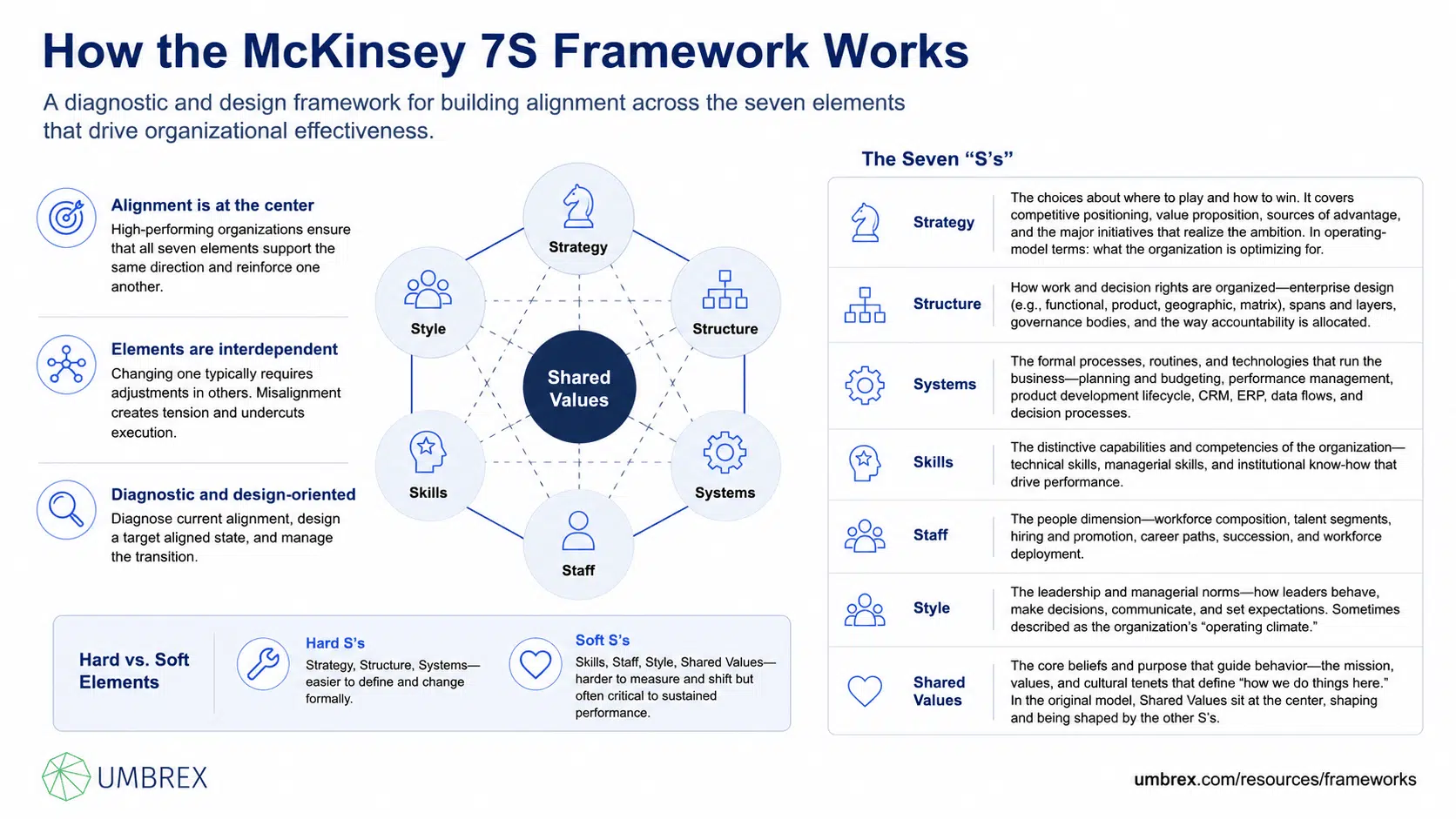
At the center of the 7S Framework is alignment. High‑performing organizations ensure that all seven elements support the same direction and reinforce one another. Misalignment—say, a bold digital strategy with legacy systems, or customer‑centric values with product‑centric metrics—creates tension and undercuts execution.
The seven elements are interdependent. Changing one typically requires adjustments in others. For example, moving to a product‑led growth strategy (Strategy) often calls for a product‑centric organization (Structure), new product analytics and release cadences (Systems), different capabilities (Skills), revised career paths (Staff), a more experiment‑friendly leadership approach (Style), and a renewed articulation of what the company stands for (Shared Values).
The Seven “S’s”
- Strategy: The choices about where to play and how to win. It covers competitive positioning, value proposition, sources of advantage, and the major initiatives that realize the ambition. In operating‑model terms: what the organization is optimizing for.
- Structure: How work and decision rights are organized—enterprise design (e.g., functional, product, geographic, matrix), spans and layers, governance bodies, and the way accountability is allocated.
- Systems: The formal processes, routines, and technologies that run the business—planning and budgeting, performance management, product development lifecycle, CRM, ERP, data flows, and decision processes.
- Skills: The distinctive capabilities and competencies of the organization—technical skills, managerial skills, and institutional know‑how that drive performance.
- Staff: The people dimension—workforce composition, talent segments, hiring and promotion, career paths, succession, and workforce deployment.
- Style: The leadership and managerial norms—how leaders behave, make decisions, communicate, and set expectations. Sometimes described as the organization’s “operating climate.”
- Shared Values: The core beliefs and purpose that guide behavior—the mission, values, and cultural tenets that define “how we do things here.” In the original model, Shared Values sit at the center, shaping and being shaped by the other S’s.
Hard vs. Soft Elements
- Hard S’s: Strategy, Structure, Systems—easier to define and change formally.
- Soft S’s: Skills, Staff, Style, Shared Values—harder to measure and shift but often critical to sustained performance.
The framework is diagnostic and design‑oriented: diagnose current alignment, design a target aligned state, and manage the transition.
4. When to Use the McKinsey 7S Framework

The 7S model is most helpful when you need to see the organization holistically and ensure coherence across strategy, operating model, and culture. Typical situations include:
- Enterprise transformations: Digital transformations, operating‑model redesigns, and cross‑functional performance turnarounds.
- Post‑merger integration: Aligning the combined entity’s strategy, structure, processes, and culture to realize synergies.
- Strategic pivots: Moving from product to platform, services to solutions, or transactional to subscription models.
- Rapid growth or scaling: Ensuring systems, talent, and leadership norms keep up with expansion across geographies and products.
- Persistent execution gaps: When strategy seems right but results lag, or when different parts of the organization work at cross‑purposes.
Especially powerful when: multiple change levers must be coordinated; culture and capabilities are as important as structure; and leaders need a common language to align on priorities.
Not a good fit when: you need fine‑grained process optimization (lean techniques work better), highly technical organizational network analysis (use ONA), or a purely financial portfolio decision (use portfolio/valuation tools). The 7S model is a thinking aid, not a substitute for rigorous analytics within each domain.
How practice has evolved: Today’s use is more data‑driven. Practitioners pair 7S with metrics (e.g., decision latency, time‑to‑market, engagement scores), advanced org diagnostics, and agile ways of working. The core insight—alignment across hard and soft elements—remains highly relevant.
5. How to Apply the McKinsey 7S Framework: Step‑by‑Step

- Clarify the objective and scope.Define the problem you are solving (e.g., accelerate growth in X, integrate acquisition Y, reduce cost to serve by Z%). Specify scope (enterprise, business unit, function) and time horizon. Agree on what “good” looks like: outcomes, constraints, and decision rights for the effort.
- Map the current state across all seven S’s.Create a succinct description of the status quo for each S:
Strategy (choices and priorities), Structure (org design and governance), Systems (key processes and IT), Skills (critical capabilities and depth), Staff (talent segments and pipeline), Style (leadership norms), Shared Values (purpose and behaviors).Use existing artifacts (org charts, strategy docs, process maps), plus targeted interviews with executives and frontline leaders to capture reality versus rhetoric.
- Collect evidence and metrics.Support the map with quantitative and qualitative data:
decision cycle times, spans/layers, R&D throughput, sales productivity, NPS, employee engagement, regretted attrition, capability assessments, customer/partner feedback, and cultural diagnostics. The goal is to move beyond opinions. - Assess alignment and maturity.For each S, rate effectiveness (e.g., 1–5) and, crucially, assess alignment with the others. Look for contradictions—e.g., a “customer‑obsessed” value set with KPIs tied to internal utilization; a platform strategy but siloed tech architecture.
- Identify the critical misalignments and root causes.Not every gap matters equally. Distill to the few misalignments that most impede performance. Use root‑cause techniques (5 Whys, issue trees) to sort symptoms from causes. For example, slow product launches may stem less from structure and more from decision rights and incentives (Systems/Style).
- Define the target 7S blueprint.Articulate the desired future state for each S, anchored in strategy and outcomes. Ensure coherence: if Strategy calls for speed, then Structure should push authority to the edge; Systems should enable rapid, data‑rich decisions; Style should normalize experimentation; Skills/Staff plans should build product and data capabilities; Shared Values should emphasize customer outcomes and learning.
- Sequence initiatives and design the path.Translate the blueprint into a sequenced portfolio of initiatives with owners, timelines, and dependencies. Balance “no‑regrets” quick wins (e.g., clarify decision rights) with foundational moves (e.g., tech platform modernization). Use an impact‑versus‑feasibility lens to prioritize.
- Define decision rights, measures, and governance.Make decision accountabilities explicit (e.g., RACI or RAPID). Set leading and lagging KPIs for each S (e.g., time‑to‑decision, cross‑sell rate, speed of hire, capability proficiency). Establish a transformation governance cadence to track progress and clear roadblocks.
- Engage leaders and anchor Shared Values.Use leadership role‑modeling and communication to reinforce the cultural elements. Update symbols and rituals (e.g., what gets celebrated, how performance reviews work) to align with the new operating model. Style and Shared Values will not shift without visible leadership behavior change.
- Pilot, learn, and iterate.Pilot the target design in one unit or market, measure outcomes, gather feedback, and refine. Scale with a change platform—playbooks, communities of practice, enablement. Reassess alignment periodically; the 7S model is a living system, not a one‑time design.
6. Example: The 7S Framework in Action
Company: A $1.5B global industrial equipment manufacturer shifting to a services‑and‑digital solutions model.
Problem: Management set a strategy to grow recurring services revenue from 20% to 40% over three years. After 12 months, progress lagged: slow service product launches, low attach rates, and inconsistent customer experience across regions.
Applying 7S:
- Strategy: Clarified the services growth thesis by segment (installed base, new equipment buyers), defined value propositions, and set three breakthrough initiatives (predictive maintenance, remote monitoring subscriptions, and outcome‑based contracts).
- Structure: Shifted from purely product/geography matrix to a “solutions business” with P&L accountability, supported by regional delivery hubs. Created a cross‑functional Services Council for prioritization and standards.
- Systems: Introduced a global offer lifecycle process (stage gates, pricing guardrails), unified CRM/field‑service platform, and telemetry data pipeline feeding product/CSM teams. Updated incentive system to reward attach and renewal.
- Skills: Built capabilities in solution design, data science, and success management. Launched an academy for service sales and technical enablement.
- Staff: Rebalanced talent—hired CSMs and IoT architects; redeployed experienced field engineers into customer advisory roles; created new career paths in services.
- Style: Leaders committed to monthly “customer outcome reviews,” shortened approval cycles, and encouraged controlled experimentation in two pilot regions.
- Shared Values: Refreshed values emphasizing “customer outcomes over product shipments” and “learn fast.” Embedded stories and rituals celebrating renewals and uptime improvements.
Insights: The root cause was not only sales focus on equipment (Structure/Systems) but also misaligned incentives and leadership norms that prioritized quarterly shipments (Style) over lifetime value. Cultural signals and decision cadence were out of step with the strategy.
Results: Within nine months, pilot regions increased service attach by 12 points and reduced offer cycle time by 35%. The company scaled the operating model globally, reaching 33% services revenue by year two and improving NPS by 10 points.
7. Strengths and Limitations
Strengths
- Holistic alignment: Forces a comprehensive view that goes beyond structure to include culture, capabilities, and leadership.
- Common language: Creates a simple, memorable vocabulary executives can use to align on priorities.
- Design and diagnosis: Equally useful for understanding current issues and designing a target operating model.
- Change catalyst: Highlights interdependencies, making it easier to build integrated change portfolios rather than isolated fixes.
Limitations
- Static snapshot risk: The model captures a point in time; without iteration it can underplay dynamics and learning loops.
- Level of abstraction: High‑level categories require complementary tools for depth (e.g., detailed process mapping, org network analysis, tech architecture).
- Subjectivity: Without data, assessments can reflect opinion or bias. Quantification and external benchmarks are necessary.
- No built‑in prioritization: The framework surfaces misalignments but does not prescribe the optimal sequence or investment cadence.
8. Common Pitfalls (and How to Avoid Them)
- Focusing only on Structure.What goes wrong: Teams redraw org charts and expect performance to change.
How to avoid: Treat Structure as one lever in a coordinated design; pair any structural change with decisions on Systems, Style, and incentives.
- Vague or aspirational Shared Values.What goes wrong: Values are slogans disconnected from behaviors and decisions.
How to avoid: Translate values into concrete leadership behaviors, decision criteria, and rituals. Measure and role‑model them.
- Underestimating Systems.What goes wrong: Strategy calls for speed, but processes and tech create drag.
How to avoid: Redesign critical processes and upgrade enabling technology in parallel with structural changes.
- Ignoring decision rights.What goes wrong: Ambiguity persists; decisions are slow or relitigated.
How to avoid: Make decision accountabilities explicit (RACI/RAPID), and align performance management accordingly.
- Not quantifying capabilities (Skills).What goes wrong: Leaders assume skills exist, then stumble in execution.
How to avoid: Assess capability depth with rubrics and proficiency data; invest in build/buy/partner plans tied to strategy.
- One‑and‑done assessment.What goes wrong: The 7S is done once and filed away; drift returns.
How to avoid: Reassess alignment quarterly during transformation and after major moves (e.g., acquisitions).
- Misdefining scope.What goes wrong: Trying to redesign the entire enterprise when only a business unit needs change—or vice versa.
How to avoid: Be explicit about the unit of analysis. Align stakeholders on where the 7S effort applies.
- Over‑engineering the model.What goes wrong: Teams create exhaustive 7S catalogs but lose the thread.
How to avoid: Keep it outcome‑focused; identify the few critical misalignments that move performance.
9. How the 7S Framework Relates to Other Frameworks
- Galbraith Star Model: Another operating‑model framework (Strategy, Structure, Processes, Rewards, People). Overlap is strong. 7S emphasizes culture and leadership (Style, Shared Values) and explicitly calls out Systems. Many practitioners use both: Star for detailed design choices, 7S for holistic alignment and culture.
- Porter’s Five Forces and growth strategy tools: Use industry/market frameworks to set Strategy, then 7S to align the organization to execute it.
- Decision rights and operating mechanisms (RACI, RAPID): These sit within the Systems element and provide the granularity 7S does not.
- Spans and Layers analysis: Complements the Structure element by quantifying organizational efficiency and managerial load.
- Balanced Scorecard and OKRs: Useful within Systems to translate strategy into measures and priorities; they reinforce alignment when integrated across S’s.
- Kotter’s 8‑Step Change Model or ADKAR: These change frameworks complement 7S by guiding how to mobilize people to adopt the new operating model, particularly across Style, Staff, and Shared Values.
- Agile and product‑operating models: Agile practices provide practical patterns within Systems/Structure/Style (e.g., cross‑functional teams, cadences) that can instantiate a 7S‑aligned design.
Choosing among them: Use 7S when you need a top‑down, integrative view of alignment. Use more specialized frameworks to deep‑dive into specific elements. They are complementary, not mutually exclusive.
10. Key Takeaways
- The McKinsey 7S Framework is a holistic organization design and operating‑model tool that aligns seven elements—Strategy, Structure, Systems, Skills, Staff, Style, and Shared Values.
- Its power lies in surfacing and correcting misalignments across hard and soft levers, not in optimizing any single lever in isolation.
- Use it for transformations, post‑merger integration, strategic pivots, and chronic execution gaps—situations where coordinated change is essential.
- Pair 7S with data, diagnostics, and complementary tools (e.g., decision rights, spans/layers, OKRs) to move from concept to actionable design.
- Its biggest risk is treating it as a one‑time checklist or focusing only on Structure; sustained leadership role‑modeling and system changes are required.
11. FAQs About the McKinsey 7S Framework
Is the 7S Framework still relevant today?
Yes. While developed decades ago, its core insight—alignment across strategy, operating mechanisms, talent, and culture—is timeless. Modern practice augments 7S with data (e.g., decision latency, engagement analytics), agile delivery, and digital operating‑model principles.
What’s the difference between the 7S Framework and the Galbraith Star Model?
Both are organization design frameworks. 7S emphasizes culture and leadership (Style, Shared Values) alongside hard elements, making it a powerful diagnostic for alignment. The Star Model provides more explicit levers for process, rewards, and people systems. Many teams use 7S for holistic assessment and Star for detailed design choices.
Can small or early‑stage companies use 7S?
Absolutely. For startups and SMBs, 7S helps ensure that rapid growth doesn’t outpace systems, roles, and culture. The application should be lighter‑weight: short workshops, quick diagnostics, and pragmatic action lists rather than large‑scale programs.
How long does a typical 7S effort take?
A focused diagnostic can be completed in 3–6 weeks for a business unit. An enterprise‑wide redesign and implementation typically runs 3–9 months for design and pilots, followed by staged rollout. Complexity, data availability, and change readiness drive variance.
Which “S” is most important?
None in isolation. Shared Values often sit at the center because they shape behavior, but performance depends on alignment among all seven elements. The most important S is the one that is most misaligned with your strategy and outcomes—and that becomes the priority to address.
