

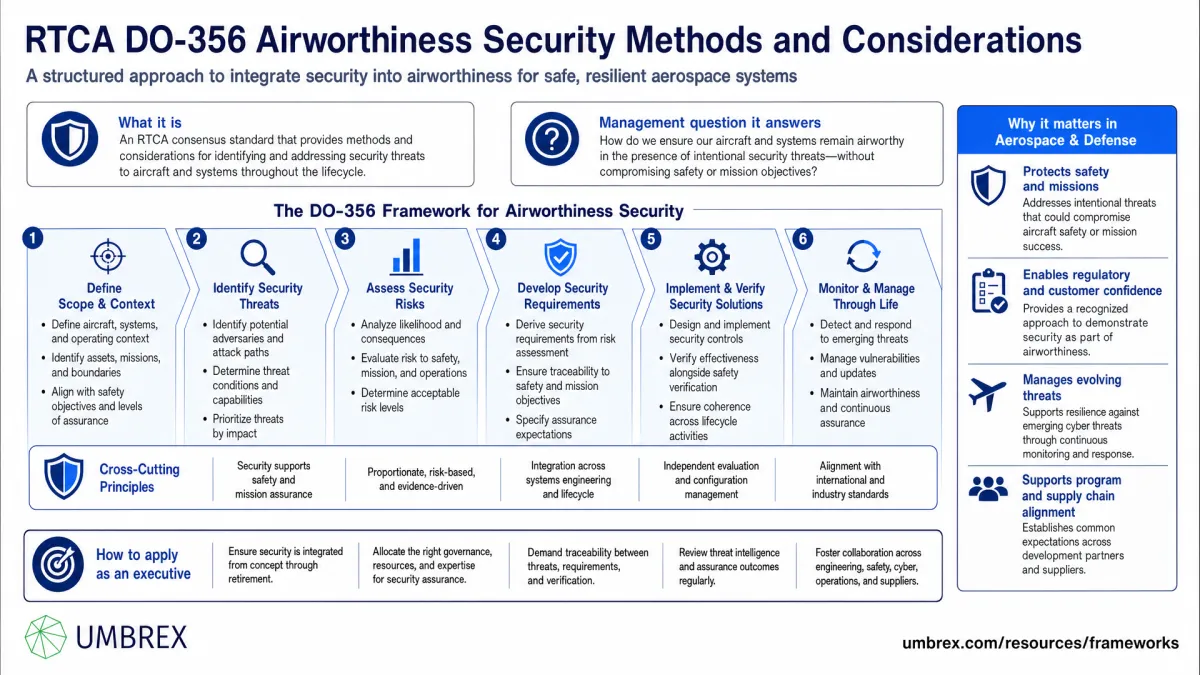
1. What Is RTCA DO-356 Airworthiness Security Methods and Considerations?
RTCA DO-356, Airworthiness Security Methods and Considerations, is technical guidance for evaluating information-security threats that could affect aircraft safety. It is an engineering assurance tool, not a conventional management matrix or an enterprise cybersecurity checklist. Its revised edition, DO-356A, provides methods supporting the airworthiness security process described in DO-326A.
For commercial aerospace manufacturers, the central question is whether aircraft connectivity, electronic interfaces, and supporting maintenance arrangements create unacceptable safety-related security risks. Executives should use the analysis to identify necessary design changes, supplier obligations, and assurance evidence—not simply to count vulnerabilities.
2. Origin and Background
RTCA, historically the Radio Technical Commission for Aeronautics, issued the original DO-356 on September 23, 2014, through Special Committee 216. DO-356A was issued on June 21, 2018, following joint development with EUROCAE Working Group 72. Its European counterpart is ED-203A. “DO-356” is a publication identifier rather than an acronym-based management model.
The guidance addressed security challenges associated with increasingly integrated aircraft electronics and networks. The original document explicitly focused on Part 25 transport-category airplanes with approved passenger seating configurations exceeding 19 seats. This scope matters: original DO-356 and revised DO-356A should not be treated as interchangeable contractual references. The application discussion below uses DO-356A; teams should confirm the edition and applicability accepted for their program.
3. How RTCA DO-356 Airworthiness Security Methods and Considerations Works
The core logic connects deliberate electronic interference to aircraft-level consequences. Teams identify what must be protected, how an attacker could affect it, what safety consequences could follow, and whether protective measures make the resulting risk acceptable. Security risk therefore depends on both the severity of the consequence and the assessed level of threat—not merely a vulnerability’s technical severity.
The following table is an executive summary of the technical concepts, not a substitute for the standard’s detailed methods and objectives.
| Technical concept | Aircraft interpretation | Useful output |
|---|---|---|
| Security scope | Define installed functions, protected assets, interfaces, and relevant external dependencies. | Architecture and boundary description. |
| Threat conditions | Identify security-related effects that could produce adverse aircraft safety consequences. | Conditions linked to safety-effect classifications. |
| Threat scenarios | Describe plausible routes from attacker access through affected systems to a threat condition. | Traceable scenarios and attack paths. |
| Security risk assessment | Evaluate consequence severity and level of threat, considering existing protection. | Risk judgments with supporting assumptions. |
| Security measures and assurance | Select protection and determine the confidence needed in its development and effectiveness. | Requirements and applicable assurance objectives. |
| Security verification | Evaluate protection through analysis, inspections, reviews, and security-oriented testing. | Evidence supporting residual-risk conclusions. |
DO-356A includes the concept of a Security Assurance Level (SAL), which informs assurance objectives. An assurance level is not a percentage security score or proof that every attack is impossible. Keep the assessment of risk separate from the evidence demonstrating confidence in protective measures.
For suppliers serving avionics and uncrewed systems, the recommended unit of analysis is the intended installation and its interfaces. Avoid labeling a component “secure” without specifying aircraft architecture, configuration, operating conditions, and external assumptions.
4. When to Use RTCA DO-356 Airworthiness Security Methods and Considerations
Consider these methods when evaluating a new aircraft architecture, connectivity installation, maintenance interface, software-loading arrangement, or modification that changes security exposure. EASA’s AMC 20-42 recognizes the relevant RTCA/EUROCAE guidance as an acceptable, but not exclusive, means of compliance for applicable certification activities.
A useful assessment requires architecture diagrams, interface definitions, configuration information, safety assessments, security requirements, supplier evidence, and operating assumptions. Assemble systems engineering, safety, product security, certification, maintenance, and supplier representatives. Plan effort around interface complexity and evidence availability rather than assuming one workshop can complete an assurance program.
The approach is especially powerful when connectivity decisions remain open and teams can change the architecture. It becomes misleading when boundaries are incomplete, supplier claims are accepted without evidence, or assumed maintenance controls do not match actual operations.
For defense aircraft, agree applicability and tailoring with the responsible military airworthiness authority. Military airworthiness assessment has its own criteria and approval arrangements; civil guidance should not be assumed automatically sufficient. Aircraft safety assessment also does not replace analysis of mission effectiveness, classified-information protection, or broader enterprise security.
5. How to Apply RTCA DO-356 Airworthiness Security Methods and Considerations: Step-by-Step
Clarify the decision and approval basis. State whether the team is selecting an architecture, approving a modification, or closing assurance findings. Confirm the applicable document revision, aircraft variants, operating modes, program milestones, and authority expectations.
Gather engineering and operational inputs. Obtain network diagrams, interface-control documents, safety analyses, software-loading procedures, supplier assessments, and existing test results. Interview maintainers and operators to challenge assumptions about access and configuration practices.
Define the units and boundaries. Map aircraft functions, protected assets, connected equipment, and relevant ground interfaces. Identify where information crosses protection boundaries and who owns each interface. Separate variant-specific configurations rather than averaging them together.
Construct the assessment record. Link assets, threat conditions, scenarios, safety effects, existing measures, and risk judgments. Add references to requirements, verification evidence, assumptions, and responsible owners. Use an architecture map alongside the assessment register.
Challenge the risk conclusions. Have safety and security specialists review scenarios together. Examine shared dependencies and combinations of compromised systems. Document uncertainty; do not substitute random equipment-failure rates for judgments about deliberate attacks.
Translate findings into changes. Allocate security requirements to aircraft systems, suppliers, and supporting processes. Specify the assurance and verification work needed. Assign funding, accountable owners, acceptance criteria, and dependencies on certification milestones.
Test alternative assumptions. Revisit conclusions if maintenance equipment is compromised, connectivity expands, credentials are mishandled, or a supplier configuration changes. Identify which assumptions materially control the result and how their continued validity will be checked.
Align, verify, and iterate. Resolve disagreements with engineering, suppliers, operators, and the approval authority as appropriate. Complete verification, reassess residual risks, and establish change-review triggers. Retain traceability from each conclusion to its supporting evidence.
The chief engineer should turn the findings into a funded cybersecurity roadmap covering architecture changes, supplier deliverables, verification capacity, and in-service responsibilities. An unresolved assumption should have an owner and closure plan, not disappear into a presentation.
6. Example: RTCA DO-356 Airworthiness Security Methods and Considerations in Action
Fictional example: Asterion Aircraft is developing a regional transport airplane and wants to introduce a networked maintenance gateway. The proposed design promises faster troubleshooting, but the chief engineer needs evidence that it will not create unacceptable safety-related security exposure.
The team uses DO-356A methods to assess the gateway, software-loading interface, maintenance workstation, and connections to relevant onboard systems. Inputs include interface specifications, preliminary safety assessments, supplier protection claims, and planned maintenance procedures. The assessment explicitly assumes that external maintenance equipment might be compromised.
The analysis reveals that two apparently separate protective measures depend on the same maintenance credential. It also identifies a scenario in which unauthorized configuration data could persist after maintenance equipment is disconnected. The team therefore rejects “ground-only access” as a sufficient justification.
Asterion changes the access architecture, introduces additional aircraft-side validation, and requires suppliers to provide traceable verification evidence. It schedules controlled laboratory testing and reassessment before the release gate, while agreeing operating assumptions with the future operator. The assessment structures the decision; it does not itself constitute certification approval.
7. Strengths and Limitations
Strengths
- Safety-centered prioritization: It connects security threats to aircraft consequences rather than treating every technical finding as equally important.
- Traceable reasoning: It links scenarios, protective measures, assurance objectives, and verification evidence.
- Cross-disciplinary integration: It provides a structured connection between security engineering and airworthiness assessment.
These strengths make the guidance useful for structuring engineering decisions and assurance discussions, provided the assessment remains grounded in the actual installation.
Limitations
An assessment cannot compensate for missing architecture information or unsupported assumptions about external organizations. Threat exposure and protective effectiveness also require reconsideration as vulnerabilities, interfaces, and operating arrangements change. A completed assessment is not a permanent guarantee of security.
The document does not prescribe an organization’s structure or division of certification responsibilities. Executives must establish ownership, supplier coordination, and lifecycle governance separately.
Multi-supplier programs may need program management support to coordinate evidence delivery, test-rig access, and review gates. Technical judgments and approval decisions must remain with appropriately qualified and authorized personnel.
8. Common Pitfalls and How to Avoid Them
- Assessing equipment in isolation. A supplier assessment may omit aircraft-level interactions. Review the installed configuration and confirm that supplier assumptions hold at integration.
- Confusing vulnerability severity with safety risk. A technical score does not establish an aircraft consequence. Trace the finding through a credible scenario to the affected function.
- Over-crediting maintenance procedures. Written access controls may not reflect field practice. Validate responsibilities, equipment arrangements, and procedural feasibility with operators and maintainers.
- Treating testing as the entire argument. Passing selected tests does not establish completeness. Connect testing to requirements, scenarios, analysis, and unresolved assumptions.
- Closing findings without durable ownership. Supplier changes or new vulnerabilities can invalidate conclusions. Establish configuration-review triggers, evidence retention, and escalation responsibilities.
These precautions reflect the need to combine risk assessment, verification, external assumptions, and continuing oversight rather than rely on a single activity.
9. How RTCA DO-356 Airworthiness Security Methods and Considerations Relates to Other Frameworks
DO-326: Establish the process
The DO-326 process family establishes the airworthiness security objectives and lifecycle process; DO-356 supplies supporting technical methods. Begin by agreeing the process and applicable revision pairing, then select the methods needed to produce the required evidence. The two are complementary, not substitutes.
ARP4761 and ARP4761A: Connect to safety assessment
SAE’s ARP4761 family addresses aircraft-system safety assessment. Use the safety assessment alongside security analysis to understand the consequences of affected functions. Prefer the safety tool for structuring safety effects and the security methods for evaluating intentional electronic interference; neither should silently replace the other.
DO-355: Maintain the assumptions in service
DO-355A addresses information security in continuing airworthiness, including operation and maintenance. Plan this handoff before design approval so operators and maintainers can sustain the protection and assumptions supporting the original assessment.
10. Key Takeaways
- Use DO-356 methods within an agreed airworthiness security process, not as a standalone checklist.
- Analyze installed configurations and aircraft consequences, not components alone.
- Separate risk judgments from confidence in protective measures.
- Convert findings into funded design changes, supplier obligations, and verification work.
- Assign ownership for maintaining assumptions and reassessing changes throughout service.
11. FAQs About RTCA DO-356 Airworthiness Security Methods and Considerations
What is the difference between DO-356 and DO-356A?
DO-356 is the original September 2014 publication. DO-356A is the June 2018 revision developed jointly with EUROCAE. Confirm the edition referenced by the program’s contracts and agreed compliance approach; the suffix is not merely editorial.
Is DO-356A mandatory for every aerospace and defense program?
No. Applicability depends on the product, approval basis, and responsible authority. EASA recognizes the relevant guidance as an acceptable means of compliance, not the only means. Military programs require their own applicability and approval decisions.
Can penetration testing demonstrate compliance by itself?
No. Testing contributes evidence, but the assurance argument also needs appropriate scope, risk assessment, requirements, and supporting verification activities. EASA describes verification using a combination of analysis, security-oriented robustness testing, inspections, and reviews.
How should a smaller avionics supplier begin?
Start with one intended installation: document interfaces, protected functions, security assumptions, and available evidence. Agree with the aircraft integrator which assessments and assurance activities the supplier owns. Expand the analysis when installation conditions differ rather than assuming one assessment covers every customer configuration.
