

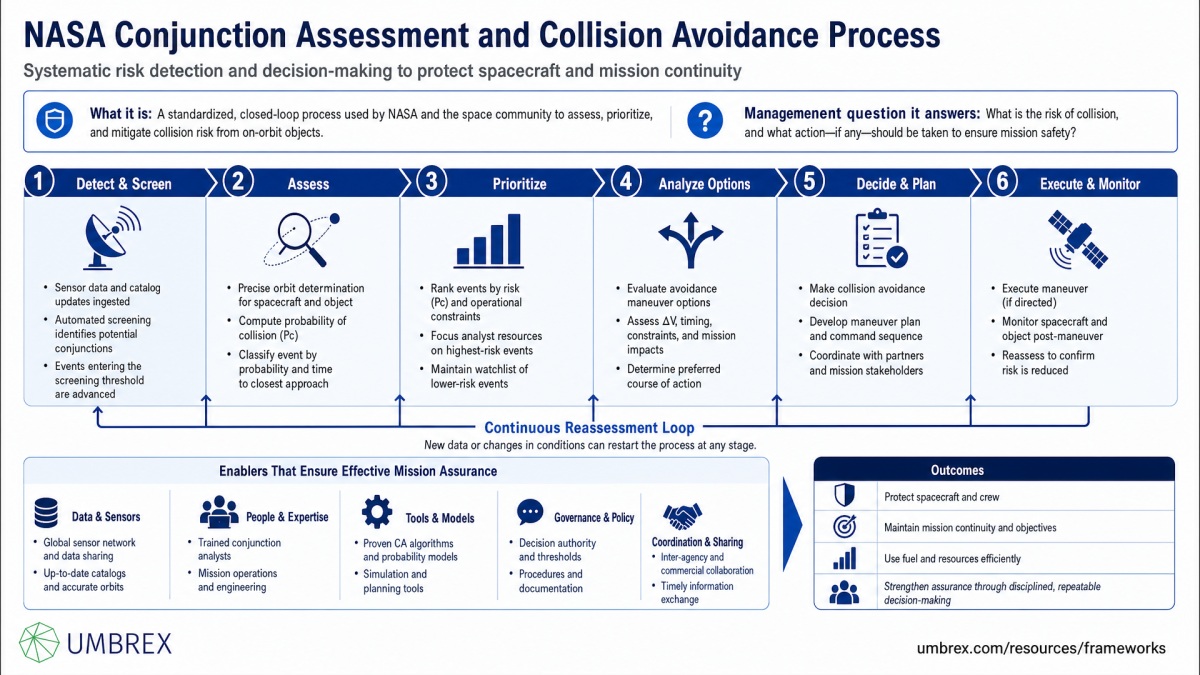
1. What Is NASA Conjunction Assessment and Collision Avoidance Process?
The NASA Conjunction Assessment and Collision Avoidance Process is an operational mission-assurance process for identifying close approaches between spacecraft and other space objects, assessing collision risk, and deciding whether and how to mitigate that risk. Its central logic is simple: predict the encounter, assess the threat, and manage the response. A conjunction warning is not, by itself, a maneuver instruction.
For organizations involved in space systems and satellite operations, it structures a consequential decision: whether to change a spacecraft’s trajectory while protecting mission objectives and the orbital environment. Consultants can help establish governance, workflows, and operating capabilities; qualified flight-dynamics specialists must provide the technical analysis.
2. Origin and Background
Origin: NASA operational practice, rather than a management model attributable to one individual. NASA Goddard Space Flight Center documented routine Conjunction Assessment Risk Analysis operations beginning in 2005. The original operational problem was assessing predicted close approaches and preparing avoidance actions when warranted.
NASA subsequently codified its experience in the 2020 Spacecraft Conjunction Assessment and Collision Avoidance Best Practices Handbook, revised in 2023 and updated through an August 2026 handbook edition. NASA Procedural Requirement 8079.1 became effective on June 27, 2023, establishing lifecycle requirements extending beyond individual encounters to mission planning, operations, and disposal. These NASA requirements and recommendations should not be confused with universally applicable commercial or defense-sector regulations.
3. How NASA Conjunction Assessment and Collision Avoidance Process Works
NASA distinguishes three operational stages. They form a recurring decision cycle, not a one-time assessment performed before launch.
Conjunction assessment: Identify potential encounters
Screen the protected spacecraft’s predicted trajectory against other known objects. The protected spacecraft is the primary object; the other spacecraft or debris object is the secondary object. Screening identifies encounters within specified search volumes and predicts the time of closest approach. It does not establish that a collision is likely.
Conjunction risk assessment: Establish whether the threat is actionable
Evaluate encounter geometry, trajectory uncertainty, object size, collision likelihood, and consequences. Probability of collision, or Pc, estimates the likelihood that the objects’ actual separation will fall within their combined collision size. Covariance describes uncertainty in estimated position and velocity. Analysts must determine whether the underlying information is sufficiently reliable for operational decisions.
Collision avoidance: Select and validate mitigation
Compare feasible responses, such as a propulsive maneuver, an appropriate attitude change, or coordinated action by another operator. Assess execution feasibility, mission disruption, and the resulting trajectory. The response must reduce the original threat without creating unacceptable new conjunctions.
NASA’s handbook recommends pursuing mitigation when Pc exceeds 0.0001, or one in 10,000, and also when predicted miss distance is smaller than the combined hard-body radius. For the recommended Pc threshold, its post-mitigation goal is approximately 0.0000032 or lower. These are operational reference points, not substitutes for approved mission-specific criteria, data-actionability checks, or additional human-spaceflight requirements.
CARA means Conjunction Assessment Risk Analysis and also identifies NASA’s specialist program. For executives, the management implication is to separate technical recommendations from authorized mission decisions. Structured decision-making support can clarify escalation rules and trade-offs without replacing flight authority.
4. When to Use NASA Conjunction Assessment and Collision Avoidance Process
Use the process throughout spacecraft operations, particularly when evaluating an approaching encounter, planning an orbit change, or establishing mission readiness. Before launch, apply its principles to trackability, orbit selection, maneuver capability, and ground-system design. Waiting until operations begin can leave the organization with risks that its spacecraft cannot readily mitigate.
For defense systems integrators, a useful application is defining the handover between spacecraft delivery and customer-operated flight control. Recommended acceptance criteria should cover trajectory-data production, alert routing, response authority, and demonstrated operational procedures—not merely functioning propulsion hardware.
The analysis requires predicted trajectories, uncertainty estimates, encounter updates, spacecraft dimensions, maneuver capabilities, and operational constraints. Flight dynamics, mission operations, spacecraft engineering, and mission assurance need to participate. Individual encounters evolve as tracking improves; organizational implementation takes longer because interfaces, tools, responsibilities, and rehearsals must be established.
The process is especially powerful when reliable data can arrive before the last feasible response opportunity. It cannot guarantee protection against untracked objects. Non-maneuverable spacecraft still benefit from assessment and coordination, but have fewer response options. Earth-orbit screening assumptions also require adaptation for non-Earth-orbiting missions.
5. How to Apply NASA Conjunction Assessment and Collision Avoidance Process: Step-by-Step
- Clarify the decision and scope.
Specify the spacecraft, orbital regime, mission phase, and prediction horizon. Distinguish establishing an operating capability from deciding how to handle a live encounter. Identify the authorized decision-maker and the latest feasible commitment time.
- Gather and validate inputs.
Collect predicted trajectories with covariance, planned maneuvers, conjunction updates, spacecraft size assumptions, and execution constraints. Check timestamps, units, reference frames, and versions. Standardized Conjunction Data Messages support information exchange, but their format alone does not establish data quality.
- Define the units of analysis.
Assess each primary–secondary encounter separately. Keep successive updates associated with that event. For a constellation, retain spacecraft-level decisions while reviewing fleet-wide staffing, coordination, and response-capacity implications.
- Build the decision artifact.
Create an event timeline and assessment record showing closest-approach time, miss distance, Pc trend, uncertainty quality, secondary-object status, feasible responses, and decision deadlines. Keep the underlying technical calculations accessible rather than reducing everything to a traffic-light dashboard.
- Interpret the evidence.
Ask whether changed risk reflects better tracking, a trajectory change, or revised assumptions. Request additional analysis where information is not actionable. Evaluate consequences alongside collision likelihood; do not rank encounters solely by miss distance.
- Develop and screen responses.
Compare feasible maneuver timings and alternatives against propulsion, pointing, communications, and mission constraints. Submit candidate trajectories for screening. When the secondary is maneuverable, coordinate responsibilities rather than independently assuming that the other operator will remain on its previous trajectory.
- Test sensitivities and contingencies.
Examine plausible uncertainty changes, maneuver-execution errors, delayed commands, and missing updates. Establish what evidence would reverse the recommendation. Preserve contingency options until their operational deadlines rather than waiting for perfect information.
- Approve, execute, verify, and learn.
Document the decision and rationale, including accepted residual risk. After action, update trajectory information, verify execution, and continue assessment. Rehearse difficult cases with the flight team and incorporate lessons into procedures.
A practical follow-on engagement is operational risk management: implementing alert ownership, data-quality controls, escalation procedures, and response exercises under the flight-operations leader. The deliverable should be an executable control system, not merely a risk register.
6. Example: NASA Conjunction Assessment and Collision Avoidance Process in Action
Fictional example: Meridian Orbital Services operates maneuverable imaging satellites serving government and commercial customers. One spacecraft receives repeated warnings about an encounter with a debris object. Operations must protect the satellite without unnecessarily sacrificing a scheduled collection campaign.
The team treats the spacecraft–debris encounter as the unit of analysis. It reviews conjunction updates, predicted trajectories, covariance quality, spacecraft dimensions, propulsion readiness, and available ground contacts. Illustratively, Pc rises from 0.00002 to 0.0002 as tracking improves. Meridian’s approved policy uses a 0.0001 mitigation threshold; these numbers are fictional, not industry benchmarks.
Flight dynamics develops two candidate maneuvers. One reduces the original risk but creates another threshold-exceeding encounter. The second achieves a predicted Pc of 0.000002 for the original event without introducing a threshold-exceeding event in the screened horizon.
The authorized operations manager selects the second option after engineering confirms execution feasibility. The team adjusts the collection schedule, commands the maneuver, verifies performance, and refreshes its predicted trajectory. The management insight is that the best response is not necessarily the smallest burn: it is the feasible action that satisfies safety criteria across the resulting trajectory.
7. Strengths and Limitations
Strengths
- Separates warnings from decisions: Screening, assessment, and mitigation have distinct purposes, helping teams avoid automatic responses to every alert.
- Makes uncertainty explicit: Trajectory uncertainty is part of the analysis rather than an informal caveat.
- Connects analysis with action: Candidate trajectories are checked before committing to mitigation.
Limitations
Results depend on tracking coverage, prediction quality, covariance realism, and appropriate calculation methods. A low calculated Pc is not proof of safety when the inputs are unreliable. The process also cannot provide maneuver capability, ground access, or decision authority that the mission lacks. Technical uncertainty and operational feasibility must therefore remain visible in the executive discussion.
8. Common Pitfalls and How to Avoid Them
- Using miss distance alone. Apparent separation does not capture trajectory uncertainty or collision size. Require a qualified risk assessment rather than a distance-only ranking.
- Equating missing data with low risk. Missing or unsuitable uncertainty information weakens the assessment. Escalate data deficiencies and distinguish “not actionable” from “safe.”
- Screening only the original encounter. An avoidance action can create another threat. Screen the proposed trajectory against the full catalog, not just a previously collected set of nearby-event messages.
- Leaving coordination until the deadline. Recommend establishing operator contacts, authorized information-sharing routes, and decision rights before live events demand them.
- Measuring success by fewer maneuvers. Recommend balancing mission disruption with residual risk, response readiness, and procedure compliance. A maneuver count alone is not a meaningful safety objective.
9. How NASA Conjunction Assessment and Collision Avoidance Process Relates to Other Frameworks
Before deployment: Failure Modes and Effects Analysis
Failure Modes and Effects Analysis, or FMEA, examines how component failures propagate through a system. Apply it to the conjunction-management capability itself: missed alerts, incorrect data transformations, or failed command generation. Fault Tree Analysis, or FTA, works backward from an undesirable outcome to contributing failures. These tools assess whether the response system can fail; they do not replace encounter-specific collision calculations.
Alongside planning: Risk-Informed Decision Making
NASA’s Risk-Informed Decision Making, or RIDM, structures alternatives around objectives, uncertainties, and performance commitments. Use it for broader choices such as maneuver capability, ground-system investment, or operating architecture. The conjunction process supplies encounter-specific evidence; RIDM helps evaluate larger design and management alternatives. Business trade-offs should not silently override approved orbital-safety criteria.
10. Key Takeaways
- Manage conjunctions through three distinct stages: prediction, risk assessment, and mitigation.
- Establish response capabilities during mission design, not after the first serious alert.
- Use qualified analysis and actionable data—not miss distance or dashboard color alone.
- Validate the resulting trajectory and preserve clear flight-decision accountability.
11. FAQs About NASA Conjunction Assessment and Collision Avoidance Process
Is the NASA process mandatory for every satellite operator?
No. NPR 8079.1 establishes NASA requirements with defined applicability. Other operators must determine their own applicable contractual, licensing, and organizational obligations. NASA’s handbook provides broader best-practice guidance; adopting it does not itself establish regulatory compliance.
Does every conjunction warning require a maneuver?
No. Screening identifies potential encounters. Risk assessment determines their significance, and the authorized mission decision considers feasible mitigation and operational constraints. Continued monitoring or additional tracking may be appropriate before a commitment deadline.
Can smaller satellite operators use this process?
Yes. A practical implementation can combine specialist screening and analysis services with a lean internal team. Retain named decision authority, reliable data interfaces, rehearsed escalation, and realistic response options; outsourcing analysis should not leave operational accountability ambiguous.
What data is essential to a useful assessment?
At minimum, analysts need encounter geometry, predicted trajectories and uncertainty, credible collision-size assumptions, and spacecraft maneuver status. Decision-makers also need execution constraints and response deadlines. Data must be current enough and sufficiently reliable to support action—not simply available in a standardized message.
