

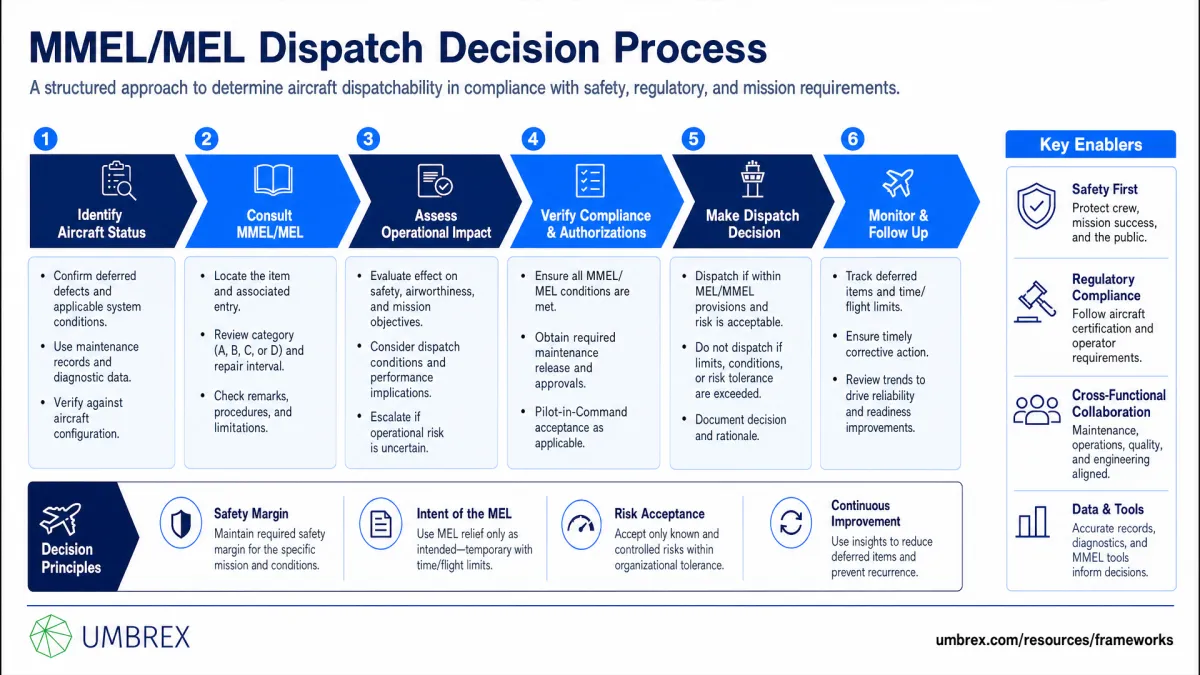
1. What Is MMEL/MEL Dispatch Decision Process?
The MMEL/MEL Dispatch Decision Process is a rules-based operational workflow for determining whether an aircraft with identified inoperative equipment may undertake a particular flight, subject to specified conditions. MMEL means Master Minimum Equipment List; MEL means Minimum Equipment List. It structures conditional dispatch eligibility, not a commercial trade-off between safety and punctuality.
For aerospace MRO leaders—where MRO means maintenance, repair, and overhaul—the management challenge is connecting defect assessment, operational restrictions, authorized decisions, and timely repair. Consultants can assess that control system, but they do not acquire dispatch authority. This article is management guidance, not an aircraft-specific release procedure.
2. Origin and Background
Origin: No single inventor or founding publication is verified for this named process. It represents an aviation regulatory workflow rather than a proprietary consulting framework. MMEL/MEL practice was documented in Federal Aviation Administration (FAA) guidance by June 28, 1991, when Advisory Circular 91-67 described methods for operating with certain inoperative equipment. That historical document is not the current operating reference.
The underlying purpose is controlled, temporary relief without abandoning the conditions necessary for safe operation. FAA Advisory Circular 120-125, issued November 1, 2023, addresses operator MEL development and management for specified civil operating regimes. Modern application should therefore connect the eligibility decision with governance and repair closure.
3. How MMEL/MEL Dispatch Decision Process Works
Two documents with different roles
- Master Minimum Equipment List: Establishes approved equipment relief at the aircraft type or model level.
- Minimum Equipment List: Translates that basis into an operator-specific document reflecting aircraft configuration, operating requirements, and procedures.
The operator’s MEL cannot simply broaden the MMEL’s relief. For the operations discussed here, the applicable approved MEL and operating authorization—not an isolated MMEL entry—govern the dispatch assessment.
The information that drives the decision
| Element | Meaning for the assessment |
|---|---|
| Item and applicability | Identify the affected equipment and applicable aircraft configuration. |
| Installed and required quantities | Determine whether the required remaining capability is available. |
| Remarks and exceptions | Identify operating restrictions, prerequisites, and compensating conditions. |
| Maintenance and operational procedures | Complete applicable procedures, commonly identified by “(M)” and “(O)” symbols. |
| Repair category | Establish the permitted rectification interval and its clock definition. |
These elements must be interpreted together, rather than reading the equipment name as permission to defer.
In the standard repair-category system, Category A uses the interval specified for the item; B, C, and D generally specify three, ten, and 120 consecutive calendar days, respectively, excluding the discovery day for B–D. The applicable MEL definitions control the actual deadline. Categories are time limits, not severity rankings.
A sequence of gates, not a score
A useful management synthesis is: confirm applicable relief; verify every condition and procedure; assess the intended flight and interacting defects; obtain the required authorized acceptance; and control repair. Individually acceptable deferrals may interact through shared systems, reduced redundancy, or crew workload. Passing one gate does not compensate for failing another.
4. When to Use MMEL/MEL Dispatch Decision Process
This discussion focuses on civil operations using an approved operator MEL, including relevant FAA Part 121 and Part 135 operations. Do not transfer that authority automatically to military aircraft. Military airworthiness and operating approvals require their own applicable framework; the United Kingdom, for example, has a dedicated Military Aviation Authority. Cross-jurisdiction fleets also need jurisdiction-specific approval baselines.
The process is particularly useful for reviewing maintenance-control handoffs, outstation support, contracted maintenance, and aircraft assignments with operational restrictions. For commercial aerospace OEMs, management applications include improving configuration information and technical-support interfaces that operators need to interpret approved relief.
Useful inputs include the technical log, configuration records, applicable MEL revision, open defects, intended route, weather, and available maintenance capabilities. An unresolved fault cannot be converted into a valid deferral merely by finding a similar description. The MEL is also not a substitute for approved in-flight abnormal or emergency procedures.
For process improvement, combine record sampling with scenario workshops. Where escalation debates recur, decision-making support can clarify mandatory gates and the scheduling choices that remain after those gates are satisfied.
5. How to Apply MMEL/MEL Dispatch Decision Process: Step-by-Step
The following sequence supports process design and executive review. Operational execution must follow the applicable approved documents and authorized personnel’s procedures.
- Clarify the decision and scope.
Define whether the team is assessing one proposed flight or redesigning fleet-wide controls. Specify aircraft types, registrations, operating jurisdiction, departure stations, and the repair-planning horizon. Keep civil dispatch eligibility separate from military mission-capability assessment.
- Gather controlled inputs.
Assemble the defect record, fault-identification evidence, aircraft configuration, applicable MEL, referenced procedures, and existing deferrals. Add flight-planning information and repair resources. Record document revisions and distinguish confirmed information from unresolved assumptions.
- Define the units of analysis.
Assess each defect against the relevant aircraft and intended flight. For a management diagnostic, examine individual deferral cases and handoffs—not fleet averages alone. A useful case record connects the defect, tail, flight, responsible roles, and closure evidence.
- Construct the decision artifact.
Build a decision tree with explicit stop and escalation points, supported by an evidence checklist. Link each gate to the governing document or procedure. This artifact supplements the approved MEL; it must not paraphrase away exceptions or become an unofficial replacement.
- Analyze eligibility and combined effects.
Verify applicability, remaining capability, restrictions, procedure completion, and the repair deadline. Review all open defects together. If the MEL pathway does not apply, escalate for repair or assessment of an independently authorized alternative; never extrapolate relief from another configuration.
- Translate the assessment into action.
Document the authorized disposition, flight restrictions, and required communications. Establish a repair owner and a feasible parts, personnel, and aircraft rendezvous. Treat extensions as an authorization-dependent exception, not the default solution to a missed repair plan.
- Test changing conditions.
Revisit the assessment when relevant circumstances change: destination weather, route, another defect, aircraft assignment, or maintenance availability. Scenario testing should change operational assumptions—not relax approved limits to preserve the preferred commercial answer.
- Align stakeholders and iterate.
Validate the workflow with maintenance engineering, maintenance control, operational-control personnel, flightcrew representatives, and compliance specialists. Rehearse ambiguous cases and shift handovers. Resolve authority questions explicitly; consensus cannot manufacture permission that the governing documents do not provide.
Persistent gaps in ownership or handoffs should trigger maintenance operating model work. The deliverable should connect deferral authority, technical escalation, repair planning, and closure verification—not merely produce another flowchart.
6. Example: MMEL/MEL Dispatch Decision Process in Action
Fictional scenario: Meridian Aero Services operates civil-certificated charter aircraft for defense contractors, with maintenance provided partly by an external MRO. A crew reports an autopilot fault before a contracted personnel-transport flight.
For illustration, assume the aircraft’s approved MEL permits the identified single-unit defect under conditions that restrict approach capability. This assumption is not dispatch guidance for any actual aircraft.
Maintenance personnel identify the affected unit and confirm configuration applicability. The assessment uses the aircraft registration, defect record, existing deferrals, proposed flight, destination forecast, and repair resources. The team finds that equipment relief exists, but the planned operation cannot satisfy the resulting approach restrictions.
Meridian assigns a serviceable replacement aircraft rather than interpreting conditional relief as unrestricted permission. It books the affected aircraft into a qualified maintenance window, assigns a repair owner, and coordinates the necessary replacement component.
The executive review then identifies a process weakness: commercial scheduling received “MEL eligible” messages without the associated operational restrictions. Meridian changes the handoff record so eligibility, restrictions, acceptance, and repair ownership remain distinct and visible.
7. Strengths and Limitations
Strengths
- Clear boundaries: Sequential gates discourage commercial urgency from replacing mandatory technical conditions.
- Traceability: An evidence-based workflow makes configuration, procedure completion, and authorized decisions easier to review.
- Cross-functional coordination: The process gives operators, technical-support teams, and maintenance providers a common case structure.
- Repair discipline: Connecting release assessment with closure planning prevents the management review from ending at departure.
Limitations
The MEL does not establish every aircraft’s fitness for every mission. Compliance with an entry still requires consideration of safe operation, other defects, and crew acceptance. Nor can MEL relief override an airworthiness directive requiring equipment to be operable unless that directive permits otherwise.
The process also cannot replace fault identification or create unavailable maintenance capability. For management purposes, distinguish lawful dispatch from mission suitability, customer commitments, and repair practicality. A legally eligible aircraft may still be the wrong operational assignment.
8. Common Pitfalls and How to Avoid Them
- Deferring the symptom: A cockpit indication may not identify the failed item sufficiently. Require appropriate fault identification before matching relief.
- Ignoring configuration: Similar aircraft may have different installed equipment or modifications. Verify applicability at registration level.
- Checking defects independently: Separate entries can conceal combined capability loss. Review interactions and additional-failure exposure.
- Treating procedures as checkboxes: Evidence must show that applicable maintenance and operational requirements were actually completed.
- Managing only departure performance: Add repair-plan feasibility, aging deferrals, repeat defects, and handoff completeness to management reviews. Avoid incentives that reward deferral volume without examining consequences.
9. How MMEL/MEL Dispatch Decision Process Relates to Other Frameworks
Failure analysis before eligibility assessment
Failure Modes and Effects Analysis (FMEA) examines failures from components upward; Fault Tree Analysis works backward from an undesirable event. They support understanding of failure consequences and dependencies. Use existing approved engineering knowledge before interpreting equipment relief; neither analysis independently authorizes dispatch.
BowTie analysis alongside the workflow
BowTie analysis adds a safety-barrier perspective and is used in the defense aviation environment. A team might apply it alongside the dispatch workflow to examine weakened defenses, handover controls, and recovery arrangements. It complements the MEL’s conditional permissions rather than expanding them.
Prefer the MEL process for an actual equipment-relief question. Prefer broader failure or barrier analysis when investigating recurring hazards and designing systemic controls.
10. Key Takeaways
- Keep type-level MMEL relief distinct from operator-specific MEL authorization.
- Assess the aircraft, defect combination, and intended flight together.
- Use sequential gates—not weighted safety-versus-cost scores.
- Connect every deferral decision with ownership and repair closure.
- Do not assume civil MEL authority transfers to military operations.
11. FAQs About MMEL/MEL Dispatch Decision Process
Is the MMEL enough to authorize a flight?
Not for the approved-operator-MEL operations discussed here. The MMEL provides the basis; the applicable approved MEL, operating authorization, and associated conditions govern the assessment.
Does meeting an MEL entry require the crew to accept the aircraft?
No. Conditional relief is not an obligation to fly. Safe operation and the required crew acceptance remain part of the assessment.
Can the process be used for military aircraft?
Its governance logic can inform a military workflow, but the authority must come from the applicable military framework. Do not treat a civil MEL as blanket permission for military operation.
What if repair cannot be completed before the deadline?
Plan rectification or remove the aircraft from the affected operation. Any extension must follow the applicable authorized process; a parts shortage or customer commitment does not itself extend the interval.
