
1. What Is the RACI Matrix (Responsible, Accountable, Consulted, Informed)?
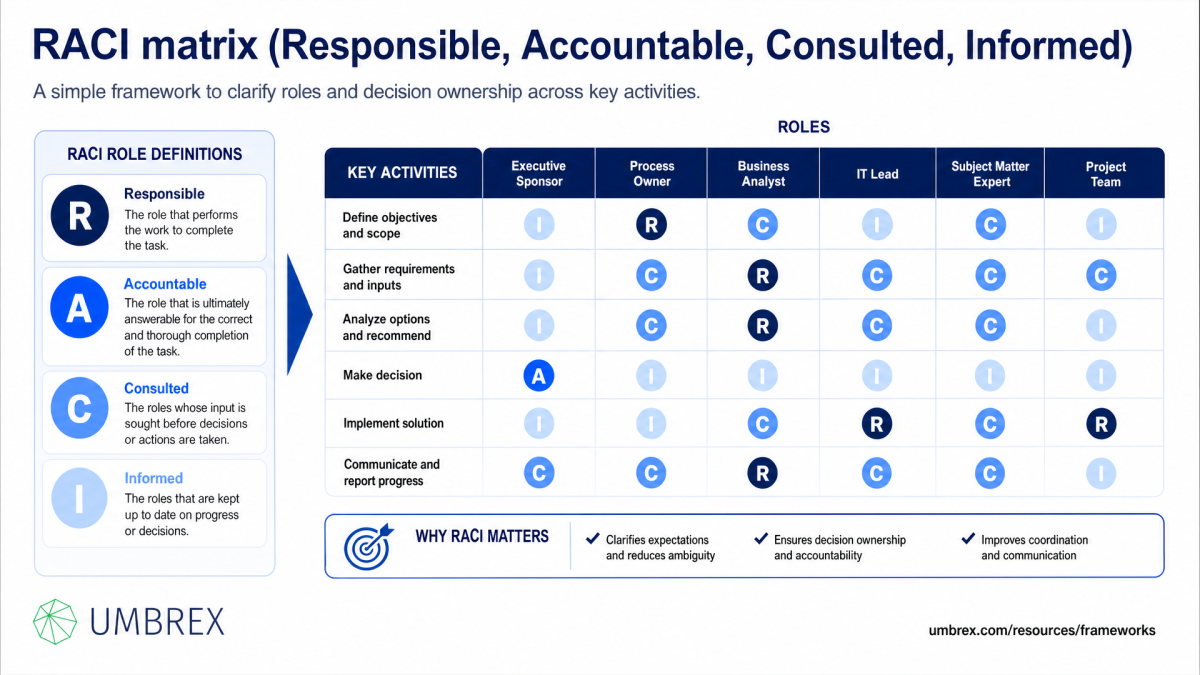
The RACI matrix is a simple, widely used tool for clarifying decision rights and execution roles in cross‑functional work. It maps key decisions or deliverables to four role types:
- Responsible (R): The doers. People who execute the work and make it happen.
- Accountable (A): The owner. The single point ultimately answerable for the decision or outcome. Approves the work Responsible produces.
- Consulted (C): The advisors. People whose input is sought before a decision is made or work is finalized.
- Informed (I): The recipients. People kept up to date on status and decisions after they are made.
Teams build a RACI by listing the most important decisions or deliverables down one axis and the relevant roles or teams across the other. They then assign R, A, C, and I entries to each item. The output provides crisp role clarity, reduces rework and slow approvals, and accelerates delivery.
In plain terms: RACI tells you who does the work, who signs off, who must be consulted before moving, and who simply needs to know—so projects don’t stall and decisions don’t ricochet.
2. Origin and Background
Origin: Unknown; in use since at least the 1970s–1980s.
RACI (also called a Responsibility Assignment Matrix) emerged from project management and organizational design practice to solve a common problem: ambiguous ownership in cross‑functional work. It was popularized through project‑management literature and consulting toolkits, and has since become a staple of governance and operating‑model design. Variants such as RASCI (adds Support), CAIRO (Consulted, Accountable, Informed, Responsible, Omitted), DACI (Driver, Approver, Contributors, Informed), and RAPID (Recommend, Agree, Perform, Input, Decide) reflect the same need with different emphases.
Why it persists: RACI is fast to build, easy to understand, and highly effective at preventing the “too many cooks” syndrome and approval gridlock in matrixed organizations.
3. How the RACI Matrix Works
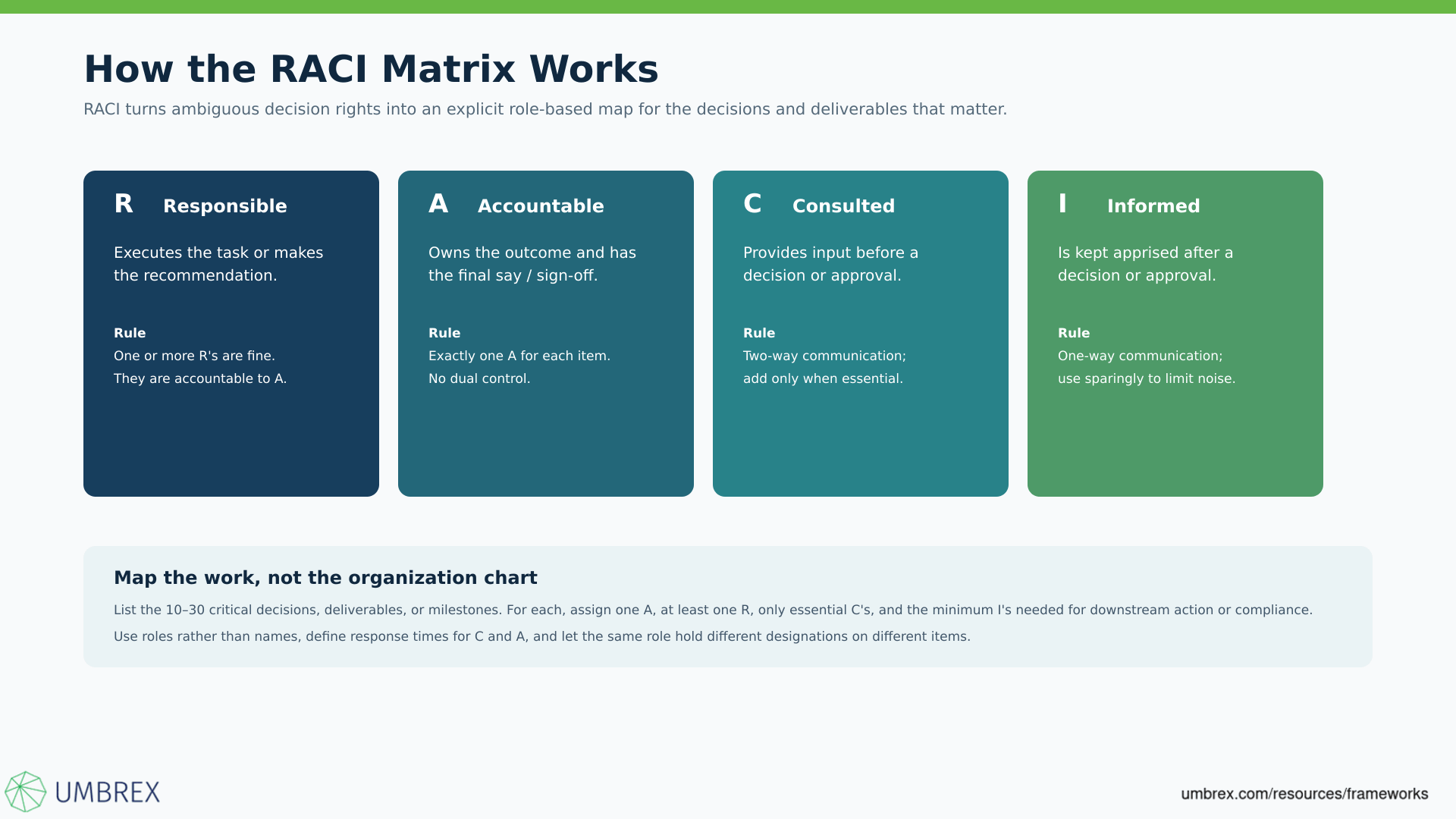
RACI operates on a few simple, non‑negotiable rules and a repeatable mapping exercise.
The Four Roles (in practice)
- Responsible (R): Executes the task or makes the recommendation. There can be multiple Rs. They are accountable to the A.
- Accountable (A): Owns the outcome and has the final say. There should be exactly one A per decision/deliverable to avoid dual control.
- Consulted (C): Provides input before the decision/approval. This is two‑way communication; the A/R must actively seek their views.
- Informed (I): Is kept apprised after the decision/approval. This is one‑way communication to avoid clogging the process.
What You Map
- Decisions: e.g., Approve pricing changes, sign off on release readiness, select vendor, accept design.
- Deliverables/milestones: e.g., Customer journey map, security risk assessment, quarterly plan, regulatory submission.
For each item, assign exactly one A, at least one R, and as few Cs as needed. I’s are used sparingly—too many create noise.
Design Principles
- Single A principle: One person (role) is accountable per item. If you can’t pick one, the decision isn’t truly designed.
- R vs. A distinction: R does the work; A owns the outcome and signs off. In small teams, the same person can be both R and A—but clarity remains.
- Intentional C’s: Add a C only if their input materially improves the decision or is legally required. Otherwise, move them to I.
- Time‑boxing: Define service‑level expectations for C input (e.g., “C has 3 business days to respond; otherwise, the A proceeds”).
- Role‑based, not name‑based: Map to roles (e.g., “Risk Officer”) rather than individuals to survive rotations.
RACI isn’t an org chart. It clarifies decision rights for specific items; the same role may be A for one item and C or I for another.
4. When to Use RACI
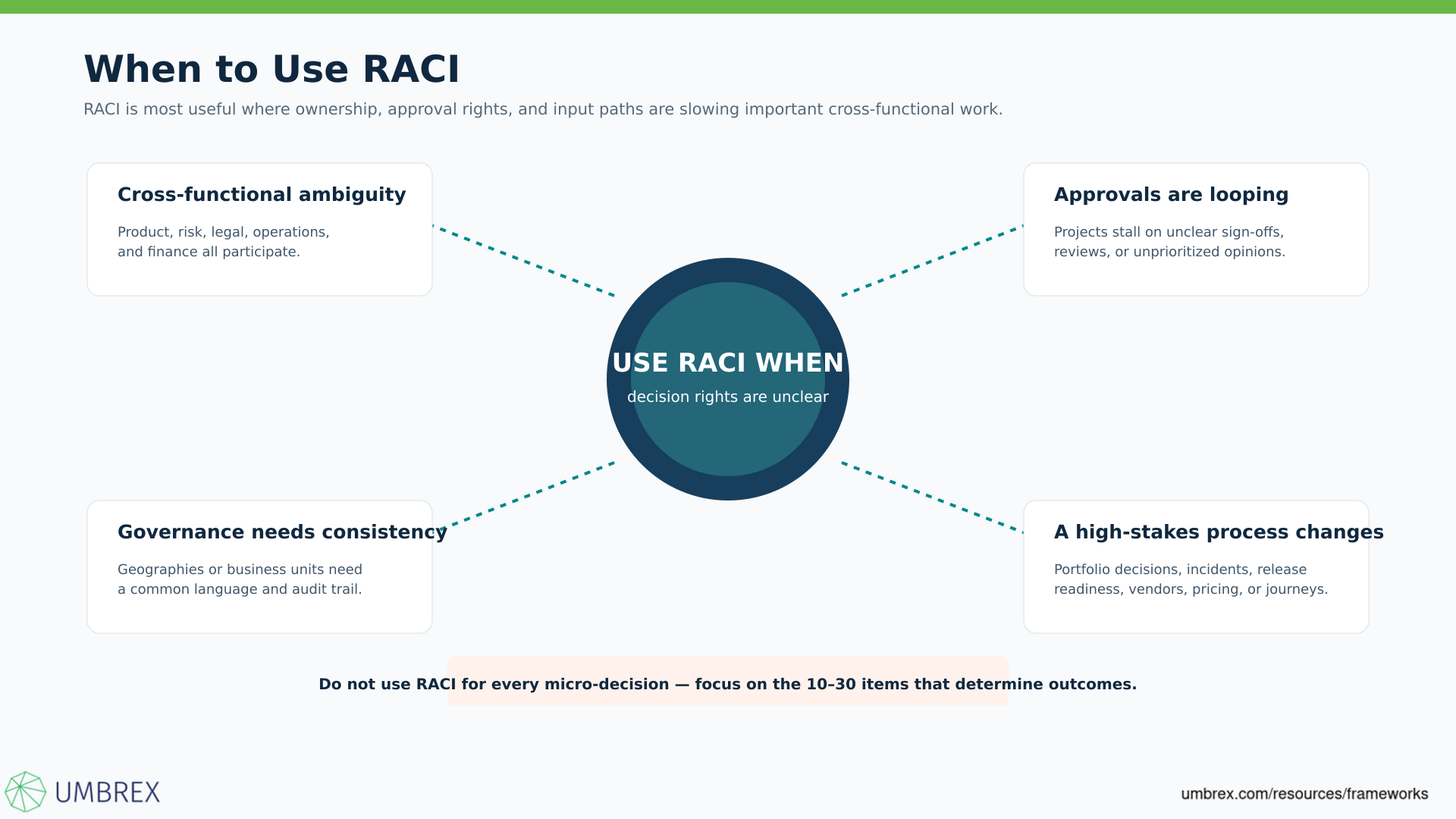
Most helpful when:
- Cross‑functional work creates ambiguity (product + risk + legal + operations).
- Projects stall due to unclear approvals, looping reviews, or unprioritized opinions.
- Multiple geographies or business units need a common governance language.
- Regulatory or risk processes require a clear audit trail of who owns decisions.
Especially powerful: During operating‑model changes (e.g., shift to product/platform), portfolio governance, incident management and release readiness, vendor selections, pricing/discount approvals, and customer journey redesigns.
Less suitable or potentially misleading:
- As a substitute for strategy or org design. RACI clarifies ownership; it doesn’t decide strategic priorities or fix structural capacity gaps.
- For every micro‑decision. Use it for the 10–30 decisions/deliverables that matter most; otherwise, it becomes bureaucracy.
- If used to avoid accountability (multiple A’s) or to silence expertise (removing legitimate C’s).
5. How to Apply RACI: Step‑by‑Step
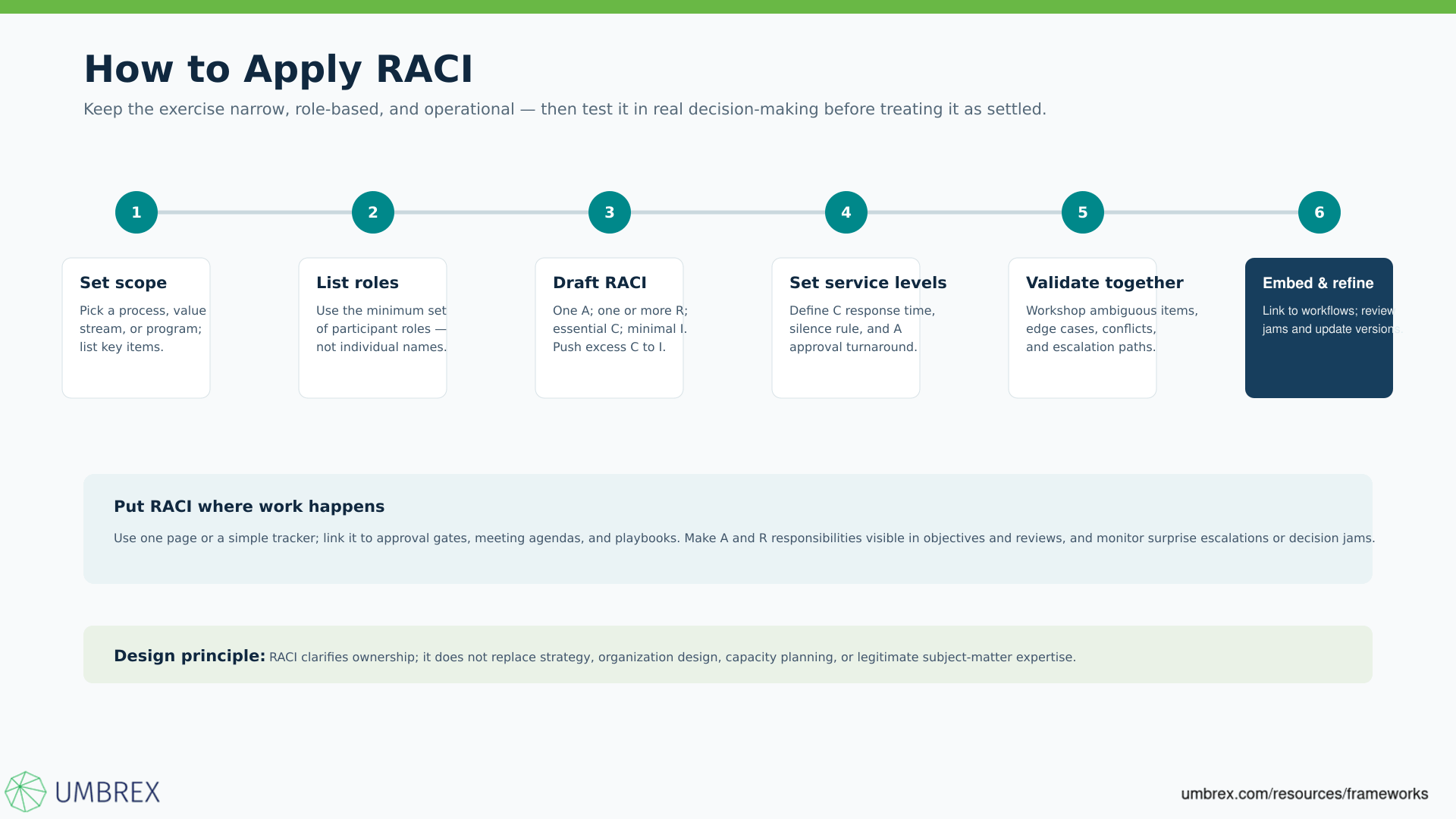
- Define the scope and the decisions/deliverables.
Pick a process, value stream, or program (e.g., “Checkout reliability,” “B2B onboarding,” “Quarterly portfolio intake”). List the 10–30 decisions or deliverables that determine success. Be concrete (“Approve risk tiering policy v2.0,” “Release to production”).
- List the roles (not names).
Include roles across business, product/tech, operations, risk/compliance, finance, legal, and key partners. Use the minimal set that truly participates; too many roles create noise.
- Draft the RACI assignments.
For each item, assign:
- Exactly one A (final sign‑off/ownership).
- At least one R (who does the work/recommendation).
- Consulted (C) only if their input is essential or required.
- Informed (I) to those who need updates for downstream work or compliance.
Apply the single A principle ruthlessly; push excess C to I.
- Add timing and service levels.
Specify when C input is due, what “silence” means (e.g., proceed), and the approval turnaround time for A. This prevents RACIs from becoming queues.
- Validate with stakeholders (“catchball”).
Run a short workshop with the roles represented. Walk through ambiguous items, reconcile conflicts, and test edge cases (“What if risk disagrees?”). Agree escalation paths.
- Publish and embed.
Document the RACI in a concise, accessible format (one page or a simple tracker). Link it into workflows (e.g., approval gates in your toolchain), meeting agendas (who signs off), and playbooks.
- Monitor and refine.
After a month or a quarter, review where decisions jammed or surprise escalations occurred. Adjust roles, C lists, and service levels. Version‑control changes.
- Align incentives and performance.
Ensure A and R responsibilities are reflected in objectives and reviews; avoid rewarding local activity that conflicts with the A’s end‑to‑end accountability.
6. Example: RACI in Action—Launching “Buy Online, Pick Up In Store” (BOPIS)
Context: A global retailer (60,000 employees) is rolling out BOPIS across 400 stores. Past initiatives suffered from approval confusion (merchandising vs. e‑comm vs. stores), slow risk/legal reviews, and inconsistent customer comms. The COO asked for a RACI to clarify who decides what.
Scope of decisions/deliverables (selected):
- Define BOPIS service levels and cut‑off times
- Approve inventory reservation and substitution rules
- Design store pickup workflow and roles
- Approve customer communications (order ready, delays, cancellations)
- Release readiness for pilot markets
- Incident response ownership for failed pickups
- Privacy and consent language for notifications
Roles: E‑comm Product Lead, Store Operations Lead, Supply Chain Lead, Customer Care Lead, Risk/Compliance, Legal, IT Platform Owner, Data Privacy Officer, Finance.
RACI highlights (illustrative):
- Define BOPIS service levels: A = Store Ops Lead; R = E‑comm Product + Supply Chain; C = Customer Care, IT Platform; I = Finance, Legal.
- Inventory reservation rules: A = Supply Chain Lead; R = IT Platform; C = Store Ops, Merchandising; I = Customer Care.
- Customer communications templates: A = E‑comm Product Lead; R = Customer Care; C = Legal, Data Privacy; I = Store Ops.
- Release readiness for pilot: A = IT Platform Owner; R = Product + QA; C = Store Ops, Risk; I = Exec Sponsor.
- Privacy/consent language: A = Data Privacy Officer; R = Legal; C = E‑comm Product; I = Customer Care.
- Incident response (failed pickup): A = Customer Care Lead; R = Store Ops; C = Supply Chain, IT (for root cause); I = Risk.
Service levels: Consulted roles had 3 business days to respond; A had 48 hours to decide after consultation; escalations went to the COO’s weekly performance dialogue.
Outcomes (two months): Approval cycle time for key decisions fell from 15 to 6 days; pilot launched on time; “who decides?” questions dropped significantly; NPS for BOPIS pilots +9 points; incident MTTR −30%. The RACI became part of the operating playbook and onboarding for new markets.
7. Strengths and Limitations
Strengths
- Clarity: Eliminates ambiguity about who does what, who signs off, and who needs to be consulted or informed.
- Speed: Reduces looping approvals and “design‑by‑committee”; accelerates decisions and execution.
- Scalability: Provides a common language across business units, functions, and geographies.
- Auditability: Creates a transparent trail of decision ownership—valuable in regulated contexts.
Limitations
- Over‑formalization risk: If applied to every micro‑task, RACI becomes bureaucracy.
- Static trap: Roles and processes evolve; a stale RACI causes friction and workarounds.
- False comfort: A RACI doesn’t fix weak capability, misaligned incentives, or lack of capacity.
- Nuance loss: Not every decision is binary; judgment and relationships still matter alongside RACI.
8. Common Pitfalls (and How to Avoid Them)
- Multiple A’s per decision.
What goes wrong: Dual control; stalemates.
Avoid by: Enforcing a single A; if truly joint, elevate to the next common leader as A. - Too many Consulted (C) roles.
What goes wrong: Slow reviews; “design by consensus.”
Avoid by: Limiting C to those who materially improve quality or are required; move others to I. - Confusing R and A.
What goes wrong: Work gets done, but no one truly owns the outcome.
Avoid by: Writing a one‑line accountability statement for each A (“owns outcome and signs off”). - No service‑level expectations.
What goes wrong: Cs reply whenever; decisions drift.
Avoid by: Setting deadlines for C input and A approvals; define “silent assent” rules. - Role titles too granular.
What goes wrong: The RACI breaks when people change jobs.
Avoid by: Using role families (e.g., “Risk Officer”) and linking the RACI to role charters. - Static document.
What goes wrong: Reality diverges; workarounds proliferate.
Avoid by: Reviewing quarterly; adjusting after incidents or post‑mortems; version‑controlling changes. - Using RACI as a weapon.
What goes wrong: Escalations and turf wars; trust erodes.
Avoid by: Facilitating co‑creation sessions; aligning incentives to shared outcomes; using RACI as a learning tool.
9. How RACI Relates to Other Frameworks
- DACI (Driver, Approver, Contributors, Informed): Similar to RACI with explicit “Driver” for day‑to‑day coordination. Useful in product management; choice is preference and context.
- RAPID (Bain): Distinguishes Recommend, Agree (veto), Perform, Input, Decide. Helpful when formal “agree” rights are needed; heavier than RACI.
- DRI (Directly Responsible Individual): Apple’s practice to name a single owner (akin to A) for clarity; RACI provides a fuller picture (C and I) around that.
- SIPOC / Process Maps / Value Stream Mapping: Define the work and flows; RACI defines who owns decisions and deliverables at each step.
- Operating Model / Org Design: High‑level structure and decision rights. RACI is the practical, item‑level instantiation in programs and processes.
- Performance Dialogues / OKRs / BSC: Use RACI to clarify who owns OKRs/KPIs and who must be consulted; performance dialogues then hold A/R to account.
- Risk & Compliance frameworks: RACI clarifies control ownership (A) and execution (R) for policies and audits.
10. Key Takeaways
- RACI clarifies who does the work (R), who owns the outcome (A—one only), who is consulted (C), and who must be informed (I) for key decisions and deliverables.
- Use it for the 10–30 items that drive success; map roles (not names); set service levels for C input and A approval.
- Keep C’s tight and I’s purposeful; too many create drag. Enforce a single A to prevent gridlock.
- Embed RACI into workflows, approvals, and performance dialogues; refresh quarterly to match reality.
- RACI complements process maps, OKRs/BSC, and operating‑model design; it doesn’t replace strategy or capacity planning.
11. FAQs About the RACI Matrix
Can there be more than one Accountable?
Best practice is one A per decision/deliverable. Multiple A’s create dual control and slow decisions. If ownership is truly shared, escalate to a common leader as A and designate the others as C or R.
What’s the difference between Responsible and Accountable?
Responsible executes the work or recommendation; Accountable owns the outcome and gives final approval. The same person can be both in small teams, but you should still write down the distinction to avoid confusion.
How detailed should a RACI be?
Focus on the 10–30 high‑value decisions/deliverables per process or program. Too much detail becomes unmanageable. You can maintain a separate, lighter RACI for recurring operational items if needed.
How often should we update our RACI?
Quarterly is typical, or after major org or process changes. Also refresh after incidents or post‑mortems that revealed role confusion. Version‑control updates and communicate changes.
Is RACI suitable for Agile teams?
Yes—lightly. Clarify A for release readiness, risk approvals, and key product decisions; R often sits with the product team. Keep C compact and time‑boxed to maintain flow; embed RACI points into your Definition of Ready/Done and release rituals.
How do we pick between RACI, DACI, and RAPID?
Choose the simplest tool that fits the decision context. RACI is sufficient for most. Use DACI where a “Driver” role is critical for coordination; use RAPID where formal “agree/veto” rights are important.
What tools should we use?
Start with a simple spreadsheet or one‑page document. Embed RACI points into workflow tools (e.g., approval gates, ticket fields) and meeting templates. The discipline matters more than the software.
How do we handle disputes over who is A?
Facilitate a brief alignment session with the relevant leaders. Ask: “Who bears the consequences if this goes wrong? Who is best placed to balance trade‑offs?” If unresolved, escalate to the next common leader to assign the A.
