

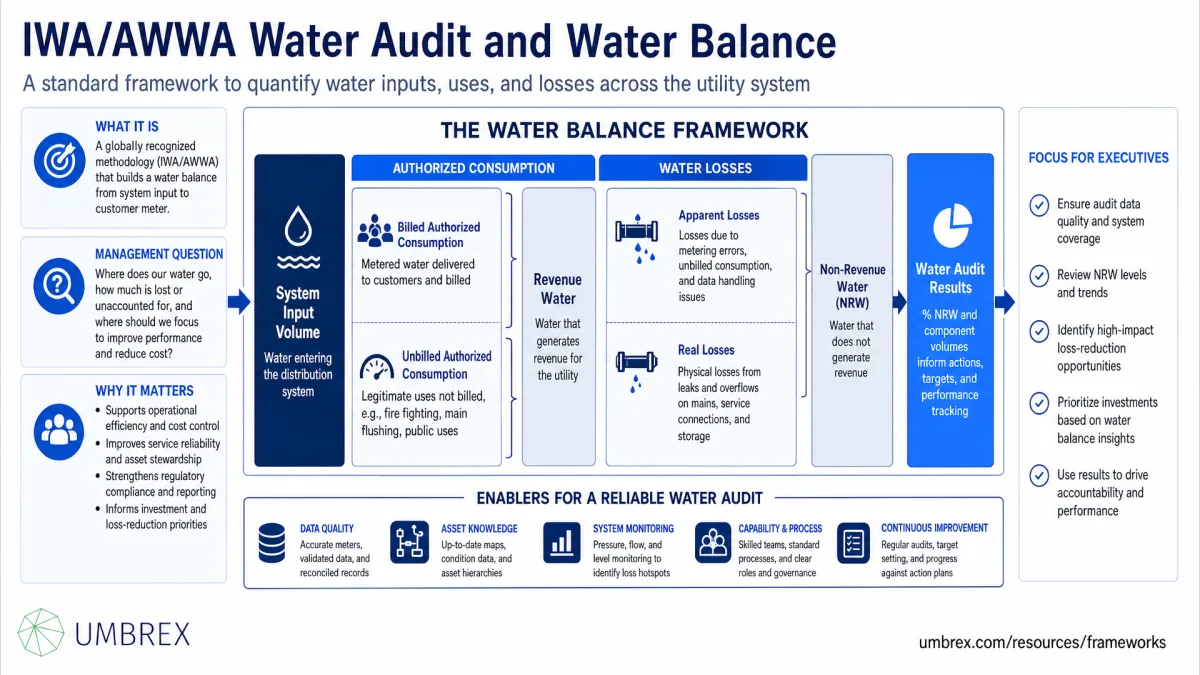
1. What Is IWA/AWWA Water Audit and Water Balance?
The IWA/AWWA Water Audit and Water Balance is an operational and financial diagnostic that accounts for water entering a supply system, separates legitimate consumption from losses, and distinguishes physical leakage from metering and billing losses. IWA stands for International Water Association; AWWA stands for American Water Works Association. The water balance is the accounting structure; the audit evaluates its inputs, reliability, and performance implications.
For executives evaluating water and wastewater utilities, the central question is concrete: should the next improvement dollar fund leak detection, pressure management, meter replacement, billing corrections, or network renewal? The framework structures that decision, but does not make it automatically.
Its direct application is to water-supply networks—not electricity distribution or wastewater collection. Sewer infiltration and inflow require a different diagnostic approach.
2. Origin and Background
The standardized approach emerged from IWA task-force work in the late 1990s. The 2000 IWA Blue Pages publication by A. O. Lambert and W. Hirner established standard terminology and recommended performance measures. The objective was to replace inconsistent definitions and simplistic comparisons with an auditable basis for assessing water losses.
AWWA’s Water Loss Control Committee advocated the methodology in its 2003 best-management-practices report. AWWA’s M36 manual and free audit software subsequently helped translate the approach into utility practice. It remains a water-sector management method rather than a framework originating in general management consulting.
3. How IWA/AWWA Water Audit and Water Balance Works
The core logic is volume reconciliation over a defined system boundary and reporting period, normally a year. Water entering the system must be assigned to authorized consumption, apparent losses, or real losses. All quantities must use consistent units, dates, and boundaries.
The principal components
| Component | Meaning | Utility interpretation |
|---|---|---|
| System input volume | Water entering the defined supply system. | Measured production and purchased water, with documented meter corrections. |
| Billed authorized consumption | Authorized consumption that is billed, whether metered or unmetered. | Retail deliveries and applicable wholesale sales. |
| Unbilled authorized consumption | Legitimate consumption that is not billed, whether metered or unmetered. | Documented firefighting, flushing, and other authorized uses. |
| Apparent losses | Unauthorized consumption, customer-meter inaccuracies, and systematic data-handling errors. | Water consumed but not correctly captured in consumption and billing records. |
| Real losses | Physical leakage from mains, storage, and service connections up to the customer meter. | Water escaping before reaching the customer-meter boundary. |
These categories distinguish consumption-accounting problems from physical network losses; their remedies are different.
Non-revenue water is not synonymous with leakage. It includes unbilled authorized consumption, apparent losses, and real losses. “Revenue water” means billed authorized consumption; the balance is not an accounts-receivable analysis of whether customers paid their bills.
In a top-down audit, real losses are calculated as the remaining volume after authorized consumption and apparent losses are deducted. That residual is an estimate, not a map of leaking pipes. Supply-meter error must be addressed in the supply input rather than misclassified as a customer-side apparent loss.
Performance indicators supplement the balance. The Infrastructure Leakage Index compares current annual real losses with estimated unavoidable annual real losses, reflecting network characteristics and pressure. It is a diagnostic indicator—not a universal economic target. Avoid relying on non-revenue-water percentage alone.
4. When to Use IWA/AWWA Water Audit and Water Balance
Use the framework when a municipal utility, investor-owned operator, or regional supplier needs to structure a loss-reduction program. It is especially valuable before major metering or distribution investments and when finance and operations disagree about what “water loss” means.
- Is rising production driven by customer demand, leakage, or measurement error?
- Would targeted meter testing be more valuable than blanket replacement?
- Should scarce funding prioritize pressure controls, faster repairs, or pipe renewal?
- Are reported improvements physical savings or better accounting?
Useful inputs include production and purchase records, customer consumption, meter tests, billing extracts, authorized-use estimates, and network information. Operations, customer services, engineering, finance, and data owners must participate. AWWA recommends annual audits meeting acceptable quality-assurance standards.
The method is powerful when boundaries are clear and uncertainty is documented. It becomes misleading when weak estimates are treated as measurements. It is not a substitute for leak localization, hydraulic analysis, water-quality assessment, or sewer infiltration studies.
5. How to Apply IWA/AWWA Water Audit and Water Balance: Step-by-Step
Clarify the decision and scope. Define the investment or operating decision, audit year, supply-system boundary, and planning horizon. Map treatment outlets, imports, exports, storage, and customer meters. Keep the audited boundary consistent with the management decision.
Gather and reconcile inputs. Assemble source-meter records, purchases, consumption extracts, meter-test evidence, flushing logs, and billing adjustments. Align consumption periods rather than simply adding bills issued during the year. Document units, missing records, corrections, and responsible owners.
Define the units of analysis. Begin with the entire distribution system. Add separately measurable service areas or pressure zones where boundaries permit. Segment meter investigations by customer class, meter size, and usage pattern—not merely by installation age.
Construct the balance and evidence register. Populate the standard categories using AWWA software or an equivalent documented model. Record the basis and quality of each input. Clearly distinguish measured quantities, tested corrections, and provisional estimates.
Interpret the results before prescribing remedies. Examine apparent and real losses separately. Challenge implausible residuals and major assumptions. Decide whether the immediate priority is better measurement, commercial correction, or physical loss control.
Translate volumes into investment choices. Value apparent-loss recovery using applicable customer tariffs. Initially value real-loss reduction using avoidable production or purchase costs, then assess scarcity and capacity benefits separately. Compare realistically recoverable volumes with implementation and ongoing costs.
Test sensitivities. Vary supply-meter corrections, customer-meter under-registration, authorized-use estimates, recovery rates, and project costs. If small changes reverse the preferred investment, improve the evidence before committing substantial capital.
Align stakeholders and establish delivery. Obtain agreement from operations, engineering, finance, and customer services. Assign workstream owners and verification measures. Repeat the audit consistently while using operational monitoring to manage work between annual reporting cycles.
The sequence above is a practical implementation guide, not a replacement for formal audit-validation guidance. Validation should challenge both the submitted values and the evidence supporting them.
A funded loss-reduction program needs program management support to coordinate meter investigations, billing fixes, leak repairs, procurement, and benefit verification. The completed spreadsheet is the starting point—not the deliverable that changes performance.
6. Example: IWA/AWWA Water Audit and Water Balance in Action
Fictional example: Riverton Municipal Utilities operates drinking-water and wastewater services. Its board is considering an extensive water-main replacement program because production exceeds billed consumption.
The team selects the water audit to test whether that difference is actually leakage. It audits the drinking-water distribution system for one year, with no wholesale exports. All figures below are illustrative, not industry benchmarks.
Corrected input is 1,000 million gallons. Billed authorized consumption is 780 million gallons; documented unbilled authorized consumption is 20 million gallons. Meter testing and billing investigations support an apparent-loss estimate of 50 million gallons. The resulting real-loss estimate is 150 million gallons.
The balance therefore identifies 220 million gallons of non-revenue water, but only 150 million gallons of estimated physical leakage. Calling the entire difference “leakage” would have overstated the pipe-related problem.
Commercial investigations identify incorrectly configured large meters. Separate pressure-zone monitoring finds evidence supporting targeted leak investigations. The team tests alternative meter-error assumptions and finds that both workstreams remain justified.
The board funds commercial corrections and targeted leakage work, while deferring blanket replacement pending asset-condition evidence. Finance tracks additional billed consumption separately from reduced production. Operations verifies repairs and monitors pressure, allowing the next audit to distinguish operational improvement from revised estimates.
7. Strengths and Limitations
Strengths
- Common language: Finance and operations can discuss the same categories rather than competing definitions of “missing water.”
- Better intervention choices: Separating apparent and real losses prevents every discrepancy from becoming a pipe-replacement proposal.
- Visible assumptions: Documented input quality makes disagreement productive and identifies worthwhile measurement investments.
Limitations
A system-wide balance does not locate individual leaks or establish which assets should be renewed. Leakage component analysis and field investigations are needed to develop a credible physical-loss intervention program.
Nor does the largest loss volume necessarily represent the best investment. Recoverability, control costs, service obligations, and the value of conserved water matter. Pressure management also requires consideration of customer service and fire-flow requirements; reducing pressure indiscriminately is not an acceptable loss-control strategy.
8. Common Pitfalls and How to Avoid Them
- Mixing boundaries: Do not combine supply figures that exclude wholesale exports with consumption figures that include them. Draw the boundary before calculating the balance.
- Calling every difference leakage: Preserve the distinction between authorized use, apparent losses, and real losses. Investigate each through the appropriate workstream.
- Promoting estimates into facts: Label provisional assumptions and commission targeted tests where uncertainty could change the decision.
- Overvaluing recovered water: Do not apply retail tariffs to all leakage savings or assume every gallon can be recovered economically.
- Celebrating a better percentage: Track absolute and appropriately normalized losses alongside non-revenue-water percentage. Changing consumption can distort percentage comparisons.
- Confusing better data with better operations: Explain revisions to prior estimates separately from verified reductions. Maintain an assumption-change log and require evidence for claimed benefits.
9. How IWA/AWWA Water Audit and Water Balance Relates to Other Frameworks
Alongside: Leakage component analysis
The balance estimates the scale of real losses; leakage component analysis helps evaluate their composition and control opportunities. Use the audit first for overall accountability, then component analysis and field evidence to design leakage interventions.
After: Asset-management frameworks
EPA’s five-core-question asset-management framework addresses asset condition, service levels, critical assets, lifecycle costs, and funding. It complements the balance because high losses alone do not establish which pipe should be replaced. Use asset-management analysis when the decision concerns long-term renewal.
After: Investment appraisal and scenario analysis
For competing meter, pressure-control, and renewal projects, supplement the diagnosis with lifecycle economics and scenarios. The natural follow-on is capital expenditure prioritization that converts validated opportunities into a funded portfolio, with explicit service-risk constraints and sensitivity tests.
10. Key Takeaways
- The audit distinguishes legitimate consumption, apparent losses, and physical losses; non-revenue water includes more than leakage.
- Match the intervention to the loss category—not to a headline percentage.
- Make boundaries, meter corrections, and uncertainty explicit.
- Compare recoverable benefits with lifecycle costs and service risks.
- Connect the annual audit to accountable implementation and verified results.
11. FAQs About IWA/AWWA Water Audit and Water Balance
Can it be used directly for wastewater collection?
No. Its standard categories address water supply. Sewer infiltration and inflow involve additional water entering collection systems and require separate flow-monitoring and diagnostic methods.
Are non-revenue water and leakage the same?
No. Non-revenue water also includes legitimate unbilled consumption and apparent losses. Only real losses represent physical leakage and storage losses within the defined boundary.
Can smaller utilities use the framework?
Yes. Start with available supply and consumption records, documented authorized uses, and transparent estimates. Prioritize measurement improvements that could materially change operating or investment decisions rather than pursuing completeness everywhere at once.
How long does an audit take?
There is no useful universal duration. Distinguish compiling an initial balance from validating it. Timing depends on record quality, billing-period alignment, meter-test requirements, system boundaries, and whether field investigations are needed before investment decisions.
