
1. What Is Conway’s Law?
Conway’s Law states that organizations design systems that mirror their internal communication structures. In other words: the way your teams are structured and interact will show up in your software, processes, interfaces, and ultimately your customer experience. If communication is siloed, you get siloed systems; if teams coordinate cleanly across clear boundaries, you get modular systems with clean interfaces.
Within Team Effectiveness & Collaboration frameworks, Conway’s Law is a socio-technical design principle and a diagnostic lens. It reminds leaders that organization and architecture are linked—and that you can use structure intentionally to shape the systems you build (or, conversely, redesign systems to prompt better structures). Practitioners often talk about a “reverse-Conway maneuver”: design the team topology you want your architecture to reflect, then evolve systems to match.
In plain terms: if you want a modular, loosely coupled platform, don’t organize as a matrix that forces dozens of handoffs; put small, cross-functional teams on end-to-end value streams with clear interfaces and let your system mirror that simplicity.
2. Origin and Background
Conway’s Law was articulated by Melvin E. Conway in his 1968 article “How Do Committees Invent?” (Datamation). He observed that the structure of a system design follows the communication structure of the organization that produced it. The phrase “Conway’s Law” became widely known after Frederick P. Brooks Jr. referenced it in “The Mythical Man-Month” (1975).
Since then, research in software engineering and organizational design has provided empirical support for “mirroring” between organizational and product architectures (e.g., studies of modularity and coordination patterns in large-scale software). The idea migrated from software into broader product and operating model thinking, and was further popularized in modern DevOps and product operating models, including Team Topologies’ explicit “reverse-Conway maneuver.”
Why it matters: it explains persistent misalignments (e.g., microservices built by functionally siloed teams that still behave like a monolith) and offers a lever for change—alter communication and team boundaries to alter system structure.
3. How Conway’s Law Works
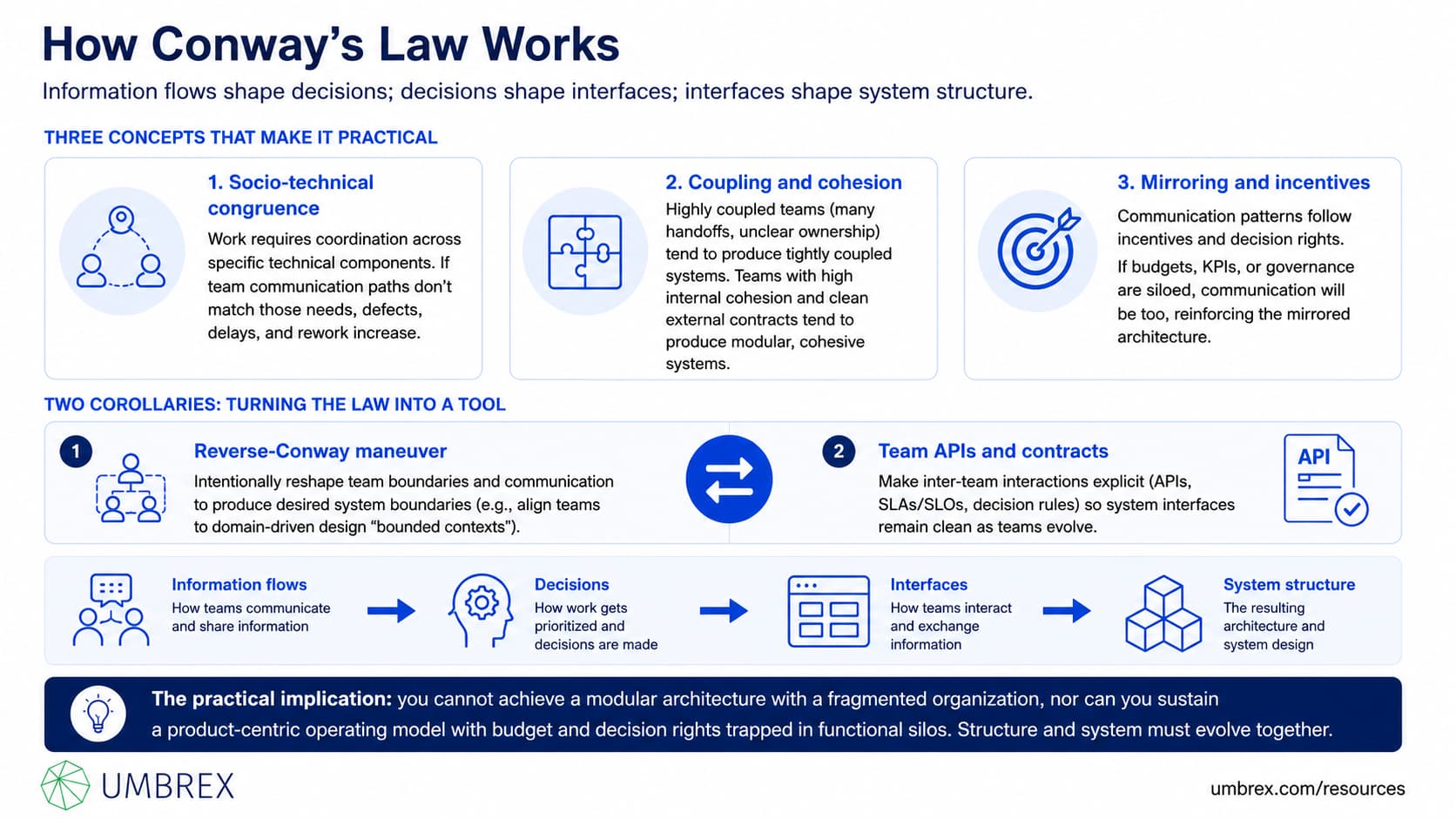
At its core is a simple, robust mechanism: information flows shape decisions; decisions shape interfaces; interfaces shape system structure. Three concepts make it practical:
- Socio-technical congruence: Work requires coordination across specific technical components. If team communication paths don’t match those needs, defects, delays, and rework increase.
- Coupling and cohesion: Highly coupled teams (many handoffs, unclear ownership) tend to produce tightly coupled systems. Teams with high internal cohesion and clean external contracts tend to produce modular, cohesive systems.
- Mirroring and incentives: Communication patterns follow incentives and decision rights. If budgets, KPIs, or governance are siloed, communication will be too, reinforcing the mirrored architecture.
Two corollaries turn the law from a warning into a tool:
- Reverse-Conway maneuver: Intentionally reshape team boundaries and communication to produce desired system boundaries (e.g., align teams to domain-driven design “bounded contexts”).
- Team APIs and contracts: Make inter-team interactions explicit (APIs, SLAs/SLOs, decision rules) so system interfaces remain clean as teams evolve.
The practical implication: you cannot achieve a modular architecture with a fragmented organization, nor can you sustain a product-centric operating model with budget and decision rights trapped in functional silos. Structure and system must evolve together.
4. When to Use Conway’s Law
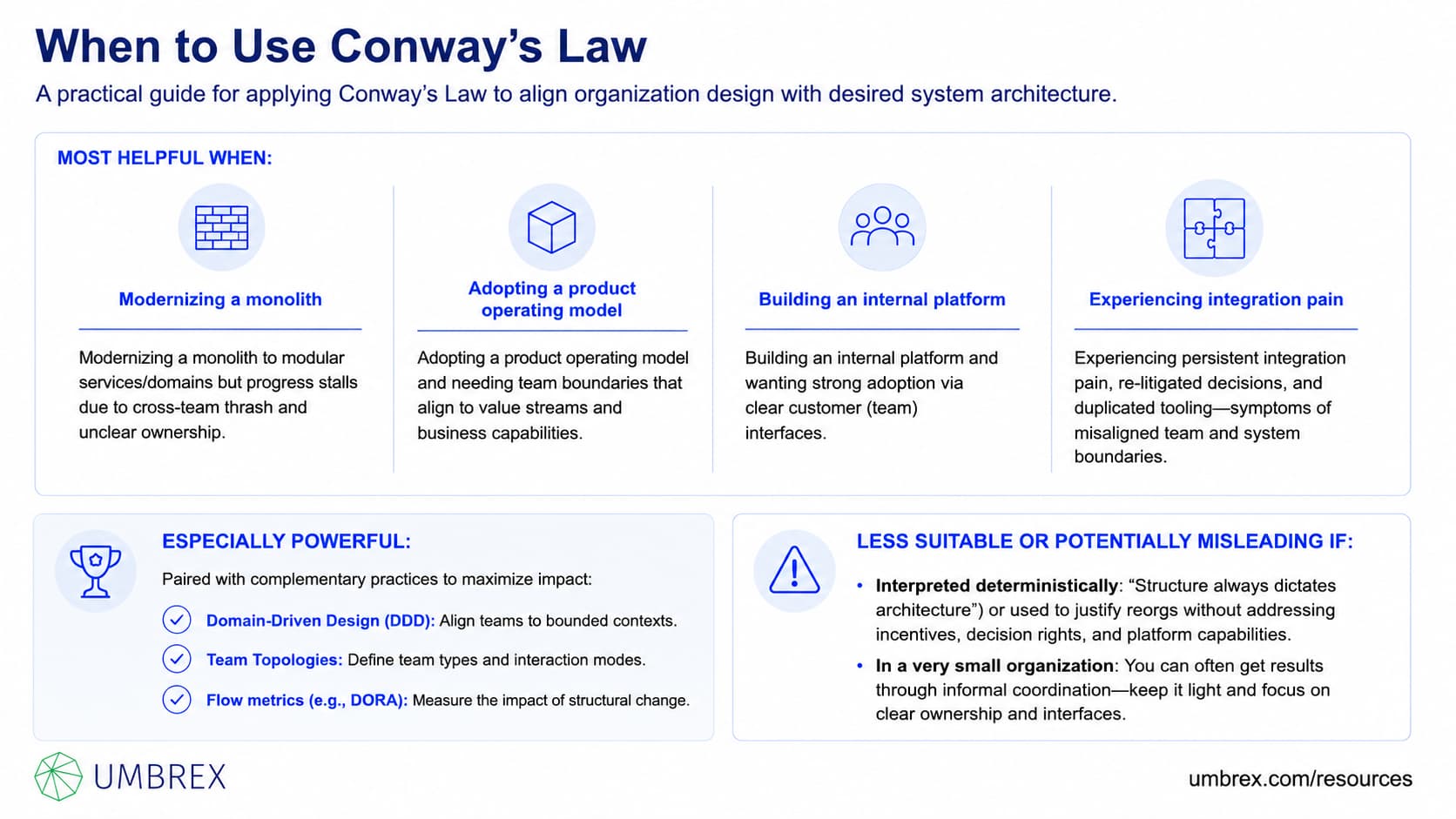
Most helpful when:
- Modernizing a monolith to modular services/domains but progress stalls due to cross-team thrash and unclear ownership.
- Adopting a product operating model and needing team boundaries that align to value streams and business capabilities.
- Building an internal platform and wanting strong adoption via clear customer (team) interfaces.
- Experiencing persistent integration pain, re-litigated decisions, and duplicated tooling—symptoms of misaligned team and system boundaries.
Especially powerful: Paired with Domain-Driven Design (DDD) to align teams to bounded contexts; with Team Topologies to define team types and interaction modes; and with flow metrics (e.g., DORA) to measure the impact of structural change.
Less suitable or potentially misleading if: Interpreted deterministically (“structure always dictates architecture”) or used to justify reorgs without addressing incentives, decision rights, and platform capabilities. In a very small organization, you can often get results through informal coordination—keep it light and focus on clear ownership and interfaces.
5. How to Apply Conway’s Law: Step-by-Step
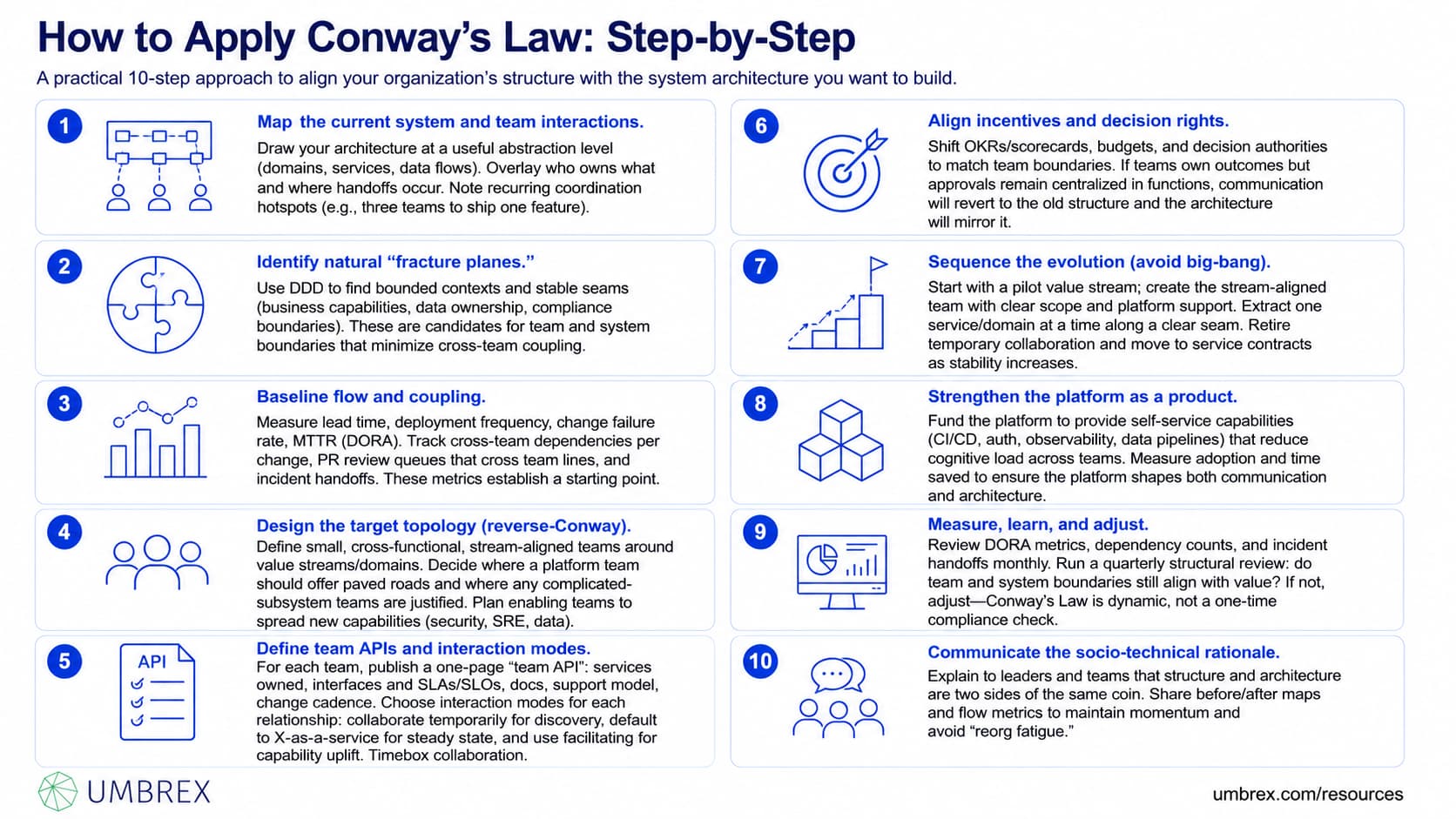
- Map the current system and team interactions.
Draw your architecture at a useful abstraction level (domains, services, data flows). Overlay who owns what and where handoffs occur. Note recurring coordination hotspots (e.g., three teams to ship one feature).
- Identify natural “fracture planes.”
Use DDD to find bounded contexts and stable seams (business capabilities, data ownership, compliance boundaries). These are candidates for team and system boundaries that minimize cross-team coupling.
- Baseline flow and coupling.
Measure lead time, deployment frequency, change failure rate, MTTR (DORA). Track cross-team dependencies per change, PR review queues that cross team lines, and incident handoffs. These metrics establish a starting point.
- Design the target topology (reverse-Conway).
Define small, cross-functional, stream-aligned teams around value streams/domains. Decide where a platform team should offer paved roads and where any complicated-subsystem teams are justified. Plan enabling teams to spread new capabilities (security, SRE, data).
- Define team APIs and interaction modes.
For each team, publish a one-page “team API”: services owned, interfaces and SLAs/SLOs, docs, support model, change cadence. Choose interaction modes for each relationship: collaborate temporarily for discovery, default to X-as-a-service for steady state, and use facilitating for capability uplift. Timebox collaboration.
- Align incentives and decision rights.
Shift OKRs/scorecards, budgets, and decision authorities to match team boundaries. If teams own outcomes but approvals remain centralized in functions, communication will revert to the old structure and the architecture will mirror it.
- Sequence the evolution (avoid big-bang).
Start with a pilot value stream; create the stream-aligned team with clear scope and platform support. Extract one service/domain at a time along a clear seam. Retire temporary collaboration and move to service contracts as stability increases.
- Strengthen the platform as a product.
Fund the platform to provide self-service capabilities (CI/CD, auth, observability, data pipelines) that reduce cognitive load across teams. Measure adoption and time saved to ensure the platform shapes both communication and architecture.
- Measure, learn, and adjust.
Review DORA metrics, dependency counts, and incident handoffs monthly. Run a quarterly structural review: do team and system boundaries still align with value? If not, adjust—Conway’s Law is dynamic, not a one-time compliance check.
- Communicate the socio-technical rationale.
Explain to leaders and teams that structure and architecture are two sides of the same coin. Share before/after maps and flow metrics to maintain momentum and avoid “reorg fatigue.”
6. Example: Conway’s Law in Action
Context: A $1.2B digital media company struggled with a monolithic content platform. Feature lead time averaged 40 days; outages often spanned multiple properties. Teams were organized by function (frontend, backend, ops), requiring handoffs for every change.
Application:
- Current-state map: Architecture showed intertwined services with shared database tables; three functions touched any given feature. PRs routinely waited for cross-team reviews.
- Fracture planes: Using DDD, the org identified bounded contexts: Content Ingestion, Editorial Workflow, Personalization, Delivery, and Analytics. These became candidate team boundaries.
- Target topology: Five stream-aligned teams (one per context), a platform team (CI/CD, auth, observability, content delivery “paved road”), and an enabling SRE team to uplift reliability practices. Interaction defaults: platform X-as-a-service; short-term collaboration between Delivery and Platform to extract a content API.
- Incentives and decision rights: OKRs shifted to customer experience and reliability by domain; teams received authority to deploy within guardrails. Ops roles embedded into teams; central approvals retired for low-risk changes.
- Team APIs: Each team published service ownership, API contracts, SLOs, and on-call models. Cross-team work required a decision record and a planned collaboration window.
Outcomes (six months): Lead time dropped to 14 days; deployment frequency tripled; change failure rate fell from 16% to 7%; MTTR halved. Incidents rarely spanned bounded contexts due to cleaner interfaces. Teams reported clearer ownership and fewer cross-team meetings. Architecture diagrams now mirrored the domain boundaries—by design.
7. Strengths and Limitations
Strengths
- Explanatory power: Makes sense of persistent integration pain and duplication—your systems mirror your org.
- Actionable: Leads directly to concrete moves (reverse-Conway maneuvers, team APIs, platform as product).
- Scalable: Applies from small product groups to global portfolios; pairs with metrics to track impact.
- Future-proofing: Encourages modular teams and systems that can evolve as strategy and technology change.
Limitations
- Not a silver bullet: Restructuring without addressing incentives, decision rights, and technical debt will not yield modular systems.
- Over-simplification risk: “Make teams match architecture” ignores cross-cutting concerns (security, data governance) that need enabling patterns.
- Timing and cost: Structural change incurs transition costs; big-bang attempts can disrupt delivery.
- Misuse: Invoked to justify reorgs without socio-technical design or to resist cross-team collaboration where it’s actually needed for discovery.
8. Common Pitfalls (and How to Avoid Them)
- Renaming without redesign.
What goes wrong: “Product teams” on paper, same cross-functional approvals and shared DBs.
Avoid by: Changing decision rights, API ownership, data boundaries, and platform capabilities—not just labels. - Everything becomes collaboration.
What goes wrong: Endless meetings and slow flow; architecture still couples teams.
Avoid by: Timeboxing collaboration for discovery; default to X-as-a-service; codify contracts and SLOs. - Ignoring incentives.
What goes wrong: KPIs remain siloed; communication patterns revert; mirrored monolith persists.
Avoid by: Aligning OKRs, budgets, and rewards to team boundaries and shared outcomes. - Over-splitting too soon.
What goes wrong: Many micro-teams/microservices without platform support; operational overhead explodes.
Avoid by: Establishing a thin platform and clear seams before aggressive decomposition. - Platform as ticket queue.
What goes wrong: Platform mirrors central ops bottlenecks; teams route around it.
Avoid by: Treating the platform as a product with self-service, SLAs, and adoption metrics. - Static topology.
What goes wrong: Teams stay misaligned as strategy shifts; coupling creeps back.
Avoid by: Quarterly reviews and reverse-Conway adjustments as domains evolve. - Data ownership afterthought.
What goes wrong: Beautiful service boundaries with a shared database underneath.
Avoid by: Aligning data ownership and contracts with team boundaries; define data products.
9. How Conway’s Law Relates to Other Frameworks
- Team Topologies: Provides concrete patterns (stream-aligned, platform, enabling, complicated-subsystem; interaction modes) to execute reverse-Conway maneuvers and manage cognitive load.
- Domain-Driven Design (DDD): Bounded contexts and domain models identify fracture planes for teams and systems; together they align organizational and technical architectures.
- Brooks’ Law: Warns that adding people to a late, tightly coupled program makes it later; Conway’s Law explains why tightly coupled structures persist. Both argue for small, well-bounded teams with clear interfaces.
- DevOps & DORA/Accelerate: Conway-aligned structures (autonomous teams, platform support) underpin improvements in lead time, deployment frequency, change failure rate, and MTTR.
- GRPI / Katzenbach–Smith: Clarify goals, roles, processes, and accountability at the team level; Conway’s Law links those choices to system boundaries and flow.
- RACI/RAPID/DACI: Decision-rights frameworks operationalize who decides within and across team boundaries defined via Conway’s lens.
- SRE & Platform Engineering: SLOs, error budgets, and paved roads become explicit elements of team APIs that keep inter-team interfaces clean.
10. Key Takeaways
- Systems mirror the communication structures of the organizations that build them; architecture and organization are inseparable.
- Use a reverse-Conway maneuver: design small, cross-functional teams around domains/value streams and evolve systems to match.
- Make team interactions explicit with team APIs and default to X-as-a-service; reserve collaboration for discovery and facilitating for capability uplift.
- Align incentives and decision rights with team boundaries; invest in a productized platform to reduce cognitive load.
- Measure flow (DORA) and dependencies; iterate structure as strategy and domains evolve—Conway’s Law is a continuous design discipline.
11. FAQs About Conway’s Law
Is Conway’s Law a hard law or just a tendency?
It’s a strong tendency, not physics. But in practice, the mirroring effect shows up consistently enough to be a reliable design principle. You can “bend” it by intentionally shaping structures and incentives.
What is a reverse-Conway maneuver?
It’s the practice of deliberately designing team boundaries and interactions to produce the system architecture you want (e.g., teams aligned to DDD bounded contexts), rather than letting existing org charts dictate architecture by accident.
Does remote or hybrid work change Conway’s Law?
It changes the mediums, not the principle. Remote can reduce accidental communication, making explicit contracts and team APIs even more important. The mirroring still occurs; be intentional about interfaces and cadences.
How do we measure if our structure matches our architecture?
Track cross-team dependencies per change, PR review paths, incident handoffs, and DORA metrics. If most changes require multiple teams and interfaces are unstable, structure and system are misaligned.
Can small companies apply this or is it overkill?
Apply it lightly. Ensure clear ownership boundaries, simple interfaces, and a minimal “platform” (paved paths) as you grow. The principle helps you scale without creating accidental complexity.
We already have microservices—does that mean we’ve solved Conway’s Law?
Not necessarily. Microservices built by functionally siloed teams often behave like a distributed monolith. Align team boundaries and incentives to service boundaries, and provide platform support, to realize the benefits.
How long does it take to see impact?
In a pilot value stream with aligned teams and a thin platform, you can see lead time and dependency reductions in 8–16 weeks. Full alignment across a portfolio typically takes a few quarters.
Do we still need architecture governance?
Yes—focused on contracts, guardrails, and interoperability (APIs, SLOs, security), not centralized feature design. Governance should enable teams, not reintroduce coupling.
