1. What Is the Mintzberg Organizational Configurations Framework?
Mintzberg’s Organizational Configurations is an organization design framework that describes a small set of “ideal types” of organizations—each with a dominant part of the organization and a primary coordination mechanism. It explains why very different structures can be effective, provided they match the work, people, and environment. In practice, it’s a tool to diagnose your current design, understand its strengths and failure modes, and decide how to evolve the operating model.
At its core, the framework says organizations tend to cohere around one of several configurations—Simple Structure, Machine Bureaucracy, Professional Bureaucracy, Divisionalized Form, and Adhocracy—each optimized for different conditions. Each is characterized by which organizational component holds power (e.g., strategic apex, technostructure, operating core) and how coordination happens (e.g., direct supervision, standardization of processes or skills, mutual adjustment).
Consultants and executives commonly use the framework to make sense of structural choices, anticipate trade‑offs, and intentionally combine or sequence configurations (e.g., stable core as Machine Bureaucracy with an Adhocracy for innovation) as strategies and markets evolve.
2. Origin and Background
The framework was developed by Henry Mintzberg and introduced in his book “The Structuring of Organizations” (1979). He refined and popularized it in “Structure in Fives: Designing Effective Organizations” (1983) and later works. The typology emerged from extensive empirical observation of organizations across sectors and sought to integrate strategy, structure, and coordination into a coherent theory of organizational design.
Mintzberg’s aim was to move beyond one‑size‑fits‑all structures and show that different environments and work types call for different organizing logics. The model spread widely through business schools, executive programs, and consulting practice, becoming a staple in the organization design canon.
3. How the Mintzberg Organizational Configurations Framework Works
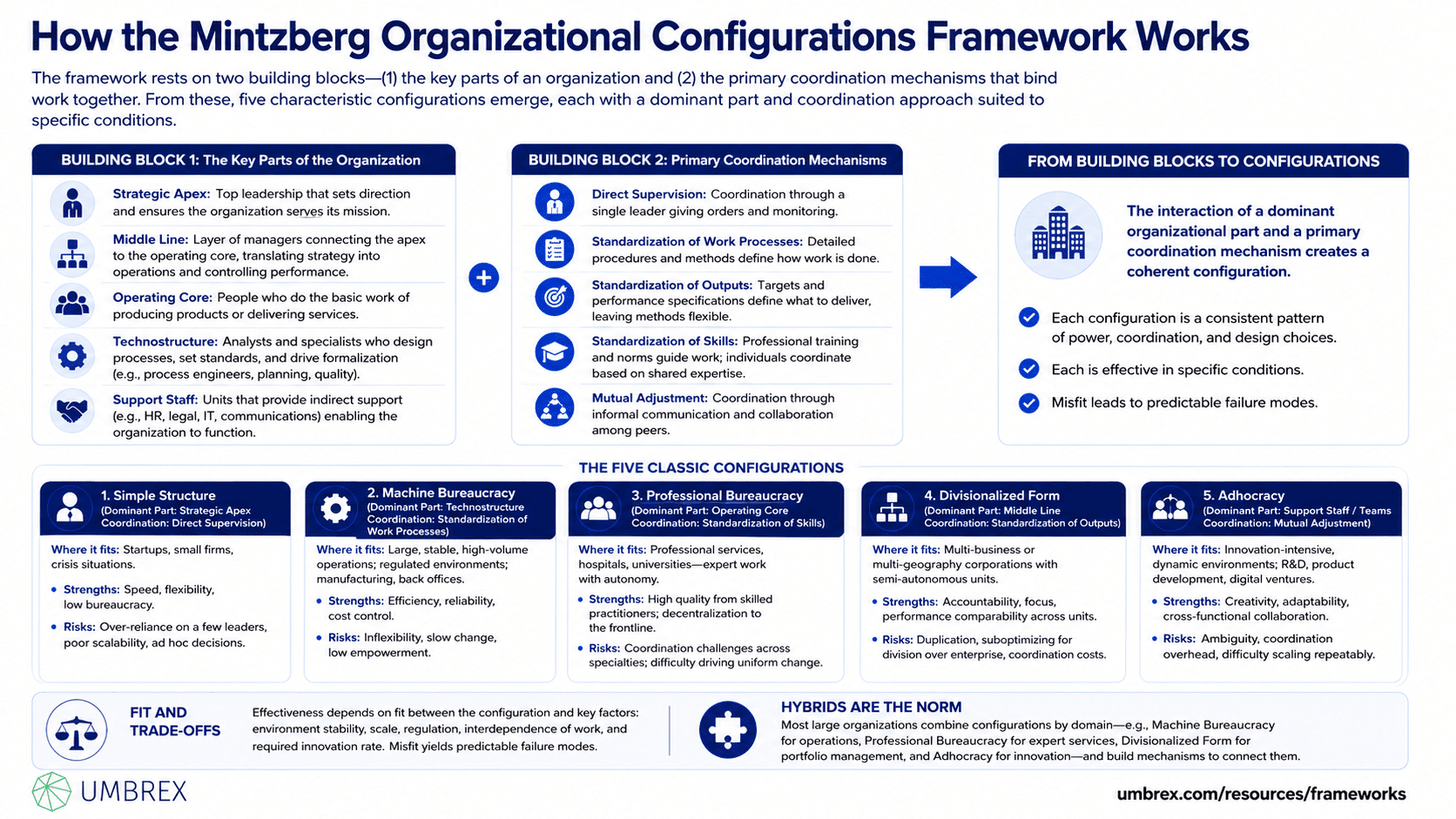
The framework rests on two building blocks: (1) the key parts of an organization and (2) the primary coordination mechanisms that bind work together. From these, characteristic “configurations” emerge, each with a dominant part and coordination approach suited to specific conditions.
The Five Key Parts of the Organization
Strategic Apex: The top leadership that sets direction and ensures the organization serves its mission.
Middle Line: The layer of managers connecting the apex to the operating core, translating strategy into operations and controlling performance.
Operating Core: The people who do the basic work of producing products or delivering services.
Technostructure: Analysts and specialists who design processes, set standards, and drive formalization (e.g., process engineers, planning, quality).
Support Staff: Units that provide indirect support (e.g., HR, legal, IT, communications) enabling the organization to function.
Primary Coordination Mechanisms
Direct Supervision: Coordination through a single leader giving orders and monitoring.
Standardization of Work Processes: Detailed procedures and methods define how work is done.
Standardization of Outputs: Targets and performance specifications define what to deliver, leaving methods flexible.
Standardization of Skills: Professional training and norms guide work; individuals coordinate based on shared expertise.
Mutual Adjustment: Coordination through informal communication and collaboration among peers.
The Classic Configurations
Simple Structure (dominant part: Strategic Apex; coordination: Direct Supervision)
Where it fits: Startups, small firms, crisis situations.
Strengths: Speed, flexibility, low bureaucracy.
Risks: Over‑reliance on a few leaders, poor scalability, ad hoc decisions.
Machine Bureaucracy (dominant part: Technostructure; coordination: Standardization of Work Processes)
Where it fits: Large, stable, high‑volume operations; regulated environments; manufacturing, back offices.
Mintzberg later described additional patterns (e.g., Missionary and Political forms), but in practice, the five above are the most widely applied in operating‑model work.
Putting It Together: Fit and Trade‑offs
Each configuration is a coherent “bundle” of design choices: who holds power, how decisions are made, the extent of formalization, and the skills required. Effectiveness depends on fit between the configuration and factors such as environment stability, scale, regulation, interdependence of work, and required innovation rate. Misfit yields predictable failure modes (e.g., Machine Bureaucracy in a fast‑changing market leads to slow response; Adhocracy at scale without guardrails leads to chaos).
Most large organizations are hybrids: a Machine Bureaucracy for operations, a Professional Bureaucracy for expert services, a Divisionalized Form for portfolio management, and an Adhocracy for innovation. The art is intentionally choosing which logic dominates where—and building mechanisms to connect them.
4. When to Use the Mintzberg Organizational Configurations Framework
Use this framework when you need a clear structural “pattern language” to match your operating model to strategy and environment, or to explain persistent execution issues rooted in mismatched coordination mechanisms.
Enterprise or BU redesigns: Choosing a primary structure (functional vs. product vs. geography) and governance model.
Scaling up: Transitioning from Simple Structure to Divisionalized Form or Machine Bureaucracy as complexity grows.
Innovation engines: Creating an Adhocracy (e.g., venture studio, digital lab) alongside a stable core.
Professionalizing expert work: Designing for Professional Bureaucracy with the right autonomy, standards, and peer controls.
Portfolio management: Introducing divisional accountability with enterprise synergies.
Especially powerful when: you must explain, in plain terms, why your current structure behaves the way it does and what will change if you shift the dominant configuration. It creates a shared language for trade‑offs (speed vs. reliability, autonomy vs. control).
Less suitable when: you need micro‑level process engineering (use Lean/Six Sigma), detailed decision rights design (RACI/RAPID), or collaboration network analytics (ONA). Mintzberg’s model is a macro design lens; it benefits from complementary depth tools.
Modern application: Practitioners often design intentional hybrids (e.g., Machine Bureaucracy operations with Adhocracy product teams) and use enabling mechanisms (platforms, APIs, agile cadences, OKRs) to achieve coherence across configurations.
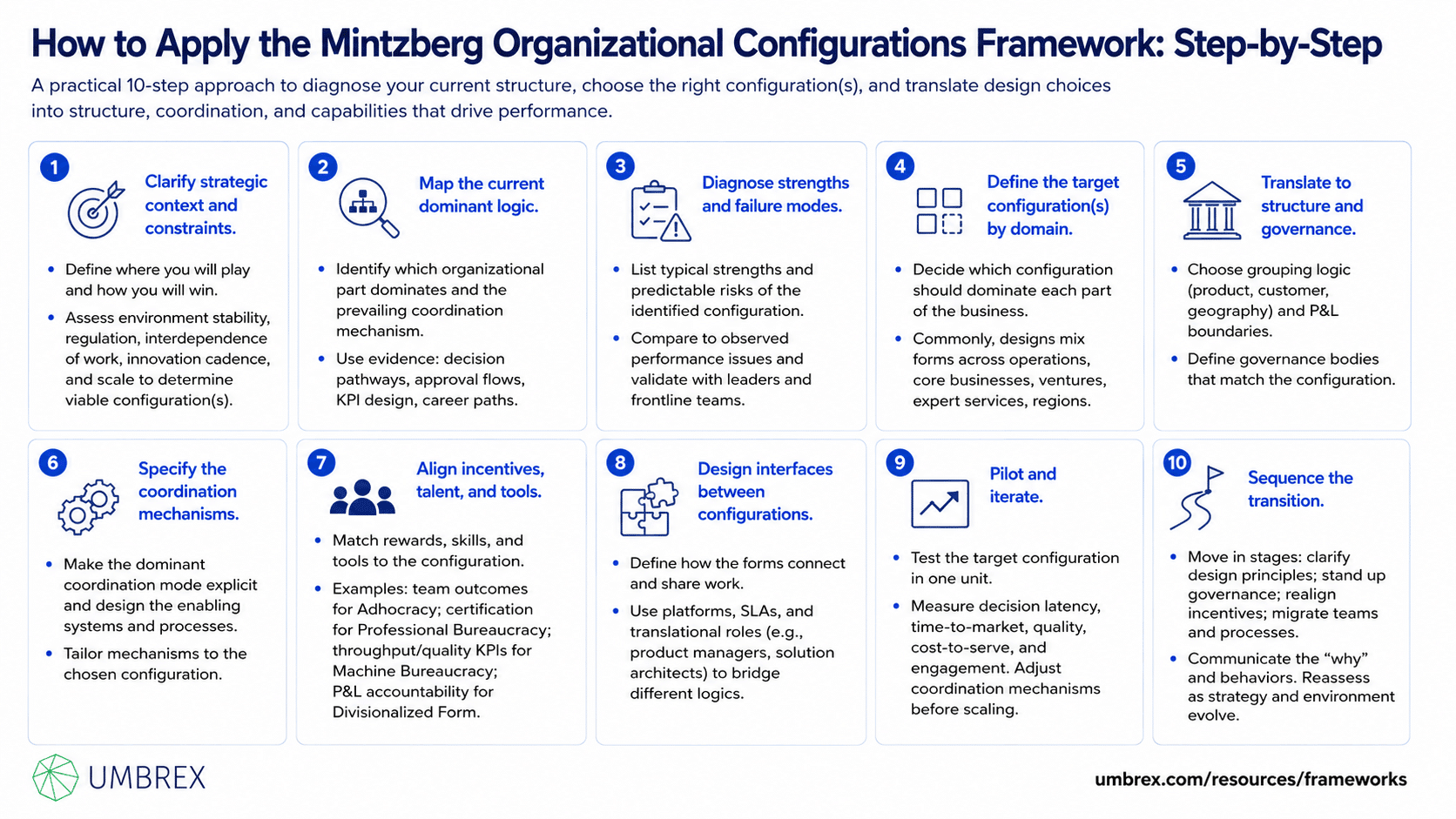
5. How to Apply the Mintzberg Organizational Configurations Framework: Step‑by‑Step
Clarify strategic context and constraints.Define where you will play and how you will win. Note environment stability, regulation, interdependence of work, innovation cadence, and scale. These factors determine which configuration(s) are viable.
Map the current dominant logic.Identify which organizational part currently dominates (apex, technostructure, operating core, middle line, support staff) and the prevailing coordination mechanism (direct supervision, standardization of processes/outputs/skills, mutual adjustment). Use evidence: decision pathways, approval flows, KPI design, career paths.
Diagnose strengths and failure modes.For the identified configuration, list typical strengths and predictable risks. Compare to observed performance issues (e.g., slow change, inconsistent quality, duplicated work). Validate with leaders and frontline teams.
Define the target configuration(s) by domain.Decide which configuration should dominate each part of the business:
operations/back office, core businesses, new ventures, expert services, regions. Many designs mix forms (e.g., Divisionalized Form for business units; Adhocracy for platform innovation; Machine Bureaucracy for shared services).
Translate to structure and governance.Choose grouping logic (product, customer, geography), P&L boundaries, and degree of centralization. Define governance bodies that match the configuration (e.g., portfolio board for divisional outputs; design authorities for standards; agile ceremonies for Adhocracy).
Specify the coordination mechanisms.Make the dominant coordination mode explicit:
for Machine Bureaucracy, codify process standards and quality systems; for Professional Bureaucracy, invest in training and communities of practice; for Divisionalized Form, set clear output metrics and comparability; for Adhocracy, establish cross‑functional teams, short cadences, and decision rights that favor mutual adjustment.
Align incentives, talent, and tools.Match rewards and skills to the configuration. Examples: team‑based outcomes and learning metrics for Adhocracy; professional certification and peer review for Professional Bureaucracy; throughput and quality KPIs for Machine Bureaucracy; P&L accountability for Divisionalized Form.
Design interfaces between configurations.Define how the forms connect: shared platforms and APIs between Adhocracy and Machine Bureaucracy; service‑level agreements between divisions and enterprise functions; translational roles (e.g., product managers, solution architects) to bridge professional and operational logics.
Pilot and iterate.Test the target configuration in one unit. Measure decision latency, time‑to‑market, quality, cost‑to‑serve, and engagement. Adjust coordination mechanisms before scaling.
Sequence the transition.Move in stages: clarify design principles; stand up governance; realign incentives; migrate teams and processes. Communicate the “why” behind the chosen configuration and the behaviors it implies. Reassess as the strategy and environment evolve.
6. Example: Mintzberg’s Configurations in Action
Company: A $1B B2B SaaS platform expanding from a single product into three industry solutions while running a scaled customer operations center.
Problem: The company had grown rapidly with an Adhocracy—cross‑functional product squads and mutual adjustment. As it added industry solutions and regions, performance diverged: innovation remained fast, but customer operations suffered inconsistent quality, and executives lacked clear accountability by market. The CEO debated centralization vs. autonomy.
Applying the framework:
Current diagnosis: Dominant Adhocracy in product (strength: rapid innovation; risk: inconsistent standards). Customer operations trending toward Machine Bureaucracy without coherent standards. No clear Divisionalized Form to manage industry P&Ls.
Target configuration by domain:
Product and platform innovation: Adhocracy with stable platform teams, short cadences, and empowered product owners.
Customer operations (support, onboarding): Machine Bureaucracy with standardized workflows, quality systems, and shared tooling.
Industry solutions (Financial Services, Healthcare, Retail): Divisionalized Form with P&L accountability and output metrics (ARR, NRR, time‑to‑value).
Coordination mechanisms:
Outputs: Quarterly business reviews and comparable KPIs across divisions.
Processes: Standardized onboarding and support runbooks in operations.
Mutual adjustment: Cross‑division product councils and agile ceremonies to reconcile roadmaps and platform dependencies.
Enablers: Divisional GM roles with P&L; platform governance for shared services; incentives balanced across innovation, quality, and growth.
Results: Within two quarters, onboarding defects fell 25% (Machine Bureaucracy gains), while time‑to‑market for platform features held steady (Adhocracy preserved). Industry divisions delivered clearer accountability; growth forecasts improved, and capital allocation shifted toward the best‑performing verticals.
7. Strengths and Limitations
Strengths
Sharp pattern recognition: Quickly explains why an organization behaves as it does and what trade‑offs come with that design.
Strategy–structure fit: Links environment and work type to appropriate coordination mechanisms.
Practical hybridization: Encourages intentional design of different configurations for different domains, with explicit interfaces.
Common language: Helps executives align on design choices without jargon or excessive detail.
Limitations
Idealized types: Real organizations are hybrids; forcing a “pure” form can mislead.
Static snapshot risk: The framework doesn’t prescribe how to evolve designs as strategy and scale change.
Limited micro‑design guidance: It doesn’t specify decision rights, process maps, or tech architecture—complementary tools are needed.
Digital/platform nuances: Platform ecosystems may require simultaneous standardization and loose coupling beyond classic categories; careful interface design is essential.
8. Common Pitfalls (and How to Avoid Them)
Labeling without action.What goes wrong: Teams declare “we’re an Adhocracy” and stop there.
How to avoid: Translate the chosen configuration into specific coordination mechanisms, incentives, and governance.
Forcing purity.What goes wrong: Attempting to make the whole enterprise a single configuration, ignoring domain differences.
How to avoid: Assign configurations by domain (e.g., operations vs. innovation) and design interfaces.
Ignoring environment fit.What goes wrong: Machine Bureaucracy in volatile markets or Adhocracy in highly regulated, safety‑critical contexts.
How to avoid: Start with environment and work characteristics; choose the configuration that fits constraints and risks.
Confusing outputs vs. processes.What goes wrong: Divisionalized Form without comparable KPIs or Machine Bureaucracy without real standards.
How to avoid: Make the dominant coordination mechanism explicit and instrumented (e.g., divisional scorecards; SOPs and audits).
Over‑indexing on structure.What goes wrong: Redrawing org charts without adjusting incentives, skills, and tools.
How to avoid: Align rewards, talent, and platforms to the chosen configuration.
Neglecting evolution.What goes wrong: Sticking with Simple Structure or Adhocracy too long as complexity grows.
How to avoid: Reassess configuration fit at growth milestones; plan transitions (e.g., to Divisionalized Form).
9. How Mintzberg’s Configurations Relate to Other Frameworks
Galbraith Star Model: Star specifies design levers (Structure, Processes, Rewards, People) to realize a strategy. Mintzberg provides the high‑level pattern (e.g., Adhocracy vs. Machine Bureaucracy) that guides which Star choices to make. Diagnose the pattern, then engineer the levers.
McKinsey 7S Framework: 7S inventories alignment across Strategy, Structure, Systems, Skills, Staff, Style, Shared Values. Mintzberg gives a structural archetype and coordination logic that you can test across the S’s (e.g., Adhocracy implies agile Systems, exploratory Skills, experimental Style).
Nadler–Tushman Congruence Model: Congruence analyzes “fit” among work, people, formal and informal organization. Use Mintzberg to hypothesize the dominant structural logic; use Congruence to test pairwise fit and root causes.
Weisbord Six‑Box Model: A simple diagnostic lens. Use Six‑Box to surface issues, then apply Mintzberg to choose structural patterns and coordination mechanisms that address them.
Ambidexterity (Explore/Exploit): While not a classic “framework page” here, the concept complements Mintzberg: run an Adhocracy for exploration and a Machine/Professional Bureaucracy for exploitation, with deliberate interfaces.
Execution toolkits: RACI/RAPID (decision rights), OKRs/Balanced Scorecard (output standardization), Agile practices (mutual adjustment), and Lean/Six Sigma (process standardization) instantiate the coordination mechanisms implied by each configuration.
Choosing among them: Use Mintzberg to pick the pattern; use Star/7S/Congruence to design and align; use execution toolkits to operationalize.
10. Key Takeaways
Mintzberg’s framework describes structural archetypes—Simple, Machine Bureaucracy, Professional Bureaucracy, Divisionalized, Adhocracy—each with a dominant coordination mechanism.
Effectiveness hinges on fit between configuration, environment, and work; misfit produces predictable failure modes.
Most enterprises are hybrids; assign configurations by domain and design robust interfaces.
The model is a macro design lens; pair it with detailed tools (Star, 7S, decision rights, process design) to get to implementation.
Revisit configuration choices as scale, regulation, and strategy evolve—what worked at $100M rarely works at $1B.
11. FAQs About Mintzberg Organizational Configurations
Is Mintzberg’s framework still relevant today?
Yes. The core idea—that different environments and work types require different coordination mechanisms—remains fundamental. Modern practice applies it to design intentional hybrids (e.g., Adhocracy for product, Machine Bureaucracy for operations) with platform and governance interfaces.
How does it differ from the McKinsey 7S or Galbraith Star Model?
Mintzberg provides archetypes and coordination logics (the “pattern”). 7S ensures alignment across hard/soft elements; Star guides specific design levers. Use Mintzberg to choose the pattern; use 7S/Star to flesh out the detailed operating model.
Can small or early‑stage companies use this framework?
Absolutely. It clarifies when to stay in Simple Structure and when to evolve toward Adhocracy (for innovation) or Divisionalized Form (for focus and accountability) as complexity grows. Keep the application lightweight—clear choices on who decides, how to coordinate, and what to standardize.
Can an organization be more than one configuration at once?
Yes—and most should be. The key is intentionality: decide which configuration dominates each domain and define interfaces (platforms, governance, metrics) so the parts don’t work at cross‑purposes.
How long does it take to apply Mintzberg’s framework in a real project?
A rapid diagnostic can be done in 2–4 weeks. Designing and piloting a hybrid model typically takes 6–12 weeks, depending on complexity, data availability, and the degree of change in incentives, governance, and platforms.

 The framework rests on two building blocks: (1) the key parts of an organization and (2) the primary coordination mechanisms that bind work together. From these, characteristic “configurations” emerge, each with a dominant part and coordination approach suited to specific conditions.
 Use this framework when you need a clear structural “pattern language” to match your operating model to strategy and environment, or to explain persistent execution issues rooted in mismatched coordination mechanisms.