
1. What Is Relational Coordination Framework?
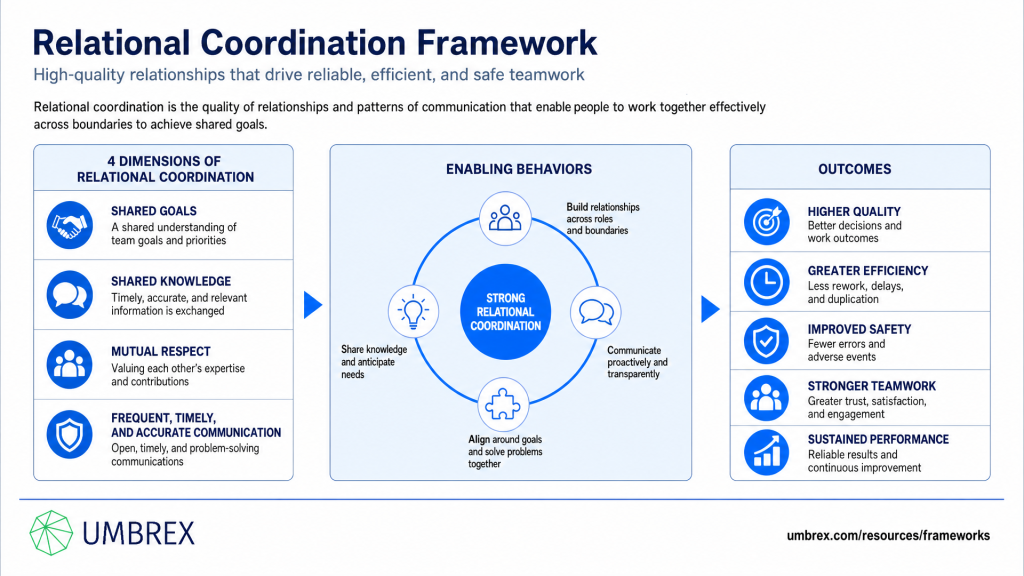
The Relational Coordination Framework is an organizational and team coordination framework used to understand how well people in different roles work together when the work is highly interdependent. Its central idea is simple: performance improves when people are connected by high-quality relationships and high-quality communication, especially when speed, judgment, and handoffs matter.
Unlike tools that focus only on structure, process, or individual behavior, this framework looks at the quality of coordination across role boundaries. Consultants often use it when the problem sits between teams rather than inside one team. Because of that boundary-spanning focus, it frequently becomes part of broader organization work aimed at improving handoffs, accountability, and execution.
2. Origin and Background
The framework was developed and popularized by Jody Hoffer Gittell through research that began in the airline industry in the 1990s and was formalized in published work by 2000. Her research explored why some organizations performed far better than others in settings where many specialized roles had to coordinate in real time. The concept became more widely known through subsequent academic articles, the 2003 book The Southwest Airlines Way, later sector-specific work in healthcare and other industries, and the development of the Relational Coordination Survey and related tools.
The problem the framework was designed to address is still familiar today: organizations often map processes carefully and define functions clearly, yet performance still breaks down at the seams. Traditional organization charts show reporting lines, and process maps show steps, but neither fully explains whether the people performing those steps share goals, understand one another’s work, respect one another’s constraints, or communicate in ways that solve problems quickly. Relational Coordination was created to make those hidden drivers visible.
3. How Relational Coordination Framework Works
At the heart of the framework is a reinforcing logic: strong relationships improve communication, and strong communication strengthens relationships. When both are present, teams coordinate complex work more effectively. When either side is weak, quality, speed, safety, cost, and employee experience often suffer.
| Category | Dimension | What strong performance looks like |
|---|---|---|
| Relationships | Shared goals | Roles optimize for the overall outcome, not only their own functional target. |
| Relationships | Shared knowledge | Each role understands how the others contribute and what constraints they face. |
| Relationships | Mutual respect | People value one another’s expertise and do not dismiss other roles as obstacles. |
| Communication | Frequent communication | Critical information is exchanged often enough to keep work moving. |
| Communication | Timely communication | Information arrives when it is still useful, not after decisions are effectively made. |
| Communication | Accurate communication | Messages are reliable and do not require repeated rework or clarification. |
| Communication | Problem-solving communication | People address issues constructively instead of blaming, escalating, or withholding. |
The unit of analysis is usually the relationship between roles, not individual personalities. For example, a company might assess coordination between sales and implementation, physicians and nurses, product managers and engineers, or procurement and manufacturing. That matters because the framework is trying to diagnose the work system, not simply identify who gets along with whom.
The framework is most powerful in work that has three features: high interdependence, uncertainty, and time pressure. In those environments, good process design alone is not enough. People need a common understanding of the task, visibility into each other’s work, and communication patterns that help them respond quickly when conditions change.
4. When to Use Relational Coordination Framework
The framework is especially useful when leaders know a cross-functional process is underperforming but cannot clearly explain why. Typical use cases include patient flow in healthcare, on-time operations in transportation, product development in technology, customer onboarding in SaaS, claims handling in insurance, and order-to-cash or forecast-to-fulfill processes in industrial companies. In each case, the key question is not just “What is the process?” but “How well do the roles involved actually coordinate?”
It is especially powerful when work spans multiple specialties and no single manager directly controls the whole workflow. The data required are usually manageable: a role-based survey, targeted interviews, workshops, and relevant operational metrics such as cycle time, defects, rework, safety incidents, service levels, or customer outcomes. A light diagnostic can be done in a few weeks; a more rigorous effort, tied to outcomes and intervention design, often takes six to ten weeks.
It is not a good fit for work that is largely independent, highly standardized, or minimally interdependent. It can also mislead if leaders treat it as a “soft culture” exercise divorced from structure, incentives, workload, or technology. Modern practitioners use it less as a standalone survey and more as a system-level diagnostic that informs workflow redesign, governance changes, management routines, and leadership behavior. The framework works best when teams accept that coordination quality is shaped by the design of work, not just by attitude.
5. How to Apply Relational Coordination Framework: Step-by-Step
- Define the focal work system. Start with one concrete workflow or performance problem, such as discharge planning, new product launch, customer onboarding, or monthly S&OP. Be explicit about scope, time horizon, business units, and the outcome you are trying to improve.
- Identify the roles and outcomes that matter. Define the units of analysis as roles, functions, or teams rather than named individuals. At the same time, agree on the outcome metrics that will anchor the discussion, such as speed, quality, safety, cost, employee burnout, or customer satisfaction.
- Gather quantitative and qualitative input. Use a role-based survey to assess the seven dimensions, then supplement it with interviews, observation, workflow reviews, and operational data. The interviews are important because they help distinguish a symptom from a root cause.
- Build the role-by-role view. Construct a matrix, heat map, or network map showing how each role rates coordination with the others. Look not only at averages but also at asymmetries; it is common for one role to believe coordination is strong while the other experiences it as weak.
- Interpret patterns in context. Examine where weak ties cluster and whether those weak ties align with performance bottlenecks. Pay particular attention to roles that sit at critical handoffs, bottleneck roles that are overloaded, and places where local optimization appears to undermine the whole system.
- Translate findings into interventions. Match each weak tie to specific changes: shared metrics, clearer escalation paths, meeting cadence, staffing adjustments, role redesign, technology enablement, or operating model redesign. The purpose is to turn a diagnostic into concrete managerial action.
- Test sensitivities and alternative explanations. Challenge the conclusions. Would the pattern look different if roles were defined differently, if you separated business units, or if you used a different time horizon? Could the issue be capacity, incentives, or technology rather than coordination quality alone?
- Align leaders, pilot changes, and remeasure. Review the findings with the relevant sponsors and frontline leaders, agree on a small number of interventions, and retest after implementation. The framework is most useful when used iteratively, not as a one-time workshop artifact.
6. Example: Relational Coordination Framework in Action
The problem
A fictional regional health system was struggling with delayed patient discharges. Beds were filling up, the emergency department was backing up, and clinicians blamed one another for the delays. The CEO had already reviewed process maps and staffing levels, but those analyses did not fully explain why the system remained unreliable.
Why the framework was selected
The discharge process required tight coordination among hospitalists, nurses, case managers, pharmacists, social workers, and transport. The work was highly interdependent, the patient mix was unpredictable, and timing mattered. The Relational Coordination Framework was chosen because the leadership team suspected that breakdowns at the interfaces between roles were a major part of the problem.
How it was applied
The team surveyed the relevant roles on the seven dimensions and paired the survey with interviews, observation of daily rounds, and data on discharge timing, length of stay, and avoidable rework. A role-by-role map showed that coordination within functions was reasonably strong, but coordination between hospitalists and case managers, and between nursing and pharmacy, was weak. Communication was frequent but often too late to be useful, and different roles were optimizing for different objectives.
The insights and actions
The diagnosis led to several changes: shared discharge-date goals, earlier interdisciplinary rounds, clearer escalation rules, and better visibility into pharmacy turnaround times. To make the new routines stick, the health system paired the redesign with disciplined management review and a sharper focus on team habits rather than heroics. Within a few months, discharge reliability improved because the underlying coordination system had improved, not because individuals simply worked harder.
7. Strengths and Limitations
Strengths
- Makes invisible coordination visible. It surfaces the quality of the relationships and communication patterns that standard org charts and process maps often miss.
- Focuses attention on interfaces. Many operational failures happen at handoffs, and the framework is designed precisely for those boundary points.
- Connects soft factors to hard outcomes. It gives leaders a disciplined way to discuss how trust, knowledge, and communication affect speed, quality, safety, and cost.
- Creates a common language. The seven dimensions are intuitive enough for executives and frontline teams to use productively.
- Works across industries. It has proved useful in airlines, healthcare, supply chains, education, professional services, and knowledge work.
Limitations
- It is partly perception-based. Survey responses are valuable, but they are still judgments. They should be triangulated with operational data and interviews.
- It is a snapshot, not a movie. Coordination changes over time, especially during seasonal peaks, crises, or transformation efforts.
- It is not a redesign blueprint. A low score tells you where coordination is weak, but not whether the answer is workflow change, staffing, technology, or clearer decision rights.
- Cause and effect can run both ways. Better relationships may improve performance, but strong performance can also improve how people perceive one another.
- It is less helpful for loosely coupled work. Where tasks are mostly independent, the framework adds less value than in tightly interdependent systems.
8. Common Pitfalls and How to Avoid Them
- Defining the scope too broadly. Teams sometimes assess an entire function or business unit instead of one specific work system. That produces vague findings. Keep the analysis focused on a concrete workflow with clear outcomes.
- Assessing people instead of roles. If the discussion becomes personal, defensiveness rises and the usefulness of the diagnosis falls. Frame the work around role interfaces and structural conditions, not personalities.
- Ignoring asymmetry. Average scores can hide the fact that one side of a relationship experiences the coordination very differently from the other. Always look for mismatched perceptions across the same interface.
- Treating it as a culture exercise only. Shared goals and mutual respect matter, but they are often shaped by metrics, workloads, and reporting lines. Pair relational findings with structural analysis.
- Using weak or outdated operational data. Without outcome data, the discussion can become abstract. Tie the diagnosis to measurable performance indicators that matter to the sponsor.
- Stopping at diagnosis. Many teams produce a beautiful heat map and then move on. Build interventions, assign owners, pilot changes, and remeasure to confirm that coordination is actually improving.
9. How Relational Coordination Framework Relates to Other Frameworks
Relational Coordination is best seen as a diagnostic lens, not a full redesign method. Once it shows which interfaces are failing, the broader work often shifts to organizational design: clarifying roles, governance, metrics, incentives, and routines so stronger coordination is built into the system.
Compared with RACI and decision-rights frameworks
RACI clarifies who is responsible, accountable, consulted, and informed. Relational Coordination asks a different question: even if the boxes are clear, do the roles actually coordinate well enough to deliver the outcome? In practice, the tools work well together. RACI can define the formal interface; Relational Coordination can test whether that interface works in reality.
Compared with process and network tools
Value stream mapping and customer journey mapping focus on the flow of work. Social network analysis maps interaction patterns among people or groups. Relational Coordination complements both by assessing the quality of cross-role communication and relationships around a specific task. For product and technology organizations, it also pairs well with team interaction models such as Team Topologies: those tools define how teams should interact, while Relational Coordination helps test how well those interactions actually function.
10. Key Takeaways
- Relational Coordination explains performance through the quality of communication and relationships across roles.
- It is most useful in work that is interdependent, uncertain, and time-sensitive.
- The framework examines seven dimensions: shared goals, shared knowledge, mutual respect, and communication that is frequent, timely, accurate, and problem-solving.
- Its real power is diagnostic: it shows where handoffs and interfaces are breaking down.
- It should be paired with outcome data and followed by concrete changes to roles, routines, governance, or workflow.
- The biggest mistake is treating it as a soft team-building exercise rather than a work-system design tool.
11. FAQs About Relational Coordination Framework
Is Relational Coordination Framework still relevant today?
Yes. It remains highly relevant because organizations are becoming more cross-functional, not less. What has changed is how it is used: strong practitioners now treat it as a system diagnostic tied to workflow, governance, and performance, rather than as a standalone survey about collaboration.
What is the difference between Relational Coordination Framework and RACI?
RACI defines formal responsibilities and involvement in decisions or tasks. Relational Coordination evaluates the quality of the working relationship and communication across those roles. One clarifies structure; the other tests whether the structure is actually producing effective coordination.
Can small or early-stage companies use Relational Coordination Framework?
Absolutely. Smaller companies can use a lighter version by focusing on one critical workflow and a handful of roles. They may not need a formal survey at first; structured interviews and a simple role-by-role discussion can still reveal important coordination gaps.
How long does it typically take to apply Relational Coordination Framework in a real project?
A rapid diagnostic can often be completed in two to four weeks. A fuller effort, including survey design, interviews, analysis, workshop sessions, and intervention planning, usually takes six to ten weeks depending on scope and stakeholder complexity.
What data is needed to use Relational Coordination Framework?
At minimum, you need a clear definition of the workflow, the roles involved, and some operational outcome data. The analysis becomes much stronger when you add role-based survey data, interviews, observation, and performance metrics such as cycle time, defects, service levels, safety events, or customer outcomes.
