

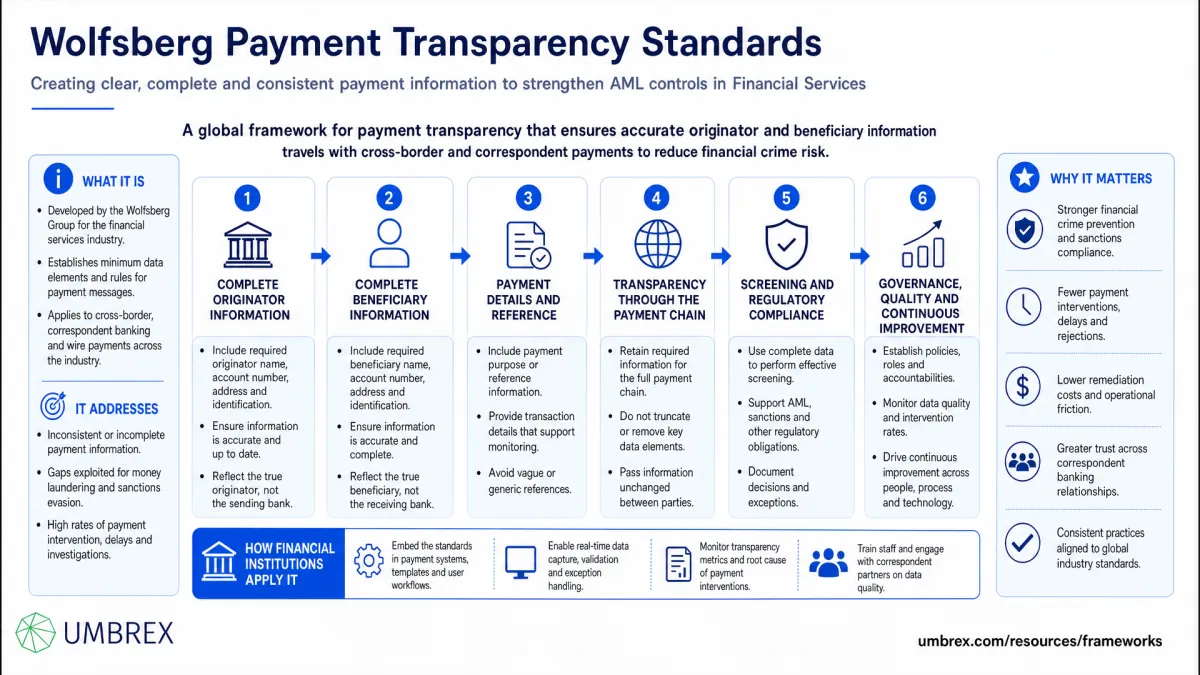
1. What Is Wolfsberg Payment Transparency Standards?
The Wolfsberg Payment Transparency Standards are an industry-developed control framework for making payer, payee, and participating-institution information understandable as payments move through a payment chain. They establish responsibilities for creating, transmitting, and using payment information—not a formula for calculating financial-crime risk.
For executives overseeing payments and networks, the central question is whether institutions handling a payment receive usable information about the transaction and its participants. Consultants can use the standards to structure payment-flow assessments, identify information gaps, and translate findings into changes to customer-data capture, message construction, partner arrangements, and operational controls.
2. Origin and Background
The Wolfsberg Group published Payment Transparency Standards in 2017 and replaced that edition in October 2023. The revised standards responded to changing payment methods, non-bank participation, increased intermediation, and messaging infrastructure that could obscure the parties behind a transfer.
On December 16, 2024, the Group published supplementary guidance on payment-transparency roles and responsibilities. Its 2026 guidance on banking services to non-bank payment service providers also builds on these publications. The framework has therefore developed beyond a bank-centric messaging discussion into a broader examination of responsibilities across payment ecosystems.
3. How Wolfsberg Payment Transparency Standards Works
The logic is role-based: establish appropriate information at origination, preserve it through transmission, and address deficiencies according to each participant’s responsibilities. A payment service provider (PSP) may be a bank or a non-bank provider. Payment market infrastructures (PMIs) support payment processing through their systems and participation rules. The standards address five stakeholder groups.
| Stakeholder group | Core responsibility |
|---|---|
| PMIs and competent authorities | Clarify permitted payment models, participant responsibilities, intermediation, and the information that supported formats can carry. |
| All PSPs | Represent parties accurately, cooperate lawfully, and avoid removing or changing information to evade detection. |
| Debtor agent PSP: the payer’s provider | Conduct applicable customer due diligence and ensure outgoing messages contain required information and appropriately represent the payment. |
| Intermediary agent PSP | Transmit received information, identify manifestly incomplete or meaningless information, and seek clarification or take other appropriate action. |
| Creditor agent PSP: the payee’s provider | Maintain risk-based procedures for handling deficient payments, including decisions to execute, reject, or suspend them. |
These responsibilities differ by role, applicable requirements, and information available to the institution; intermediaries do not necessarily have the originating provider’s customer relationship or visibility.
The 2023 standards address cross-border fiat payments and domestic payments where applicable under local regulations, regardless of value. They distinguish card-funded person-to-person transfers from purchases that may qualify for exceptions. They are not intended to apply directly to digital assets.
For management purposes, trace relevant names, addresses, account numbers or transaction references, and institution identifiers from source records to outgoing messages. Separate legally required information from scheme requirements and transparency enhancements: these categories should not become an undifferentiated checklist.
4. When to Use Wolfsberg Payment Transparency Standards
Use the standards when approving a payment product, opening a corridor, onboarding a payment-provider partner, changing message formats, or investigating recurring information deficiencies.
In commercial and SME banking, useful review subjects include corporate payment arrangements and payment-provider customers using correspondent accounts. Frame the assessment around questions such as:
- Whose information belongs in each payment field?
- Where could aggregation or message conversion remove useful detail?
- What can the receiving institution actually assess?
- Which deficiencies require product, partner, or system changes?
The approach is especially powerful at organizational and technical handoffs. It is not a substitute for an entire anti-money laundering (AML), sanctions, or fraud-control program. Nor should it become a portfolio-ranking tool.
A credible diagnostic requires representative message evidence and participation from operations, engineering, compliance, legal, and partner owners. Plan separately for evidence collection, assessment, and implementation; effort depends on routes, interfaces, and access to counterparties.
Keep the regulatory overlay current. The Financial Action Task Force (FATF) revised Recommendation 16 in June 2025, with countries expected to be ready to implement the changes by the end of 2030. That international timetable should not be confused with individual jurisdictions’ legal effective dates.
5. How to Apply Wolfsberg Payment Transparency Standards: Step-by-Step
The following is a practical consulting method, not a separately prescribed Wolfsberg implementation sequence.
- Clarify the decision and scope.
Specify whether management is approving a launch, retaining a partner, or remediating existing flows. Define products, corridors, currencies, customer types, payment infrastructures, and the institution’s role in each route. Include fallback routing.
- Gather evidence and requirements.
Collect customer instructions, incoming and outgoing messages, field mappings, customer identification records, scheme rules, contracts, and exception logs. Build a requirements register distinguishing law, infrastructure rules, Wolfsberg guidance, and internal policy. Obtain legal validation of regulatory interpretations.
- Define the units of analysis.
Assess a specific payment flow and each information handoff—not simply a business unit. Separate direct customer payments, correspondent processing, aggregated remittances, and corporate payment arrangements. Treat materially different routing configurations as separate cases.
- Construct the assessment artifact.
Draw an end-to-end flow map showing parties, providers, jurisdictions, message formats, and customer relationships. Attach a field-level matrix recording the required information, its source, received and transmitted values, applicable control, evidence, and accountable owner.
- Analyze gaps and consequences.
Compare actual payloads across handoffs. Distinguish missing source data, inaccurate role assignment, conversion losses, and information unavailable because of the payment model. Assess each gap against its applicable requirement rather than averaging deficiencies into a reassuring overall score.
- Translate findings into action.
Assign changes to data capture, message construction, routing, partner requirements, exception handling, or training. Define acceptance tests before development begins. Track meaningful-field completeness, transmission losses, repair workload, and unresolved information requests as proposed management measures—not Wolfsberg benchmarks.
- Test alternative configurations.
Replay representative payments through normal, fallback, and partner-change scenarios. Test long names, address variations, multiple intermediaries, and aggregation. Mandatory information is not an assumption to relax; the test is whether the proposed design preserves it.
- Align stakeholders and iterate.
Bring payments leadership, compliance, legal, technology, and relevant partners together to resolve interpretations. Establish escalation rights, independent validation, and evidence-based closure. Reassess the map when products, partners, or routing arrangements change.
A multi-corridor remediation effort can benefit from program management support to coordinate platform releases, partner amendments, operational readiness, and tested closure.
6. Example: Wolfsberg Payment Transparency Standards in Action
Fictional illustration: Northbridge Bank provides corporate payments and correspondent services to licensed remittance providers. An overseas partner repeatedly requests information about payments arriving with insufficient payer detail. Management must decide whether to expand the affected service or first change its design.
The team selects the standards because the problem spans several institutions and message formats. It examines individual customer-transfer flows separately from aggregate settlement movements, using customer instructions, incoming messages, conversion rules, outgoing payloads, and partner agreements.
The assessment identifies two different failures. One interface discards payer information that Northbridge received. Another route aggregates transfers under an arrangement whose transparency requirements have not been clearly documented. Treating both as a screening-system problem would miss their causes.
Northbridge pauses expansion of the affected route, repairs the interface, and requires a documented assessment of the aggregation model before continuing it. The bank and its partners agree on message requirements, information-request handling, and test evidence. Expansion depends on demonstrated information preservation, not merely successful settlement.
The follow-on AML and KYC controls work connects know-your-customer (KYC) records, payment-message policies, partner expectations, and evidence that the redesigned controls operate effectively.
7. Strengths and Limitations
Strengths
- Clarifies accountability. It helps teams distinguish what originates with the payer’s provider from what intermediaries and receiving providers can assess.
- Connects policy with infrastructure. It directs management attention toward message construction and transmission, not just written compliance commitments.
- Supports concrete investment decisions. A flow-level assessment can translate broad concerns into specific interface, routing, and partner changes.
Limitations
- Transparency is not comprehensive detection. The standards and supplementary guidance do not specify an entire customer-due-diligence, sanctions, monitoring, or recordkeeping program.
- Infrastructure constrains outcomes. Structured messaging helps, but inconsistent implementation can limit its benefits. A format upgrade alone does not establish reliable end-to-end information.
- Legal requirements remain jurisdiction-specific. International recommendations and industry guidance must be translated into applicable local requirements; information-sharing and privacy considerations also matter.
Executives should therefore treat a favorable assessment as evidence about payment transparency—not proof that a payment is legitimate or that every financial-crime obligation has been satisfied.
8. Common Pitfalls and How to Avoid Them
- Checking presence rather than meaning. A populated field may contain a placeholder or inappropriate party. Include substantive validation and sample review, rather than relying exclusively on technical acceptance.
- Confusing the provider with the payer. Do not automatically substitute a payment provider’s identity for underlying party information. Validate the legal roles and document any permitted exception.
- Reviewing only the final payout. Map the full customer-payment arrangement. A local disbursement should not be treated as sufficient evidence about the nature of preceding legs.
- Applying blanket aggregation judgments. Examine the actual model, information available, applicable rules, and customer relationships. Avoid assuming that every batch is unacceptable—or that every settlement arrangement is adequately transparent.
- Closing findings on policy changes alone. Require message replay, downstream evidence, operational acceptance, and named ownership. A revised procedure does not demonstrate that an interface preserves information.
9. How Wolfsberg Payment Transparency Standards Relates to Other Frameworks
Before: Risk-based assessment
Use a financial-crime risk assessment to prioritize products, corridors, and relationships for examination. Then use payment-transparency analysis to inspect the relevant flows. Risk prioritization should guide attention and control design, not become a rationale for disregarding applicable information requirements.
Alongside: ISO 20022 harmonization
ISO 20022—the International Organization for Standardization’s financial messaging standard—addresses structured information exchange. The Committee on Payments and Market Infrastructures’ harmonization requirements support consistent implementation. Combine these technical requirements with Wolfsberg’s role-based perspective: one helps structure messages; the other helps explain responsibilities for their information.
Alongside and after: Correspondent-banking due diligence
The Wolfsberg Correspondent Banking Due Diligence Questionnaire supports institution-level relationship assessment. Payment-transparency analysis examines transaction flows and their information. Use relationship due diligence to understand a provider’s model, then test whether actual payment behavior matches the agreed arrangement. Neither lens should replace the other.
10. Key Takeaways
- Assess usable payment information, not merely successful settlement.
- Define responsibilities by payment role and customer relationship.
- Use flow maps and actual message evidence to locate deficiencies.
- Separate legal obligations, scheme rules, and transparency enhancements.
- Close gaps through tested operational changes—not policy documents alone.
11. FAQs About Wolfsberg Payment Transparency Standards
Are the Wolfsberg Payment Transparency Standards legally mandatory?
They are industry standards, not a standalone statute. Determine binding obligations from applicable law and payment-system rules. For example, the United States funds Travel Rule has its own scope and information requirements.
Does adopting ISO 20022 guarantee payment transparency?
No. Structured formats create capacity for better information, but their benefits depend on consistent implementation. Test data sourcing, mapping, transmission, and downstream usability rather than equating format adoption with transparency.
What data is needed for a useful assessment?
Start with representative payment instructions, incoming and outgoing messages, field mappings, route descriptions, and applicable requirements. Add customer records, exception histories, and partner agreements to explain why information is missing or inconsistent.
Can smaller payment providers use the standards?
Yes. Start with one material product or corridor, a simple flow diagram, and a field-level evidence register. Keep the assessment manageable, but retain legal validation, named ownership, and testing of proposed changes.
