
Florida Crystals Strategy and Business Model
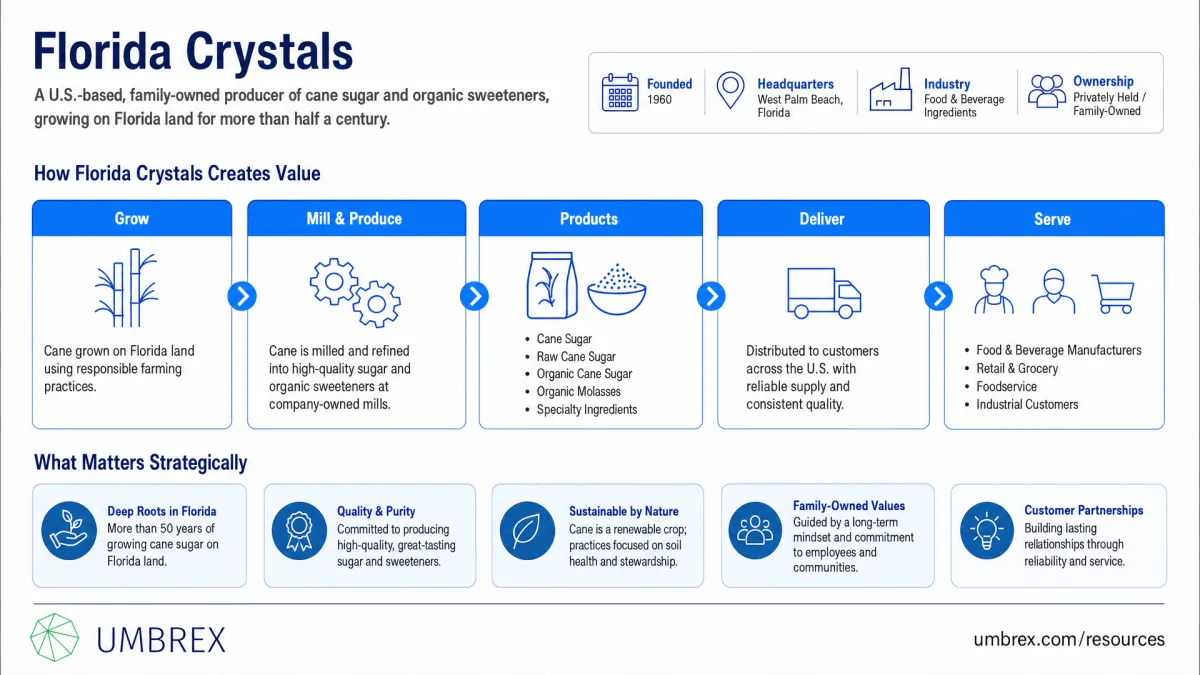
Executive Overview
Florida Crystals is a privately held, Fanjul-family-owned agricultural and food business headquartered in West Palm Beach, Florida. Its core operations combine sugarcane and rotational crop production with sugar milling, refining, packaging, rice processing and renewable-energy generation. The corporation is substantially broader than the Florida Crystals consumer sugar brand: its holdings include ASR Group, the international cane-sugar refining and marketing business, and FCI Residential, an apartment developer and operator. Principal customers include grocery retailers, food and beverage manufacturers, foodservice businesses and, through the property business, apartment residents.
The business creates value by connecting agricultural production with processing, established brands and distribution. Florida provides its farming and industrial base, while ASR extends its footprint across North America, Central America and Europe. Strategically, the combination offers several ways to compete: dependable industrial supply, recognizable regional sugar brands, differentiated U.S.-grown organic products and productive use of agricultural byproducts. A reasonable interpretation is that Florida Crystals seeks to capture more value from its crops and capabilities rather than compete solely as a raw-sugar producer. That integration also makes coordination across harvests, factories, inventories and customer demand particularly important.
Florida Crystals at a Glance
| Logo |  |
|---|---|
| Name | Florida Crystals |
| Headquarters | West Palm Beach, Florida |
| Industry | Agriculture & Food |
| Year Founded | Not supplied |
1. What Is the Strategy of Florida Crystals?
The following assessment uses the five-choice structure associated with A.G. Lafley and Roger Martin’s Playing to Win framework. It is an external interpretation, not a claim that Florida Crystals formally uses that framework.
1a. What Is the Winning Aspiration of Florida Crystals?
Success appears to mean sustaining a multigenerational agricultural business while delivering reliable food products and extracting more value from its farming and processing capabilities. For the Florida Crystals consumer brand, the customer promise emphasizes domestic provenance, traceability and differentiated organic sugars. The broader corporation also competes through conventional sugar production, industrial service and downstream businesses; its aspiration should therefore not be reduced to organic retail sugar alone.
1b. Where Does Florida Crystals Play?
The core playing field is the cane-sugar value chain, from cultivation through packaged consumer products and industrial ingredients. Rice and vegetables complement the agricultural base. ASR adds international refining, regional brands and specialty sweeteners, while Tellus and FCI Residential extend the portfolio into plant-fiber foodservice products and rental housing. These are distinct activities with different customers and economics, rather than interchangeable extensions of a single consumer brand.
1c. How Does Florida Crystals Plan to Win?
The available evidence suggests three complementary sources of advantage:
- Control over production: farming and milling integration supports traceability and coordination of sugarcane supply with processing requirements.
- Differentiation where customers value it: U.S.-grown organic sugars provide a distinct proposition alongside the broader group’s conventional offerings.
- More complete use of resources: sugarcane fiber supplies energy, and recovered agricultural and processing materials become compost. The strategic benefit is both resource efficiency and reduced dependence on selected purchased inputs.
1d. What Capabilities Must Florida Crystals Have in Place?
Executing this model requires coordinated agronomy, harvest scheduling, milling expertise, food-quality control, certification management and distribution. Organic and conventional production also require disciplined identification and handling of product streams. At the customer interface, specialty ingredients require technical support, while branded sugar requires packaging and retail execution. These are capability requirements inferred from the company’s disclosed activities, not a description of an unpublished internal capability model.
1e. What Management Systems Does Florida Crystals Require?
Analytically, the critical disciplines are integrated crop and factory planning, raw-sugar inventory management, maintenance planning, product traceability, environmental monitoring and capital allocation. A particularly important coordination problem is that Florida’s sugarcane harvest is seasonal while refining continues year-round. Management therefore needs to balance agricultural output, storage, processing capacity and customer commitments rather than optimize each activity independently.
2. Strategic Priorities
Several durable themes are visible in public actions, although they should not be mistaken for a complete official strategic plan:
- Protecting agricultural productivity: the company’s regenerative agriculture program emphasizes soil health, biodiversity, water conservation, byproduct reuse and reduced synthetic inputs.
- Making differentiation verifiable: Regenerative Organic Certified products and related packaging connect farming practices to a recognizable customer proposition.
- Expanding downstream service capabilities: ASR’s acquisition of Ingredients Plus added liquid and bulk processing, packaging and regional delivery capabilities.
- Developing adjacent uses and markets: rice flour and Tellus foodservice products extend the portfolio beyond conventional packaged sugar. Tellus uses globally sourced plant fibers, so its business should not be described simply as converting Florida Crystals’ own cane residue into tableware.
3. Business Model
Florida Crystals primarily earns income by selling physical products: sugar, related sweeteners, rice and other agricultural or manufactured offerings. Customers pay for a combination of ingredient functionality, consistent specifications, packaging, dependable availability and delivery. Retail brands add consumer recognition and product positioning; business customers place greater emphasis on production suitability and service reliability.
The strategic economics differ across the portfolio. Standard sugar depends heavily on efficient processing and logistics, whereas differentiated organic products can compete on provenance and certification as well as price. Specialty processing and delivery can make an otherwise substitutable ingredient more useful to a customer. This interpretation follows from the group’s combination of certified products, regional delivery capabilities and multiple product formats.
Repeat business depends on replenishment and consistent performance rather than a software-style subscription. Structural performance drivers include crop productivity, recoverable sugar, factory utilization, energy requirements, packaging complexity and freight. Separately, FCI Residential operates a residential rental development and management model, creating a different source of recurring customer payments and a different set of capital-allocation decisions.
4. Products and Services
| Offering | Scope and strategic role |
|---|---|
| Cane sugar and specialty sweeteners | The group serves grocery, industrial and foodservice markets with conventional sugar and specialty sweetening products. This broad offering supports both consumer brands and ingredient relationships. |
| Florida Crystals branded sugars | The consumer range includes regenerative organic raw cane, light brown and powdered sugars, alongside raw turbinado sugar. Organic certification should not be assumed to apply to every product bearing the brand. |
| Rice and rice flour | Organic and conventional brown and white rice, rice flour and heat-treated rice flour connect rotational agriculture to foodservice and manufacturing applications, including gluten-free formulations. |
| Liquid ingredients and delivery services | Ingredients Plus provides liquid and bulk processing, packaging and transportation capabilities. Its value proposition includes getting ingredients to manufacturers in appropriate forms and delivery windows. |
| Tellus foodservice products | U.S.-made plant-fiber products provide an adjacent offering for foodservice customers. ASR specifically identifies Tellus Classic products as compostable; claims should be checked at the product level rather than generalized across every range. |
| Renewable electricity | Sugarcane fiber supports internal energy generation, with excess electricity supplied to the Florida grid. Energy is therefore both an operating input and an additional useful output of the agricultural system. |
| Rental communities | FCI Residential develops, constructs and manages apartment communities. This is a separate property business, not a distribution channel for the food operations. |
5. Competitors and Peers
Competition varies by product and geography. The following comparisons are based on overlapping offerings, not a claim that every company competes for every Florida Crystals account. Domino, C&H and Redpath belong to the ASR portfolio and should not be listed as independent competitors.
| Company or business | Competitive relevance |
|---|---|
| U.S. Sugar | A direct U.S. cane-sugar competitor with Florida farming and processing operations and refining in Florida and Georgia. Its integrated production model makes it particularly relevant to comparisons of manufacturing, agricultural efficiency and domestic supply. |
| Wholesome | A differentiated retail competitor in organic cane sugar. Its organic and Fair Trade positioning overlaps with shoppers seeking alternatives to conventional sugar, while its sourcing proposition differs from Florida Crystals’ U.S.-grown positioning. |
| Lantic | A Canadian sugar and sweetener competitor relevant to ASR’s Redpath business. Its Lantic and Rogers brands and industrial ingredient operations overlap in household, food-manufacturing and specialty sweetener markets. |
| British Sugar | A relevant U.K. comparator to ASR’s Tate & Lyle Sugars operations. Its manufacturing footprint and Silver Spoon retail brand create overlap in the British sugar market. |
| Cargill | A diversified ingredient competitor and supplier of substitutes. Its portfolio includes sugar, corn sweeteners, stevia and other sugar-reduction ingredients, making competition partly about manufacturers’ formulation choices rather than simply switching sugar suppliers. |
6. Marketing Strategy
Florida Crystals’ consumer marketing links product performance with a farming story. Packaging communicates origin and certifications, while recipes, baking advice, farmer stories and social content demonstrate everyday uses. This makes an ingredient purchase more distinctive without requiring consumers to understand the corporation’s wider refining and property portfolio.
The business-to-business approach is more application-oriented. Product information, sample requests, available formats and distributor access help buyers evaluate an ingredient or foodservice product. Rice flour marketing, for example, addresses manufacturing uses rather than home-baking imagery alone. A reasonable strategic interpretation is that consumer marketing creates preference, while technical marketing reduces uncertainty about suitability and supply.
7. Customer Segments
- Retail buyers and households: retailers provide access to consumers who use sugar for baking, cooking and beverages. The commercial buyer and ultimate user are usually different.
- Food and beverage manufacturers: customers in packaged food and beverage manufacturing purchase ingredients for their own production processes. Specifications and dependable supply matter alongside price.
- Foodservice businesses: distributors and operators buy bulk ingredients, portion-controlled sweeteners and, through Tellus, disposable foodservice products.
- Specialty manufacturers: the group also markets specialty sweeteners to pharmaceutical manufacturers, illustrating that its ingredient relationships extend beyond household food brands.
- Apartment residents: FCI Residential serves a separate consumer market through leasing and ongoing property services.
8. Sales and Distribution Model
The sales model combines retail distribution with business-account engagement and foodservice channels. The consumer website directs shoppers to stores and retailer purchasing options. Professional product pages provide contact, distributor-finding and sample-request routes, supporting evaluation before an account purchases at operating scale.
Ingredients Plus adds a more service-intensive route to market through its processing facilities, truck fleet and rail infrastructure in the northeastern and mid-Atlantic United States. Its positioning illustrates how delivery capability can be part of the product proposition rather than merely a back-office function.
Analytically, channel design must balance coverage against customer intimacy. Retailers and distributors broaden access, while direct commercial and technical engagement helps explain product specifications and service requirements. Different formats also create different fulfillment needs: portion packs, retail bags and industrial ingredients should not be treated as one undifferentiated distribution problem.
9. Geographic Footprint
Florida Crystals’ agricultural and industrial base is concentrated in western Palm Beach County. Important facilities include the Okeelanta and Osceola sugar mills, the Florida refinery and packaging operations, and the rice mill in Belle Glade. The concentration links fields and processing assets, but also makes regional weather and infrastructure resilience strategically important.
ASR extends the group beyond Florida through refining operations in the United States, Canada, Mexico, the United Kingdom and Portugal, and a refining joint venture in Italy. It also farms and mills sugarcane in Mexico and Belize. Consequently, the global group’s products should not all be described as originating on Florida farms. FCI Residential’s apartment portfolio is a separate Florida-focused footprint.
10. Who Owns Florida Crystals?
Florida Crystals is a privately held, Fanjul-family-owned business associated with the broader Fanjul corporate group. Family ownership should not be interpreted as disclosure of individual family members’ stakes or a complete shareholder register.
A significant structural change occurred in 2024, when Florida Crystals became the sole owner of ASR Group. Earlier descriptions of ASR as jointly owned with Sugar Cane Growers Cooperative of Florida describe the historical arrangement. ASR’s sustainability reporting also distinguishes its legal entity and board from Florida Crystals, despite the ownership relationship.
11. Organization
The public record supports the following practical organizational distinctions:
- Florida agricultural and processing operations: farming, sugar milling and refining, rice processing, packaging, distribution, composting and biomass energy.
- ASR Group: a holding-company structure operating through refining, manufacturing and marketing subsidiaries. It is not simply another product brand.
- Tellus: a distinct plant-fiber products business within the Florida Crystals and ASR corporate family.
- FCI Residential: the subsidiary responsible for apartment development, construction and management.
These are operating and legal distinctions, not a reconstruction of formal financial reporting segments. Consumer brands, manufacturing companies and corporate ownership entities should remain separate concepts when assessing accountability or portfolio performance.
12. Operations
Coordinating farms with processing
The operating cycle begins with crop management and harvest preparation. Company-described practices include rotating sugarcane with rice, vegetables and cover crops, using barn owls for pest control and returning recovered materials to the land. Harvest scheduling must then connect field activity with mill availability. The managerial objective is coordinated throughput and product quality, not simply maximizing field or factory output independently.
Separating milling from refining
Mills process sugarcane, while refining converts raw sugar into further processed products. Florida Crystals’ Okeelanta food-grade mill also produces differentiated organic and raw cane sugars. This distinction matters: not every product follows the same processing route. Seasonal milling and year-round refining create an inherent need for inventory planning and coordinated maintenance.
Recovering useful materials
Sugarcane fiber supplies energy, while the compost operation combines materials such as recovered soil, leaves and boiler ash. This creates operating links between agriculture, mills, energy generation and soil management. The company’s compost facility also uses conveyors and piping for much of its material movement, reducing the need to handle every transfer by truck.
Preparing products for customers
Packaging and distribution turn processed sugar into usable customer formats. Florida Crystals has documented the development of its Okeelanta packaging operation and the associated maintenance, engineering and materials responsibilities. Operationally, packaging changeovers, equipment reliability and order accuracy must be managed alongside upstream production.
13. Growth Opportunities
Publicly pursued avenues include certified organic products, rice-based ingredients and expanded processing and logistics capabilities through Ingredients Plus. These developments provide a basis for growth without assuming that the company has announced a particular volume or geographic target.
Several further opportunities follow from the disclosed capabilities. These are external strategic assessments:
- Deepen differentiated ingredient relationships: use certified sugar, molasses and rice products to serve manufacturers seeking documented agricultural provenance.
- Develop rice-flour applications: target manufacturing uses where treatment, consistency and technical support matter more than selling undifferentiated grain.
- Improve conversion of consumer interest into purchases: connect recipes, product education, packaging and retailer availability more closely.
- Prioritize integration productivity: evaluate whether better planning, maintenance and inventory coordination offer more attractive returns than simply adding processing capacity.
Important constraints include agricultural seasonality, capital requirements, certification integrity and competition from sugar-reduction solutions. Growth analysis should therefore distinguish gaining share or adding service value from assuming that customers will continually increase sugar consumption.
14. History
The company’s published history dates its Florida farming and milling business to 1960, when the Fanjul family established operations in Pahokee. The family brought sugar-industry experience from Cuba and assembled the Osceola mill using equipment acquired from Louisiana mills. Subsequent farmland purchases and acquisitions expanded the agricultural base.
Three developments explain much of the business today. Organic sugarcane farming created a differentiated product path during the 1990s. Expansion into large-scale refining established the foundation for the international ASR business. The creation of FCI Residential in 2012 introduced a separate property-development activity drawing on land-management experience.
Later developments strengthened that model rather than replacing it. Organic sugar, molasses and rice received Regenerative Organic Certified status in 2022, and Florida Crystals became ASR’s sole owner in 2024. The resulting company combines an agricultural origin with downstream manufacturing, brands and distinct adjacent businesses.
15. Brand Portfolio
The group’s brands serve different markets and should not be treated as interchangeable labels:
- Florida Crystals: differentiated U.S.-grown sugar products, including certified organic offerings. The name identifies both the corporation and a consumer brand, but their scopes differ.
- Domino and C&H: established U.S. sugar brands within ASR, supporting consumer and professional channels.
- Redpath: the group’s Canadian sugar brand.
- Tate & Lyle, Lyle’s and Sidul: brands associated with the group’s British and Portuguese businesses.
- Tellus: the brand for plant-fiber foodservice products rather than sweeteners.
Brand rights also require care: ASR’s 2024 acquisition of a U.K. packaging business included a license to use the Whitworths Sugar brand. A licensed brand should not automatically be described as owned outright.
16. Technology and Innovation
Technology as an operating enabler
Florida Crystals describes precision agriculture as part of its farming approach. The strategic role is to support resource management and agricultural decisions, rather than turn the business into a software provider. Its published regenerative program also emphasizes testing and farm-level information.
A documented warehouse example is the use of laser-guided vehicles receiving work from the company’s SAP system. This shows a connection between enterprise orders and physical product movement. It does not establish the architecture or deployment status of every system across the international group.
Energy reliability and process innovation
In 2023, Florida Crystals installed solar generation and a Tesla Megapack battery at its Sem-Chi rice mill. Beyond energy sourcing, the project addressed continuity of power for equipment such as storage-silo fans. That is strategically relevant because stored rice must be protected during a period that can coincide with hurricane-related outages.
Product innovation is visible in heat-treated rice flour and in the broader ASR group’s application-development resources, including its Boca Raton innovation center. Together, these examples suggest an innovation model centered on practical farming, processing, ingredient and customer-use problems rather than technology development detached from the core business.
17. Environmental and Market Constraints
Sugar-market structure: U.S. sugar operates within a policy framework that includes domestic marketing allotments and tariff-rate quotas. Florida Crystals’ domestic competitive position therefore cannot be assessed as though sugar moved through an unrestricted global market. Changes in market-access rules are a structural planning consideration, even when no specific policy change is assumed.
Water management: agriculture in the Everglades Agricultural Area operates within a phosphorus-control and monitoring framework. The South Florida Water Management District reports results for the basin collectively; those outcomes should not be attributed entirely to Florida Crystals. Nutrient, irrigation and sediment management are consequently operating disciplines as well as environmental issues.
Harvesting practices and community concerns: preharvest cane burning has drawn community complaints and air-quality scrutiny. Florida Crystals has disputed claims linking cane burning to residents’ health problems.
The strategic implication is that product certifications, environmental monitoring and community engagement address different questions. Certification should not substitute for site-level operating evidence, and sustainability messaging should remain specific to the practice, facility or product being described. This is an analytical governance recommendation rather than a claim about an unpublished company policy.
18. Major Acquisitions
Acquisitions expanded the group’s position from Florida agriculture into refining, brands and customer service. Much of that expansion occurred through ASR and its predecessor arrangements.
| Year | Development | Strategic contribution |
|---|---|---|
| 1998 | Refined Sugars and its Yonkers refinery | Established a downstream refining platform through the partnership with Sugar Cane Growers Cooperative. |
| 2001 | Domino Sugar | Added East Coast refining assets and an established consumer brand. |
| 2005 | C&H Sugar | Extended refining and branded-market access on the U.S. West Coast. |
| 2007 | Redpath Sugar and Ingenio San Nicolás | Expanded into Canada and added Mexican milling and refining capabilities. |
| 2010 | Tate & Lyle Sugars | Added British and Portuguese refining operations and regional brands. |
| 2012 | Investment in Belize Sugar Industries | Extended the group into Central American sugar production and sourcing. |
| 2024 | Ingredients Plus | Added sweetener processing and regional logistics capabilities closer to manufacturing customers. |
19. How Companies Like Florida Crystals Leverage Independent Consultants through Umbrex
Umbrex has built a global community of more than 8,000 independent management consultants based in more than 50 countries, including alumni of McKinsey, Bain, BCG and other top firms. Companies engage Umbrex when they need experienced consulting talent without necessarily requiring the structure and overhead of a full traditional consulting team. Consultants work across strategy, operations, organization, marketing, sales, finance, technology, enterprise resource planning and artificial intelligence.
For a business with Florida Crystals’ operating characteristics, representative projects could include:
- Harvest-to-mill planning: coordinate field readiness, harvesting resources, transport and mill availability, with scenarios for weather disruptions and processing bottlenecks.
- Seasonal inventory and production planning: connect the cane harvest with raw-sugar storage, year-round refining, packaging schedules and customer commitments.
- Organic product and packaging economics: assess pack sizes, retail positioning, promotional spending and the cost of maintaining differentiated certified offerings.
- Industrial account development: identify account-level opportunities across sugar, molasses, rice flour and liquid ingredients, including technical qualification and service requirements.
- Distribution network optimization: evaluate factory, warehouse and regional delivery flows, balancing inventory, transport expense, order formats and customer service.
- Energy and byproduct allocation: compare investments in biomass energy, composting and other material-recovery uses without assuming that every proposed use is economically interchangeable.
- Enterprise data and planning readiness: assess interfaces among SAP, inventory, quality and operating data, including the feasibility of AI-assisted planning or maintenance rather than assuming existing deployment.
- Organization and shared-service design: clarify decision rights among Florida operations, ASR and specialized subsidiaries while preserving appropriate legal and operational accountability.
- Portfolio capital allocation: compare agricultural, processing, packaging and residential-development investments using business-specific risks, constraints and return requirements.
- Certification and environmental-claims governance: connect farm records, product traceability, operating evidence and marketing approvals so that claims remain specific and supportable.
These are illustrative consulting opportunities, not statements that Florida Crystals has engaged Umbrex.