
Breakthru Beverage Group Strategy and Business Model
Executive Overview
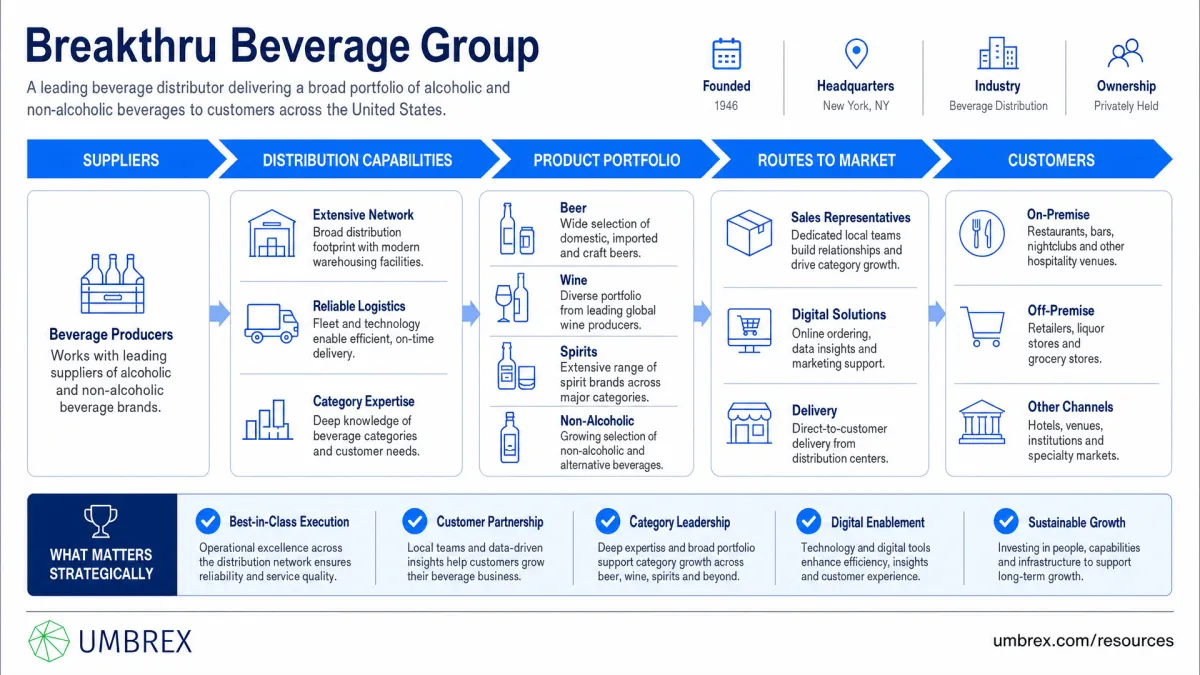
Breakthru Beverage Group is a privately held beverage wholesaler connecting producers and importers with retailers, bars, restaurants, and other licensed buyers. Within the consumer and retail sector, its core activity is wine, beer, and spirits distribution, complemented by non-alcoholic beverages. Headquartered in New York, New York, Breakthru operates across multiple U.S. regions and maintains a Canadian sales brokerage business. Its principal offering is market access: a combination of local sales relationships, product availability, delivery, brand development, and customer support.
The company creates value for both sides of the distribution relationship. Suppliers gain commercial representation and access to fragmented retail and hospitality accounts; customers gain a broad assortment and support in selecting, purchasing, and selling beverages. Breakthru combines this distribution infrastructure with specialist capabilities, including Aspect fine wine services, Trident emerging-brand development, and the Breakthru Now ordering platform. A reasonable strategic interpretation is that Breakthru seeks the efficiency of a coordinated, multistate distributor without losing the product expertise and local relationships associated with specialist wholesalers. Executing that combination requires disciplined portfolio selection, reliable fulfillment, and careful allocation of sales attention.
Breakthru Beverage Group at a Glance
| Logo |  |
|---|---|
| Name | Breakthru Beverage Group |
| Headquarters | New York, New York |
| Industry | Consumer Packaged Goods, Retail |
| Year Founded | 2016 |
1. What Is the Strategy of Breakthru Beverage Group?
The following analysis applies the five connected choices in the Playing to Win framework developed by A.G. Lafley and Roger Martin. It is an external interpretation of Breakthru’s activities, not a claim that the company formally uses that framework.
1a. What Is the Winning Aspiration of Breakthru Beverage Group?
Breakthru’s public positioning emphasizes becoming the preferred distribution partner for suppliers and customers. Its promise extends beyond transporting beverages: it aims to help suppliers build brands while making customers’ businesses easier to operate. Success therefore appears to mean earning durable supplier mandates and customer relationships through dependable service, commercial expertise, and innovation. Family ownership and the company’s emphasis on its multigenerational heritage reinforce this long-term positioning.
1b. Where Does Breakthru Beverage Group Play?
Breakthru participates primarily in beverage distribution and supplier representation, rather than positioning itself as a beverage manufacturer or consumer retail chain. It serves selected U.S. markets across the West, Midwest, Mid-Atlantic, and Southeast, alongside Canadian brokerage operations. Its commercial scope includes mainstream and premium beverages, fine wine, emerging brands, and both retail and hospitality channels. The market footprint does not imply that every supplier or product is available in every territory.
1c. How Does Breakthru Beverage Group Plan to Win?
The available evidence suggests a combination of broad distribution capabilities and specialized selling. Aspect brings fine-wine expertise to customers supported by Breakthru’s wider infrastructure. Trident provides focused development support for emerging brands. Acquisitions extend geographic access, while digital ordering makes routine purchasing more convenient. The strategic logic is to give suppliers access to a substantial operating network without treating every brand or customer as interchangeable.
1d. What Capabilities Must Breakthru Beverage Group Have in Place?
Executing this model requires beverage-category knowledge, supplier relationship management, local account coverage, and reliable warehouse and delivery operations. It also requires translating product knowledge into useful recommendations for a restaurant wine list, retail assortment, or emerging-brand launch. Analytically, acquisition integration is another essential capability: new territories must gain shared capabilities without losing the local relationships that made their businesses attractive.
1e. What Management Systems Does Breakthru Beverage Group Require?
The model calls for coordinated demand planning, inventory controls, customer credit management, warehouse performance measurement, and supplier reviews. Licensing and trade-practice compliance must also inform commercial execution. These are analytical requirements, not assertions about undisclosed internal procedures. Breakthru’s public reporting does document operational performance initiatives and investment in sales information tools, providing evidence of an effort to connect commercial decisions with execution.
2. What Are Breakthru Beverage Group’s Strategic Priorities?
Several durable themes emerge from the company’s investments and commercial actions:
- Expand selectively into strategically useful markets. The acquisitions of Major Brands in Missouri and Wine Warehouse in California added established customer relationships, supplier portfolios, facilities, and local operating teams—not simply geographic coverage.
- Deepen supplier relationships within the existing network. Treasury Wine Estates’ selection of Breakthru for additional California portfolios illustrates how an operating presence can support broader supplier mandates over time.
- Make customer engagement more productive. Breakthru Now supports customer self-service, while the company’s reporting describes investments in frontline sales information through Breakthru IQ. These capabilities address different parts of the same relationship.
- Increase operating capacity and consistency. Warehouse automation and facility improvements support a broader portfolio and more complex fulfillment requirements. Their strategic value depends on translating capacity into reliable service rather than simply adding equipment.
3. What Is Breakthru Beverage Group’s Business Model?
Breakthru’s U.S. wholesale activities occupy the middle tier between beverage suppliers and licensed sellers. In a conventional wholesale transaction, the distributor purchases products and resells them to customers. The difference between purchasing and selling prices must cover sales coverage, inventory, warehousing, delivery, administration, and other operating costs. Breakthru’s value proposition combines these physical distribution activities with commercial support.
The company serves two interconnected constituencies. Suppliers need distribution access, brand execution, and market information. Retail and hospitality customers need suitable products, availability, dependable deliveries, and manageable purchasing processes. Repeat business depends on replenishment, but retaining that business also requires useful service and relevant assortment.
Canada introduces a different model: sales brokerage and supplier representation. That role should not be assumed to involve the same inventory ownership and delivery arrangements as every U.S. wholesale operation. Public descriptions establish the brokerage function but do not disclose the detailed economics of individual supplier agreements.
Analytically, profitability depends on the interaction of product mix and service intensity. A premium product may require substantial education and selling time; a high-volume product may require efficient handling and dense delivery routes. Attractive brands can strengthen customer demand, but neither brand prestige nor volume alone establishes attractive account economics.
4. What Products and Services Does Breakthru Beverage Group Offer?
| Offering | Strategic role |
|---|---|
| Wine | A broad category spanning everyday purchasing and fine-wine programs. It supports both retail assortment and hospitality beverage selection. |
| Spirits | Established and emerging brands provide opportunities across retail shelves, cocktail programs, and different consumption occasions. |
| Beer | Domestic, imported, and craft offerings broaden account coverage and diversify the beverage portfolio. |
| Non-alcoholic beverages | Extend the assortment beyond alcohol and allow Breakthru to address additional customer purchasing needs. |
These are distributed product categories, not evidence that Breakthru manufactures the beverages or owns the consumer brands. Availability depends on the local market and supplier relationship.
Breakthru also differentiates its services through specialized commercial programs:
- Aspect: A fine-wine approach combining specialist knowledge, account segmentation, education, and the broader company’s distribution capabilities.
- Trident: Emerging-brand support focused on selecting suitable partners, shaping market-entry plans, and helping brands expand at a pace consistent with their resources.
- Alchemy: Beverage development and bartender education, including assistance with cocktail creation and team training. Its published materials describe these services as available without a separate fee.
- Breakthru Now: A business-to-business ordering and account-management channel that complements the sales relationship.
5. Who Are Breakthru Beverage Group’s Competitors?
Competition is market- and portfolio-specific. Distributors compete for supplier representation as well as customer orders, so geographic overlap alone does not capture every competitive relationship. The following companies are relevant peers across different parts of Breakthru’s model.
| Company | Nature of overlap | Why it matters |
|---|---|---|
| Southern Glazer’s Wine & Spirits | Broad wine and spirits distribution | Competes through supplier relationships, extensive market coverage, logistics, customer insights, and the Proof digital purchasing platform. |
| Johnson Brothers | Multistate beverage distribution | A close business-model peer combining family ownership, local execution, national-account capabilities, and wine, spirits, beer, and non-alcoholic portfolios. |
| Reyes Beverage Group | Beer and increasingly broad beverage distribution | Its beer heritage, distribution infrastructure, and wine and spirits activities create overlap across multiple beverage categories and territories. |
| Winebow | Specialized fine wine and spirits | Its importing and wholesale capabilities make it particularly relevant to Breakthru’s fine-wine and specialist-service positioning. |
| Charton Hobbs | Canadian beverage representation and commercial services | Serves suppliers, retailers, and hospitality businesses in Canada, making it a relevant peer for Breakthru’s Canadian commercial model. |
6. What Is Breakthru Beverage Group’s Marketing Strategy?
Breakthru’s marketing is closely connected to trade selling. Rather than relying only on corporate advertising, it helps customer-facing businesses understand and sell the brands in its portfolio. Fine-wine education, product knowledge, and account-specific advice are therefore both services and mechanisms for creating demand.
Alchemy illustrates this approach. Cocktail development and bartender training can help a hospitality customer turn a product purchase into a usable beverage program. Strategically, that makes the distributor relevant to the customer’s menu and staff capabilities, not merely its replenishment order. The commercial benefit is an analytical interpretation of the documented service, not a disclosed measurement of its impact.
Supplier-facing marketing emphasizes a different promise: access to customers, brand-building support, and informed local execution. Trident makes that proposition especially explicit for emerging brands by connecting market development with the supplier’s operational and financial readiness.
7. What Customer Segments Does Breakthru Beverage Group Serve?
Breakthru’s customer model is principally business-to-business, with consumer demand reached through licensed intermediaries. Its major customer groups include:
- On-premise businesses: Bars, restaurants, and other hospitality accounts purchasing beverages for consumption at their establishments.
- Off-premise businesses: Beverage retailers, convenience stores, and other licensed outlets selling products for consumption elsewhere.
- Supplier partners: Producers and brand owners seeking representation, distribution access, and commercial execution.
The first two groups buy beverages; the third supplies or appoints the distributor. Treating all three as identical “customers” would obscure how the business works. Breakthru publicly describes service to retail, convenience, bar, and restaurant businesses.
These end markets impose different service requirements. In restaurants and foodservice, product education and beverage-program fit can matter alongside delivery. In licensed grocery retail and other store formats, assortment, replenishment, and coordinated account execution become more important. This segmentation is an analytical application of Breakthru’s documented customer and category capabilities.
8. What Is Breakthru Beverage Group’s Sales Model?
Breakthru combines relationship-based selling with digital self-service. Sales consultants remain an important point of contact, while Breakthru Now allows customers to handle routine purchasing and account activities online. Account services also support onboarding, credit applications, payments, and supplier access.
The model separates activities that benefit from human judgment from those that can be completed efficiently through software. Product selection, staff education, and account development can require a consultative conversation; reordering and checking delivery status are more suitable for self-service. Breakthru has explicitly connected digital ordering with reducing administrative work for sales consultants.
Importantly, an online order does not eliminate the underlying distribution relationship. Breakthru Now is a business purchasing channel, not evidence of a general direct-to-consumer retail model. Customer eligibility and the applicable wholesale permissions remain relevant to how beverages reach the market.
9. Where Does Breakthru Beverage Group Operate?
Breakthru’s headquarters is in New York, New York. Its operating footprint spans several regional clusters rather than every U.S. state:
- West: Markets including California, Arizona, Colorado, and Nevada.
- Midwest: Illinois, Minnesota, Missouri, and Wisconsin.
- Mid-Atlantic and Southeast: Delaware, Maryland, Pennsylvania, Virginia, Washington, D.C., Florida, and South Carolina.
- Connecticut: Identified in the company’s location directory through its CDI affiliate.
This structure combines local market presence with shared enterprise capabilities. The distinction between operating businesses and affiliates matters when interpreting the breadth of the network.
In Canada, Breakthru identifies offices in Toronto, Montréal, Edmonton, and Vancouver, supporting activity in Ontario, Quebec, Alberta, and British Columbia. The Canadian business extends supplier representation beyond the U.S., but its brokerage role should not be confused with a uniform cross-border warehouse and delivery model.
10. Who Owns Breakthru Beverage Group?
Breakthru is privately held and family-owned, with ownership rooted in the Merinoff and Wirtz families. Those family interests came together through the combination of Charmer Sunbelt and Wirtz Beverage. Public reporting identifies the two families as co-owners, while the company itself continues to describe its business as family-owned and operated.
Family participation also appears in governance: Breakthru’s executive leadership materials identify Charles Merinoff and Danny Wirtz as co-chairmen. These disclosures support a high-level description of family ownership, but they do not justify assumptions about equal ownership, a complete capitalization table, or the absence of other interests.
11. How Is Breakthru Beverage Group Organized?
Public information indicates a combination of local market businesses, regional oversight, and enterprise functions. The executive structure includes commercial leadership, operations, supply chain, finance, human resources, legal, and information technology. This provides a practical picture of the organization without implying that the company publishes formal financial reporting segments.
Product-oriented approaches such as Aspect and Trident sit alongside that geographic structure. They are best understood as specialized commercial capabilities, rather than automatically treated as separate legal subsidiaries or financial divisions. Canada has its own leadership and identifies United and Pinnacle divisions within its organization.
The central organizational challenge is balancing consistency with local judgment. Shared tools and processes can improve efficiency, while account relationships, supplier portfolios, and market conditions require local expertise. That balance is a strategic interpretation of the company’s documented structure.
12. How Does Breakthru Beverage Group Operate?
In its physical distribution businesses, Breakthru connects supplier purchasing, inventory availability, warehouse handling, order preparation, and delivery. Sales and customer-service activities must remain synchronized with what the operating network can actually supply. The company has described investments in warehouse automation and capacity, including conveyor improvements in California.
Specific facilities illustrate the operating requirements. Westfalia documents automated storage and retrieval technology at Breakthru Beverage Illinois. Breakthru’s Delaware distribution facility includes temperature-controlled storage, reflecting the need to accommodate products with different handling requirements. These examples establish particular capabilities, not identical automation or storage arrangements across every location.
Analytically, the operating difficulty lies in combining breadth with precision. A wide assortment increases storage and picking complexity. Small mixed orders can consume disproportionate handling effort, while stockouts can undermine the sales relationship. Important performance drivers therefore include inventory accuracy, order accuracy, product protection, warehouse throughput, and delivery reliability.
Operating arrangements also vary by jurisdiction. For example, Virginia’s government manages distilled-spirits distribution at the wholesale level. Consequently, a market presence should not automatically be interpreted as Breakthru physically wholesaling every beverage category there in the same way.
13. What Are Breakthru Beverage Group’s Growth Opportunities?
Publicly demonstrated growth avenues include acquisitions, broader supplier appointments, specialist portfolio development, and digital customer engagement. California is an example: acquiring an established wholesaler created a base from which Breakthru could pursue additional supplier relationships.
Beyond those documented actions, several opportunities follow from the business model:
- Deepen existing accounts: Expand relevant category coverage rather than treating every new product placement as equally valuable.
- Improve sales-channel allocation: Use digital ordering for routine transactions while preserving specialist attention for complex or high-potential accounts.
- Increase fulfillment productivity: Align assortment, warehouse capacity, and delivery frequency with account economics.
- Develop emerging brands selectively: Favor suppliers whose demand-building resources and production readiness can support sustained distribution.
These are external strategic interpretations, not announced company targets. They build on Breakthru’s documented digital, operating, and emerging-brand capabilities.
The corresponding constraints are meaningful. A larger portfolio can dilute selling attention; additional territory can increase integration complexity; and supplier appointments can change. Delicato’s California transition illustrates why supplier relationships create opportunity but also expose distributors to portfolio movement.
14. What Is the History of Breakthru Beverage Group?
- 2016: Formation. Breakthru was established through the combination of Charmer Sunbelt and Wirtz Beverage. Charles Merinoff and W. Rockwell “Rocky” Wirtz became co-chairmen, and Greg Baird became its first president and chief executive. The founding joined established distribution businesses rather than creating a new network from scratch.
- 2016: Canadian integration. Wirtz Beverage Canada joined Breakthru in August. The predecessor Canadian brokerage had been established in 2014, giving the newly formed group an international commercial presence.
- 2017–2019: Proposed RNDC combination. Breakthru and Republic National Distributing Company announced plans to combine, but terminated the proposed merger in 2019 following an extended regulatory review. The announced transaction did not become a completed merger.
- 2021: Specialized and digital selling. The launch of Aspect formalized a focused fine-wine approach. Breakthru Now also began its phased rollout, adding a proprietary digital purchasing channel.
- 2022: Missouri expansion. Breakthru completed its acquisition of Major Brands, which became Breakthru Beverage Missouri.
- 2023: California entry. The completed acquisition of Wine Warehouse established Breakthru Beverage California, incorporating facilities in northern and southern California and an existing supplier portfolio.
- 2025: Broader California representation. Delicato Family Wines and Treasury Wine Estates appointed Breakthru to additional California distribution responsibilities, illustrating the commercial significance of the earlier market entry.
15. Who Are Breakthru Beverage Group’s Key Suppliers and Partners?
Brand owners, wineries, distillers, brewers, and importers are central inputs to Breakthru’s business. Their importance is not limited to physical product supply: their distribution appointments determine which brands the company can represent in particular markets. Supplier relationships are therefore strategic assets, but should not be confused with ownership of the underlying brands.
Two documented examples illustrate the distinction:
- Delicato Family Wines: Its California appointment announcement identified brands including Bota Box, Francis Ford Coppola Diamond Collection, and Black Stallion within the represented portfolio. These are supplier brands, not Breakthru-owned products.
- Treasury Wine Estates: Its California appointment covered the Treasury Americas and Treasury Collective U.S. portfolios and built on relationships in other states. That is a defined market-and-portfolio mandate, not a universal distribution arrangement.
Operational partners also matter. Westfalia’s documented Illinois installation provides a concrete example of an external technology provider supporting Breakthru’s warehouse infrastructure.
16. What Is Breakthru Beverage Group’s Technology Strategy?
Breakthru’s technology investments address three connected layers: customer transactions, sales decisions, and physical fulfillment. Breakthru Now provides the customer-facing purchasing channel. Breakthru IQ, described in the company’s reporting as launched in 2025, gives frontline sales teams customer-specific information and helps identify distribution opportunities. Warehouse automation addresses the physical movement and storage of inventory.
A reasonable strategic interpretation is that these tools are most valuable when they reinforce one another. An effective digital recommendation must match the customer’s eligibility and available inventory; a sales opportunity must be supported by service capacity. Accordingly, product data, account information, inventory visibility, and order status are important integration priorities. This is an assessment of what the model requires, not a claim about an undisclosed enterprise software architecture.
17. How Is Breakthru Beverage Group Using AI?
Breakthru disclosed deployed artificial intelligence and machine-learning functionality in Breakthru Now in October 2023. The described uses included personalized product recommendations, product sorting, alternatives when an item is unavailable, and suggestions informed by purchasing patterns. Inputs included account characteristics, location, and sales information. These were described as platform enhancements, not merely a proposed pilot.
The company’s 2025 reporting also describes an AI summit for executive and senior leaders intended to build organizational understanding. That learning initiative is distinct from the customer-facing recommendation functionality.
Analytically, the important test is whether recommendations help a specific customer make better purchasing decisions. Relevant management questions include product availability, suitability for the account, recommendation quality, and the treatment of commercially sensitive information. Those are appropriate evaluation priorities, not claims about independently verified performance.
18. How Companies Like Breakthru Beverage Group Leverage Independent Consultants through Umbrex
Umbrex has built a global community of more than 8,000 independent management consultants based in more than 50 countries, including alumni of McKinsey, Bain, BCG, and other top firms. Companies engage Umbrex when they need experienced consulting talent without necessarily requiring the structure and overhead of a full traditional consulting team. Its consultants work across strategy, operations, organization, marketing, sales, finance, technology, enterprise resource planning (ERP), and artificial intelligence.
For a beverage distributor with Breakthru’s characteristics, representative projects could include:
- Distribution network optimization: Evaluate warehouse coverage, delivery frequency, route density, and service levels while distinguishing physical distribution from brokerage markets.
- Acquisition integration planning: Coordinate supplier onboarding, customer records, inventory, commercial responsibilities, and operating processes without disrupting established local relationships.
- Supplier and portfolio economics: Assess the selling effort, working capital, handling requirements, and account contribution associated with mainstream, fine-wine, and emerging-brand portfolios.
- Inventory and demand planning: Improve forecasting and replenishment for seasonal demand, new launches, slow-moving products, and supplier transitions.
- Sales coverage redesign: Allocate field sales, specialist support, and digital self-service by customer needs, growth potential, and cost to serve.
- Trade marketing effectiveness: Evaluate how tastings, staff education, cocktail development, and account activation translate into repeat purchasing and durable brand distribution.
- Warehouse automation assessment: Build investment cases around throughput, picking accuracy, product protection, maintenance requirements, and operational flexibility.
- ERP and master-data integration: Align product identifiers, bottle formats, vintages, account credit information, territorial eligibility, and inventory records across acquired businesses and digital channels.
- AI recommendation evaluation: Design testing and governance for product recommendations, including availability constraints, customer relevance, supplier considerations, and measurable purchasing outcomes.
These examples illustrate potential consulting applications for comparable businesses; they do not imply that Breakthru has engaged Umbrex.