
Boost AI Search Visibility and Build Credibility With a Practical GEO Plan
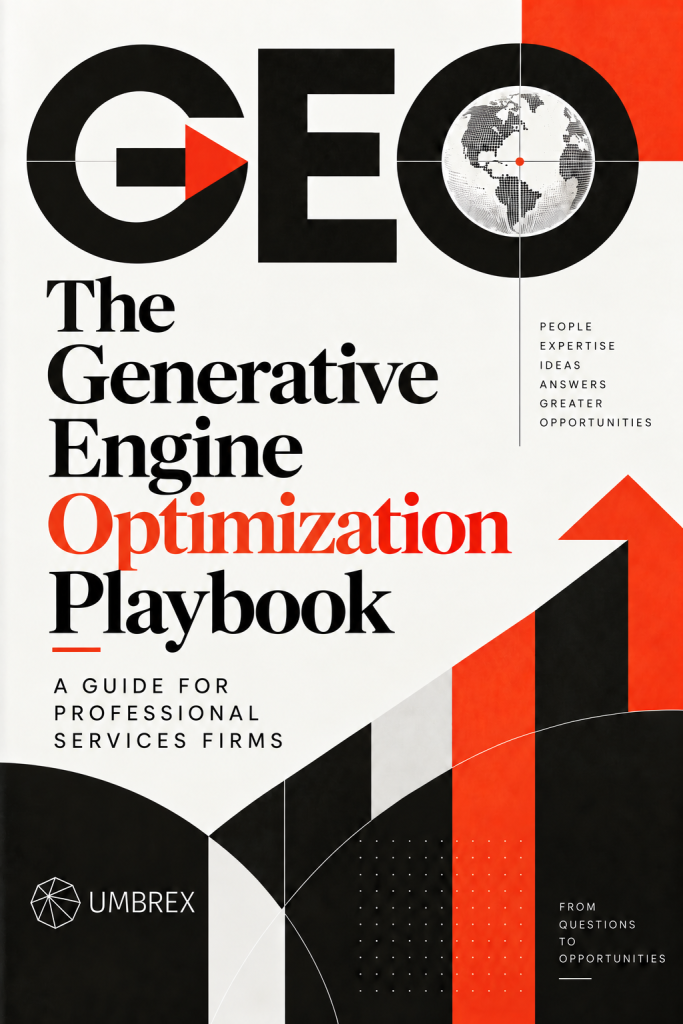
The Generative Engine Optimization Playbook: A Guide for Professional Services provides a practical framework for helping professional services firms improve their visibility, credibility, and representation in AI-powered search and discovery. It guides firms through developing a GEO strategy, evaluating AI-generated recommendations, optimizing websites and expert profiles, and creating authoritative content that addresses client needs. The playbook also explores monitoring tools, performance metrics, reputation management, and ethical practices for strengthening digital presence and generating qualified business opportunities. With actionable frameworks, checklists, and a phased 90-day implementation plan, it equips firms to build, measure, and continuously improve a sustainable GEO program.
Table of Contents
Part I — Understand AI Discovery and Set the Strategy
Chapter 1. How Generative Engines Discover and Evaluate Professional Services Firms
1.1 Where GEO Fits Alongside SEO, Referrals, Reputation, and Business Development
1.2 How Assistants Use Client Questions, Searches, and Retrieved Sources to Develop Answers
1.3 The Difference Between Model Training and Current Information Retrieval
1.4 What It Means to Be Mentioned, Cited, Described Favorably, or Recommended
1.5 Distinguishing the Visibility of a Firm, Practice, Office, and Individual Professional
1.6 Why Answers Vary, What Firms Can Influence, and Where Control Ends
Chapter 2. Define Your Firm’s GEO Program
2.1 Set Objectives for Accurate Representation, Relevant Consideration, and Qualified Opportunities
2.2 Choose the Practices, Services, Industries, Client Groups, and Markets in Scope
2.3 Agree Priorities Across the Firm, Its Practices, and Individual Professionals
2.4 Assign Ownership Across Leadership, Marketing, Business Development, Technology, and Professional Reviewers
2.5 Budget for Expert Time, Internal Work, Specialist Support, and Tools
2.6 Define the Initial Phase, Success Criteria, Review Points, and Investment Decisions
Chapter 3. Map Clients, Referrers, and Buying Questions
3.1 Identify Prospective Clients, Referrers, Internal Sponsors, Evaluators, and Procurement Teams
3.2 Gather Real Questions From Interviews, Proposals, Intake Discussions, and Business Development
3.3 Map Problem Definition, Referral Validation, Shortlisting, Due Diligence, and Engagement Selection
3.4 Distinguish General Discovery Questions From Questions Naming a Firm or Professional
3.5 Segment Questions by Practice, Industry, Geography, Urgency, and Client Circumstances
3.6 Build Representative Test Prompts, Including Situations in Which the Firm Is Unsuitable
Chapter 4. Set the Rules for Publishing and Promoting Professional Expertise
4.1 Identify Applicable Obligations by Profession, Service, and Jurisdiction
4.2 Classify Public, Internal, and Confidential Information for Publication and Use in AI Tools
4.3 Set Standards for Advertising, Credentials, Comparisons, Endorsements, and Disclosure
4.4 Document Permissions and Rights to Use Client Names, Work Products, Quotations, and Results
4.5 Assign Professional Review and Approval Responsibilities to Employees and Suppliers
4.6 Exclude Fabricated Evidence, Fake Reviews, Covert Instructions, and Deceptive Promotion
Part II — Establish the Baseline and Choose Priorities
Chapter 5. Audit What AI Systems Say About Your Firm and Professionals
5.1 Run an Initial Audit Across the AI Experiences Relevant to Your Clients
5.2 Record Prompts, Dates, Interfaces, Search Modes, Locations, and Relevant Context
5.3 Capture Firm and Expert Mentions, Recommendations, Citations, Omissions, and Competitors
5.4 Assess Factual Accuracy, Completeness, Suitability, and Favorability Consistently
5.5 Inspect Cited Sources and Distinguish Observed Evidence From Assumptions About Answer Origins
5.6 Separate Isolated Answers From Recurring Gaps and Material Misrepresentations
Chapter 6. Build a Reliable GEO Monitoring Program
6.1 Design a Stable Prompt Panel Covering Priority Practices, Clients, and Markets
6.2 Set Sampling Frequency, Repeated Runs, and Rules for Changing the Panel
6.3 Define Mention, Citation, Recommendation, Accuracy, Favorability, and Sample-Based Share Metrics
6.4 Keep Consumer Interfaces, APIs, Platforms, and Search Modes Distinguishable
6.5 Select and Validate Tools for Answer Monitoring, Source Analysis, Crawl Diagnostics, and Referral Tracking
6.6 Evaluate Vendor Methods, Human Review, Exports, Privacy, Costs, Dashboards, and Alerts
Chapter 7. Turn Findings Into a Prioritized Work Plan
7.1 Diagnose Gaps in Access, Firm Facts, Expert Profiles, Content, Evidence, and Outside Representation
7.2 Prioritize Improvements by Client Relevance, Business Value, Confidence, Effort, and Risk
7.3 Separate Urgent Factual Corrections From Experiments and Longer-Term Investments
7.4 Decide Which Pages and Assets to Improve, Create, Consolidate, or Retire
7.5 Assign Owners, Expert Reviewers, Deliverables, Dependencies, and Acceptance Criteria
7.6 Sequence Work According to Dependencies, Available Expertise, and Implementation Capacity
Part III — Make Expertise Accurate, Accessible, and Credible
Chapter 8. Describe Your Firm, Practices, and Markets Clearly
8.1 Explain Firm Identity, Ownership, Affiliations, Networks, and Independent Member-Firm Relationships
8.2 Define Services, Industries, Client Sizes, Engagement Models, Deliverables, and Limitations
8.3 Distinguish Office Locations, Actual Service Coverage, and Authorization to Practise
8.4 Build Useful Practice, Industry, and Location Pages With Relevant Supporting Evidence
8.5 State Suitability and Client-Acceptance Conditions, Including Conflicts or Independence Where Applicable
8.6 Maintain Verified Facts, Consistent Names, Supporting Sources, Owners, and Review Dates
Chapter 9. Make Partners and Professionals Discoverable
9.1 Distinguish Firm Experience, Individual Experience, and Work Performed at Previous Employers
9.2 Write Biographies That Explain Expertise, Industries Served, and Actual Project Responsibilities
9.3 Verify Credentials, Professional Status, Licences, Admissions, and Specialist Designations
9.4 Connect Expert Profiles With Practice Pages, Publications, Research, and Professional Records
9.5 Align Relevant Personal Websites, LinkedIn Profiles, and External Biographies
9.6 Update Representation When People Join, Leave, Change Roles, or Move Between Firms
Chapter 10. Make Your Website Accessible to Search and AI Systems
10.1 Distinguish Crawling, Indexing, Retrieval, and Inclusion in an AI Answer
10.2 Set Separate Policies for Search Crawlers, User-Initiated Fetching, and Model-Training Crawlers
10.3 Configure robots.txt, Indexing Controls, Hosting, CDNs, Firewalls, and Bot Protection
10.4 Make Important Public Information Available Through Reliable HTML, Rendering, Navigation, and Internal Links
10.5 Check Sitemaps, Canonical URLs, Redirects, Structured Data, and the Limits of Proposals Such as llms.txt
10.6 Verify Public Crawler Access While Protecting Client Portals and Restricted Files With Appropriate Access Controls
Chapter 11. Create Content That Helps Clients Choose and Engage Your Firm
11.1 Map Priority Client Questions to Useful Service Pages, Guides, and Explanations
11.2 Explain the Problem, Scope, Approach, Deliverables, Team, and Limitations of an Engagement
11.3 Address Fees, Cost Drivers, Timing, Selection Criteria, Alternatives, and Tradeoffs
11.4 Develop Clear FAQs, Checklists, Buying Guides, and Evidence-Based Comparisons
11.5 State Relevant Dates, Jurisdictions, Assumptions, and the Boundaries of General Information
11.6 Explain Next Steps, Who to Contact, and What Information Is Appropriate to Share
Chapter 12. Demonstrate Experience Without Compromising Confidentiality
12.1 Match Capability and Outcome Claims to Evidence That Can Support Them
12.2 Develop Case Studies With Context, the Firm’s Role, Methods, Results, and Limitations
12.3 Distinguish Named Cases, Anonymized Accounts, Aggregated Findings, and Labelled Illustrations
12.4 Review Permissions, Confidentiality, Indirect Identification Risks, and Work-Product Rights
12.5 Describe Results Without Overstating Causality, Representativeness, or Future Outcomes
12.6 Use Approved Work Samples, Methodologies, and Other Evidence When
Chapter 13. Publish Research and Thought Leadership
13.1 Choose Topics Where the Firm Has Substantive Expertise and the Audience Has Meaningful Questions
13.2 Turn Practitioner Knowledge Into Useful Frameworks, Diagnostics, and Explanations
13.3 Design Original Research, Surveys, Benchmarks, and Technical or Regulatory Analyses
13.4 Document Methods, Sources, Dates, Authorship, Limitations, and Relevant Interests
13.5 Use Newsletters, Podcasts, Webinars, and Conference Contributions to Share Substantive Expertise
13.6 Publish Accessible Text, Evidence, and Summaries While Making Deliberate Decisions About Gated Material
Part IV — Build Credibility Beyond the Firm’s Website
Chapter 14. Earn Independent Coverage and Professional Recognition
14.1 Identify Relevant Trade Publications, Professional Journals, Journalists, Analysts, and Researchers
14.2 Develop Expert Contributions and Findings That Merit Editorial Attention
14.3 Contribute Through Interviews, Podcasts, Conferences, Panels, and Professional Education
14.4 Build Relationships With Professional Bodies and Credible Industry Institutions
14.5 Distinguish Independent Assessment From Syndicated Copy, Sponsorship, and Paid Promotion
14.6 Evaluate Relevance, Accuracy, and Evidentiary Value Without Assuming Every Mention Improves Visibility
Chapter 15. Manage Directories, Reviews, and Professional Profiles
15.1 Inventory Professional Directories, Association Listings, Public Registers, and Local Business Profiles
15.2 Keep Service Descriptions, People, Credentials, Locations, and Contact Information Accurate
15.3 Assess Rankings, Awards, Paid Profiles, Selection Criteria, and Claims of Independence
15.4 Request Authentic Reviews and Testimonials Where Appropriate Under Applicable Rules
15.5 Respond to Feedback Without Disclosing Confidential Relationships or Client Information
15.6 Participate Usefully in Professional Communities and Disclose Affiliations
Chapter 16. Correct Errors and Respond to Unfavorable Answers
16.1 Distinguish Factual Errors, Outdated Information, Ambiguity, Criticism, and Appropriate Exclusions
16.2 Prioritize Issues by Client Impact, Professional Reputation, Recurrence, and Available Evidence
16.3 Trace Verifiable Errors to Their Sources and Prepare Factual Corrections
16.4 Update Owned Sources, Request Third-Party Corrections, and Use Platform Feedback Channels
16.5 Address Legitimate Service Concerns While Respecting Confidentiality and Independent Judgment
16.6 Recheck Answers Over Time and Document What Changed, What Persisted, and What Remains Uncertain
Part V — Measure, Operate, and Improve the Program
Chapter 17. Run GEO Experiments and Learn What Works
17.1 Turn Proposed Changes Into Specific Hypotheses and Observable Outcomes
17.2 Choose Practices, Expert Pages, Topics, or Markets as Test Units and Comparisons
17.3 Set Baselines, Success Criteria, Observation Windows, and Decision Thresholds
17.4 Record Changes Alongside News, Competitor Activity, Seasonality, and Platform Updates
17.5 Interpret Repeated Observations Without Confusing Variation or Correlation With Causation
17.6 Decide Whether to Expand, Revise, Reverse, or Stop an Intervention
Chapter 18. Connect GEO to Qualified Opportunities and Revenue
18.1 Separate AI Visibility, Actual Consideration, Inquiries, Qualified Opportunities, Engagements, and Revenue
18.2 Combine Referral Analytics, Client Interviews, Self-Reported Discovery, and Business-Development Records
18.3 Route Inquiries to the Appropriate Practice and Support an Informed Initial Conversation
18.4 Evaluate Fit, Value, Capacity, Jurisdiction, and Applicable Client-Acceptance Requirements
18.5 Account for Referrals, Buying Committees, Long Sales Cycles, and Uncertain Attribution
18.6 Assess Opportunity Quality, Conversion, Commercial Contribution, and Total Program Cost
Chapter 19. Build a Sustainable Publishing and Maintenance Process
19.1 Capture Expertise Efficiently Through Interviews, Project Debriefs, and Existing Materials
19.2 Coordinate Writers, Subject-Matter Experts, Professional Reviewers, Marketing, and Website Owners
19.3 Use AI Assistance With Source Verification and Clear Human Responsibility
19.4 Make PDFs, Videos, Podcasts, and Webinars Accessible Through Appropriate Text and Attribution
19.5 Maintain Service Information, Credentials, Publications, and Time-Sensitive Technical or Regulatory Content
19.6 Manage Agencies and Freelancers With Clear Methods, Approvals, Work Ownership, and Handover
Chapter 20. Launch, Run, and Expand the Program
20.1 Turn the Approved Backlog Into a Phased 90-Day Launch Plan
20.2 Establish Weekly Delivery Routines and Monthly and Quarterly Management Reviews
20.3 Maintain Accountability Across Managing Partners, Practice Leaders, Offices, and Billable Professionals
20.4 Adapt the Operating Model for Solo Practices, Boutiques, Regional Firms, and International Networks
20.5 Expand Into Practices, Industries, Locations, and Languages When Evidence and Capacity Justify It
20.6 Track Platform Changes, Reassess Investment, and Discontinue Low-Value Activity
Companion Templates and Appendices
A. Program Planning
B. Client and Referrer Research
C. Monitoring and Evaluation
D. Firm Facts and Professional Profiles
E. Technical Readiness
F. Content, Research, and Experience
G. Professional Review and Permissions
H. Improvement and Commercial Management
I. Tools and Further Study
