
Fortune 500 Ranking: #13 in 2024
Company Website: shell.com
Annual Revenues: US$308 billion in 2024
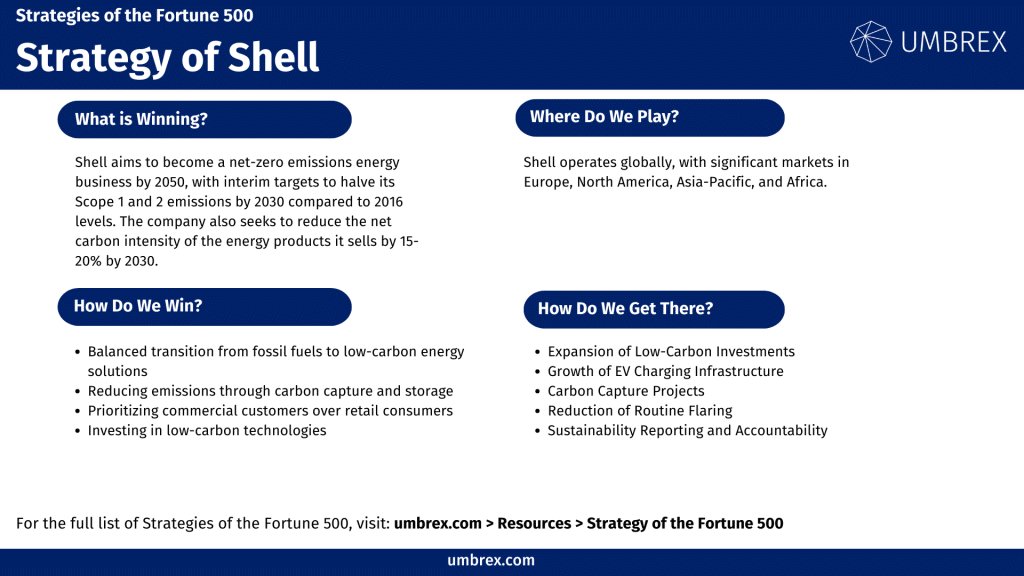
1. What is Winning?
Shell aims to become a net-zero emissions energy business by 2050, with interim targets to halve its Scope 1 and 2 emissions by 2030 compared to 2016 levels. The company also seeks to reduce the net carbon intensity of the energy products it sells by 15-20% by 2030. Additionally, Shell has committed to investing $10-15 billion in low-carbon energy solutions between 2023 and the end of 2025, demonstrating its focus on transitioning towards sustainable energy sources while maintaining profitability.
2. Where Do We Play?
Shell operates globally, with significant markets in Europe, North America, Asia-Pacific, and Africa. The company serves a wide range of customer segments:
- Industrial and Commercial Clients: Providing fuels and lubricants for manufacturing, transportation, and logistics.
- Retail Consumers: Through its extensive network of service stations offering gasoline, diesel, and convenience store products.
- Government Entities: Supplying energy solutions for public infrastructure projects and government contracts.
- Energy Sector Partners: Collaborating with other companies in joint ventures for exploration and production.
Shell’s product offerings encompass: - Fossil Fuels: Crude oil, natural gas, gasoline, diesel, and jet fuel.
- Low-Carbon Energy Solutions: Investments in biofuels, hydrogen production, and carbon capture technologies.
- Electric Vehicle (EV) Infrastructure: Expanding its EV charging network to support the transition to electric mobility.
3. How Do We Win?
Shell’s distinctive approach includes several strategic elements:
- Integrated Energy Transition Strategy: The “Powering Progress” strategy emphasizes a balanced transition from fossil fuels to low-carbon energy solutions while ensuring secure energy supplies. This integrated approach allows Shell to leverage its existing resources while investing in future technologies.
- Focus on Carbon Management: Shell is committed to reducing emissions through carbon capture and storage (CCS), with plans to increase its CCS capacity significantly by 2035. This focus on managing carbon emissions positions Shell as a leader in sustainability within the energy sector.
- Adaptation to Market Dynamics: The company has shifted its strategy to prioritize commercial customers over retail consumers in its energy sales, aligning with market trends that favor business-to-business relationships in renewable energy sectors.
- Investment in Infrastructure: By expanding its EV charging network and investing in low-carbon technologies, Shell aims to meet growing consumer demand for sustainable energy solutions while enhancing its competitive position.
4. How Do We Get There?
To achieve its strategic objectives, Shell has announced several key initiatives:
- Expansion of Low-Carbon Investments: Committing $10-15 billion between 2023 and 2025 towards low-carbon energy solutions, including investments in renewable power projects and hydrogen production capabilities.
- Growth of EV Charging Infrastructure: Plans to expand its public EV charging network to 200,000 stations by 2030, supporting the transition to electric mobility while capitalizing on the growing demand for charging services.
- Carbon Capture Projects: Increasing CCS capacity by an additional 25 million tonnes per year by 2035, focusing on key projects like Quest in Canada and Northern Lights in Norway to enhance its carbon management capabilities.
- Reduction of Routine Flaring: Accelerating efforts to eliminate routine gas flaring from upstream operations ahead of the original target date of 2030, now set for completion by 2025.
- Sustainability Reporting and Accountability: Implementing an annual advisory vote on its Energy Transition Plan at shareholder meetings to ensure transparency and accountability regarding progress towards its climate goals.
These strategies collectively position Shell as a proactive player in the global energy transition, balancing traditional fossil fuel operations with a robust commitment to sustainability and innovation in response to evolving market demands.
Contact us at [email protected] for a full list of sources.
Most Recent Shell Investor Presentation
Menu of the Fortune 50:
- 1. Walmart
- 2. Amazon
- 3. State Grid
- 4. Saudi Aramco
- 5. Sinopec Group
- 6. China National Petroleum
- 7. Apple
- 8. United Health Group
- 9. Berkshire Hathaway
- 10. CVS Health
- 11. Volkswagen
- 12. ExxonMobil
- 13. Shell
- 14. China State Construction Engineering
- 15. Toyota Motor
- 16. McKesson
- 17. Alphabet
- 18. Cencora
- 19. Trafigura Group
- 20. Costco Wholesale
- 21. JPMorgan Chase
- 22. Industrial & Commercial Bank of China
- 23. TotalEnergies
- 24. Glencore
- 25. BP
- 26. Microsoft
- 27. Cardinal Health
- 28. Stellantis
- 29. Chevron
- 30. China Construction Bank
- 31. Samsung Electronics
- 32. Hon Hai Precision Industry
- 33. Cigna
- 34. Agricultural Bank of China
- 35. China Railway Engineering Group
- 36. Ford Motor
- 37. Bank of America
- 38. Bank of China
- 39. General Motors
- 40. Elevance Health
- 41. BMW Group
- 42. Mercedes-Benz Group
- 43. China Railway Construction
- 44. China Baowu Steel Group
- 45. Citigroup
- 46. Centene
- 47. JD.com
- 48. Home Depot
- 49. Marathon Petroleum
- 50. Electricité de France
- 51. Kroger
- 52. Phillips 66
- 53. Ping An Insurance
- 54. Sinochem Holdings
- 55. China Mobile Communications
- 56. China National Offshore Oil
- 57. Honda Motor
- 58. Fannie Mae
- 59. China Life Insurance
- 60. Walgreens Boots Alliance
- 61. Valero Energy
- 62. Banco Santander
- 63. China Communications Construction
- 64. BNP Paribas
- 65. Mitsubishi
- 66. Meta Platforms
- 67. HSBC Holdings
- 68. Verizon Communications
- 69. China Minmetals
- 70. Alibaba Group
- 71. CITIC Group
- 72. China Resources
- 73. Hyundai Motor
- 74. AT&T
- 75. Shandong Energy Group
- 76. Comcast
- 77. Deutsche Telekom
- 78. China Southern Power Grid
- 79. Uniper
- 80. Wells Fargo
- 81. Hengli Group
- 82. Allianz
- 83. China Post Group
- 84. China Energy Investment
- 85. Xiamen C&D
- 86. Reliance Industries
- 87. Goldman Sachs Group
- 88. Freddie Mac
- 89. Rosneft Oil
- 90. Target
- 91. Equinor
- 92. Humana
- 93. SAIC Motor
- 94. State Farm Insurance
- 95. Life Insurance Corp. of India
- 96. Nestlé
- 97. Enel
- 98. ENI
- 99. Petrobras
- 100. SK
