
Fortune 500 Ranking: #39 in 2024
Company Website: gm.com
Annual Revenues: US$171 billion in 2024
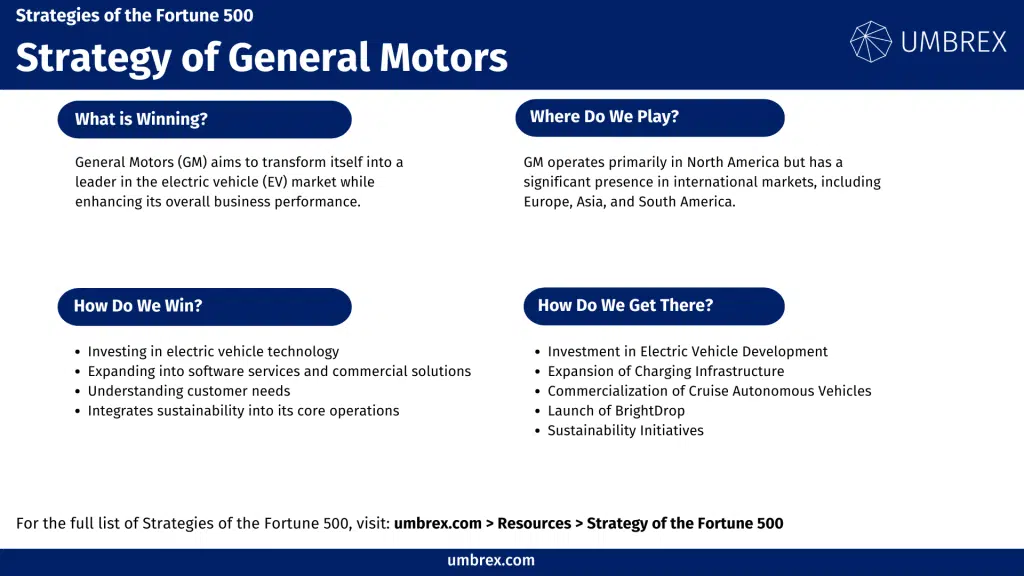
1. What is Winning?
General Motors (GM) aims to transform itself into a leader in the electric vehicle (EV) market while enhancing its overall business performance. Key targets include:
- Doubling its annual revenue from an average of $140 billion to $280 billion by 2030.
- Achieving a margin expansion goal of 12% to 14% by the end of the decade, driven by growth in EV sales and software-enabled services.
- Increasing its electric vehicle revenue from approximately $10 billion in 2023 to about $90 billion annually by 2030.
2. Where Do We Play?
GM operates primarily in North America but has a significant presence in international markets, including Europe, Asia, and South America. The company serves various customer segments:
- Individual Consumers: Offering a range of passenger vehicles, including sedans, SUVs, and trucks under brands like Chevrolet, GMC, Buick, and Cadillac.
- Commercial Customers: Providing fleet solutions and commercial vehicles tailored for businesses, including delivery vans and trucks.
- Government Entities: Engaging in public sector contracts for vehicles and transportation solutions.
- Electric Vehicle Market: Targeting environmentally conscious consumers with a growing lineup of electric and hybrid vehicles.
GM’s product offerings encompass: - Passenger Vehicles: Cars, SUVs, and trucks across its diverse brand portfolio.
- Electric Vehicles: The Chevrolet Bolt EV, GMC Hummer EV, and upcoming models built on the Ultium battery platform.
- Commercial Vehicles: Electric delivery vans through its BrightDrop subsidiary.
- Software Services: Connected vehicle services and subscription-based software offerings.
3. How Do We Win?
GM’s distinctive approach is characterized by several strategic elements:
- Commitment to Electrification: GM is heavily investing in electric vehicle technology through its Ultium battery platform, which allows for flexible vehicle design and efficient production processes. This commitment positions GM as a frontrunner in the EV market while aligning with global trends toward sustainable transportation.
- Diversified Revenue Streams: By expanding into software services and commercial solutions through subsidiaries like BrightDrop and Cruise (its autonomous vehicle division), GM aims to create new revenue opportunities beyond traditional vehicle sales. This diversification enhances financial resilience amid changing market dynamics.
- Customer-Centric Innovation: GM focuses on understanding customer needs through data analytics and market research, allowing it to tailor products effectively while enhancing customer experiences through technology integration (e.g., advanced driver-assistance systems). This customer-centric approach fosters loyalty and retention.
- Sustainability Commitment: The company integrates sustainability into its core operations by prioritizing eco-friendly manufacturing processes and materials while committing to carbon neutrality by 2040.
4. How Do We Get There?
To achieve its strategic objectives, GM has announced several key initiatives:
- Investment in Electric Vehicle Development: Committing $50 billion through 2026 to develop new electric models across various segments, including high-volume vehicles aimed at mass-market appeal. This includes launching several new EVs built on the Ultium platform over the coming years.
- Expansion of Charging Infrastructure: Investing nearly $750 million in charging infrastructure through 2025 to enhance access to reliable public charging stations across the U.S. and Canada as part of the Ultium Charge 360 initiative. This investment aims to support the growing EV market by improving convenience for customers.
- Commercialization of Cruise Autonomous Vehicles: Focusing on scaling up Cruise’s autonomous driving technology with plans to generate significant revenue from autonomous services by the end of the decade. This includes expanding pilot programs in urban areas where demand for autonomous ride-hailing services is expected to grow.
- Launch of BrightDrop: Developing a connected ecosystem for electric delivery solutions aimed at commercial customers, with expectations to generate $5 billion in revenue by mid-decade through innovative products like the EV600 electric van.
- Sustainability Initiatives: Implementing strategies aimed at reducing emissions across production facilities while transitioning to renewable energy sources for manufacturing operations as part of its broader commitment to sustainability.
These strategies collectively position General Motors as a forward-thinking leader in the automotive industry focused on electrification, innovation, sustainability, and operational excellence while adapting to the evolving needs of consumers in a rapidly changing market environment.
Contact us at [email protected] for a full list of sources.
Fortune 50:
- 1. Walmart
- 2. Amazon
- 3. State Grid
- 4. Saudi Aramco
- 5. Sinopec Group
- 6. China National Petroleum
- 7. Apple
- 8. United Health Group
- 9. Berkshire Hathaway
- 10. CVS Health
- 11. Volkswagen
- 12. ExxonMobil
- 13. Shell
- 14. China State Construction Engineering
- 15. Toyota Motor
- 16. McKesson
- 17. Alphabet
- 18. Cencora
- 19. Trafigura Group
- 20. Costco Wholesale
- 21. JPMorgan Chase
- 22. Industrial & Commercial Bank of China
- 23. TotalEnergies
- 24. Glencore
- 25. BP
- 26. Microsoft
- 27. Cardinal Health
- 28. Stellantis
- 29. Chevron
- 30. China Construction Bank
- 31. Samsung Electronics
- 32. Hon Hai Precision Industry
- 33. Cigna
- 34. Agricultural Bank of China
- 35. China Railway Engineering Group
- 36. Ford Motor
- 37. Bank of America
- 38. Bank of China
- 39. General Motors
- 40. Elevance Health
- 41. BMW Group
- 42. Mercedes-Benz Group
- 43. China Railway Construction
- 44. China Baowu Steel Group
- 45. Citigroup
- 46. Centene
- 47. JD.com
- 48. Home Depot
- 49. Marathon Petroleum
- 50. Electricité de France
- 51. Kroger
- 52. Phillips 66
- 53. Ping An Insurance
- 54. Sinochem Holdings
- 55. China Mobile Communications
- 56. China National Offshore Oil
- 57. Honda Motor
- 58. Fannie Mae
- 59. China Life Insurance
- 60. Walgreens Boots Alliance
- 61. Valero Energy
- 62. Banco Santander
- 63. China Communications Construction
- 64. BNP Paribas
- 65. Mitsubishi
- 66. Meta Platforms
- 67. HSBC Holdings
- 68. Verizon Communications
- 69. China Minmetals
- 70. Alibaba Group
- 71. CITIC Group
- 72. China Resources
- 73. Hyundai Motor
- 74. AT&T
- 75. Shandong Energy Group
- 76. Comcast
- 77. Deutsche Telekom
- 78. China Southern Power Grid
- 79. Uniper
- 80. Wells Fargo
- 81. Hengli Group
- 82. Allianz
- 83. China Post Group
- 84. China Energy Investment
- 85. Xiamen C&D
- 86. Reliance Industries
- 87. Goldman Sachs Group
- 88. Freddie Mac
- 89. Rosneft Oil
- 90. Target
- 91. Equinor
- 92. Humana
- 93. SAIC Motor
- 94. State Farm Insurance
- 95. Life Insurance Corp. of India
- 96. Nestlé
- 97. Enel
- 98. ENI
- 99. Petrobras
- 100. SK
