
A guidebook that explains the range of titles typically found within a corporation
The Chief Information Officer (CIO) is a senior executive responsible for managing and implementing information and computer technologies within an organization. The CIO ensures that IT infrastructure and systems support the company’s goals, enhance operational efficiency, and provide robust security. This role involves overseeing IT strategy, managing IT operations, and driving technological innovation.
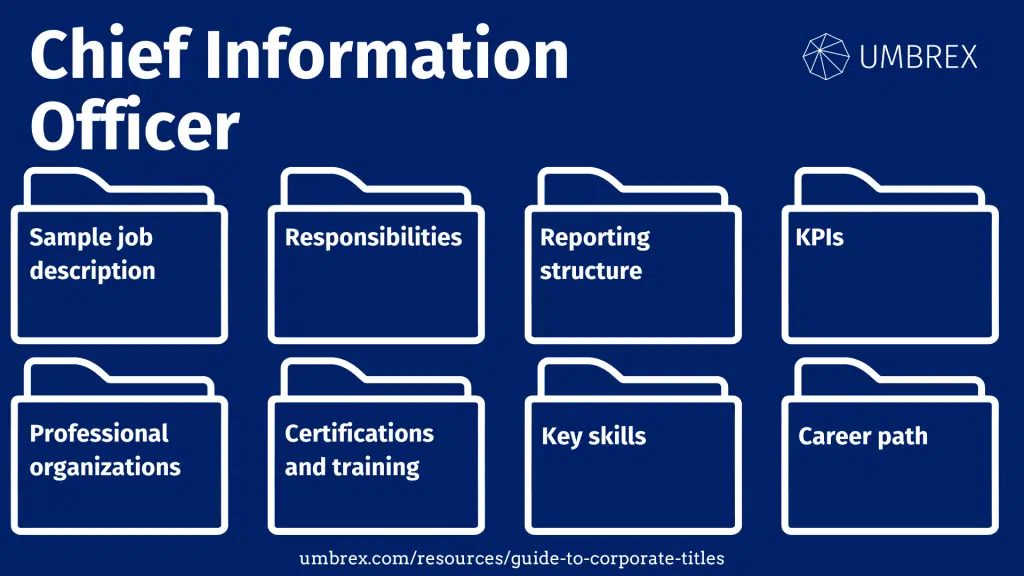
Reporting Structure
The CIO typically reports directly to the Chief Executive Officer (CEO) and may also work closely with other senior executives such as the Chief Technology Officer (CTO) and Chief Financial Officer (CFO).
List of Direct Reports
The direct reports to the CIO often include:
- Vice President/Director of IT Operations: Manages the daily operations of the IT department.
- Vice President/Director of Information Security: Oversees cybersecurity measures and data protection.
- Vice President/Director of Applications Development: Leads the development and implementation of software applications.
- IT Project Managers: Oversee IT projects and ensure they are completed on time and within budget.
- Network Administrators: Manage the organization’s network infrastructure.
- Systems Analysts: Analyze and improve IT systems and processes.
- IT Support Managers: Lead the IT support team to address technical issues and provide user support.
Roles and Responsibilities
The roles and responsibilities of a CIO can vary depending on the size and structure of the company but generally include the following:
IT Strategy and Leadership:
- Develop and implement IT strategies that align with the company’s overall business objectives.
- Provide strategic recommendations to the CEO and executive team based on technological trends and business insights.
IT Operations Management:
- Oversee the daily operations of the IT department to ensure efficiency and effectiveness.
- Manage IT resources, including personnel, budgets, and technology, to achieve business goals.
Cybersecurity and Risk Management:
- Develop and implement cybersecurity strategies to protect the company’s data and IT infrastructure.
- Identify and manage IT risks to ensure business continuity and data protection.
Technology Innovation and Integration:
- Drive technological innovation to enhance operational efficiency and competitive advantage.
- Oversee the integration of new technologies and systems within the organization.
Data Management and Analytics:
- Manage data storage, processing, and analysis to support business decision-making.
- Ensure data quality, integrity, and security.
Project Management:
- Oversee IT projects, ensuring they are completed on time, within budget, and meet business requirements.
- Coordinate cross-functional teams to achieve project objectives.
Vendor and Stakeholder Management:
- Manage relationships with technology vendors and service providers.
- Collaborate with internal stakeholders to ensure IT solutions meet business needs.
Leadership and Team Development:
- Lead and mentor the IT team, fostering a culture of innovation, collaboration, and high performance.
- Ensure the IT team has the skills and resources necessary to support the company’s objectives.
Key Skills and Competencies
Strategic Thinking:
- Ability to develop and implement IT strategies that align with business objectives.
- Experience in providing strategic recommendations to senior management.
Leadership and Influence:
- Strong leadership skills to manage and develop the IT team.
- Ability to influence and collaborate with senior executives and stakeholders.
Technical Expertise:
- Deep understanding of IT infrastructure, cybersecurity, and software development.
- Experience with IT operations, project management, and technology integration.
Analytical and Problem-Solving Skills:
- Strong analytical skills to assess IT performance and identify areas for improvement.
- Excellent problem-solving skills with a proactive approach to addressing challenges.
Communication and Interpersonal Skills:
- Excellent communication skills with the ability to effectively present IT information to various stakeholders.
- Strong interpersonal skills with the ability to build and maintain relationships with internal and external stakeholders.
Customer Focus:
- Strong customer focus with the ability to understand and meet the technology needs of internal and external customers.
Career Path
The career path to becoming a CIO typically involves a combination of education, experience, and professional development. The following are common steps in the career progression:
Education:
- A bachelor’s degree in computer science, information technology, business administration, or a related field is typically required. Many CIOs also hold advanced degrees such as an MBA or a master’s in information technology management.
Early Career:
- Entry-level roles in IT support, network administration, or software development provide foundational experience.
- Gaining experience in different IT functions is crucial during this stage.
Mid-Career:
- Progressing to more senior roles, such as IT manager, systems analyst, or network manager, allows individuals to develop leadership skills and gain exposure to strategic IT management.
- Experience in managing teams and overseeing IT operations is important for career advancement.
Senior Leadership Roles:
- Serving in senior leadership roles, such as vice president of IT or director of information technology, provides the experience needed to take on the CIO role.
- Developing expertise in strategic IT management, cybersecurity, and executive leadership is essential during this stage.
Becoming a CIO:
- To become a CIO, candidates typically need 15-20 years of experience in IT, with a track record of success in senior leadership roles.
- Networking, mentorship, and continuous professional development are important for reaching the CIO position.
Typical Key Initiatives CIOs are Working on This Year
Digital Transformation and Technology Integration:
- Implementing advanced technologies and digital solutions to improve efficiency and drive innovation.
- Enhancing IT capabilities and infrastructure to support business objectives.
Cybersecurity and Data Privacy:
- Developing and implementing robust cybersecurity measures and data privacy practices.
- Ensuring compliance with data protection regulations.
Cloud Migration and Management:
- Transitioning IT infrastructure and applications to cloud-based platforms.
- Managing cloud services to optimize performance and cost-efficiency.
Data Analytics and Business Intelligence:
- Leveraging data analytics to gain insights into business performance and customer behavior.
- Implementing data-driven decision-making processes to optimize IT strategies.
IT Governance and Compliance:
- Establishing IT governance frameworks to ensure compliance with industry standards and regulations.
- Implementing policies and procedures to manage IT risks and ensure business continuity.
IT Infrastructure Modernization:
- Upgrading IT infrastructure to support current and future business needs.
- Implementing new technologies to enhance operational efficiency.
Innovation and Emerging Technologies:
- Exploring and integrating emerging technologies such as artificial intelligence, blockchain, and IoT.
- Driving innovation through the adoption of cutting-edge technologies.
Key Performance Indicators (KPIs) for a CIO
IT Performance Metrics:
- System Uptime: Measures the availability and reliability of IT systems.
- Incident Response Time: Tracks the time taken to respond to and resolve IT incidents.
- IT Service Delivery: Evaluates the quality and efficiency of IT services provided to users.
Cybersecurity Metrics:
- Security Incident Frequency: Measures the number and severity of security incidents.
- Compliance Rate: Assesses the level of compliance with cybersecurity regulations and standards.
- Vulnerability Management: Tracks the identification and resolution of security vulnerabilities.
Financial Metrics:
- IT Budget Adherence: Measures the extent to which the IT budget is managed effectively.
- Cost Savings from IT Initiatives: Evaluates the financial impact of IT cost-saving initiatives.
Innovation and Technology Metrics:
- Adoption Rate of New Technologies: Measures the rate at which new technologies are adopted within the organization.
- Innovation Impact: Assesses the impact of innovation initiatives on business performance.
Customer and User Metrics:
- User Satisfaction: Measures the satisfaction levels of internal and external users with IT services.
- Support Ticket Resolution Time: Tracks the time taken to resolve IT support tickets.
Project Management Metrics:
- Project Completion Rate: Measures the percentage of IT projects completed on time and within budget.
- Project Success Rate: Evaluates the success of IT projects in meeting their objectives.
Professional Organizations and Networks
CIO Network:
- The CIO Network provides resources, events, and networking opportunities for CIOs and IT leaders.
- Website: www.cionetwork.com
Information Systems Audit and Control Association (ISACA):
- ISACA offers certifications, resources, and networking opportunities for IT governance and cybersecurity professionals.
- Website: www.isaca.org
Society for Information Management (SIM):
- SIM provides resources, events, and networking opportunities for IT leaders and professionals.
- Website: www.simnet.org
Institute of Electrical and Electronics Engineers (IEEE):
- IEEE offers resources, conferences, and networking opportunities for technology professionals.
- Website: www.ieee.org
Project Management Institute (PMI):
- PMI offers certifications, resources, and networking opportunities for project management professionals.
- Website: www.pmi.org
Certifications and Training
Certified Information Systems Security Professional (CISSP):
- Offered by (ISC)², this certification covers essential cybersecurity skills and knowledge.
- Benefits: Provides a comprehensive understanding of cybersecurity practices.
- Requirements: Passing the CISSP exam and meeting experience requirements.
Certified Information Security Manager (CISM):
- Offered by ISACA, this certification focuses on managing information security programs.
- Benefits: Enhances skills in information security management.
- Requirements: Passing the CISM exam and meeting experience requirements.
Certified Information Systems Auditor (CISA):
- Offered by ISACA, this certification focuses on information systems auditing, control, and security.
- Benefits: Provides expertise in IT auditing and control practices.
- Requirements: Passing the CISA exam and meeting experience requirements.
Project Management Professional (PMP):
- Offered by PMI, this certification validates expertise in project management principles and practices.
- Benefits: Provides skills in managing and leading IT projects.
- Requirements: Passing the PMP exam and meeting educational and project management experience requirements.
Certified in the Governance of Enterprise IT (CGEIT):
- Offered by ISACA, this certification focuses on IT governance principles and practices.
- Benefits: Provides expertise in managing and governing IT resources.
- Requirements: Passing the CGEIT exam and meeting experience requirements.
Executive MBA (EMBA):
- An Executive MBA program is designed for experienced professionals looking to enhance their strategic leadership and management skills. It typically covers advanced topics in business management, finance, and leadership.
- Benefits: Provides comprehensive business education with a focus on leadership and strategic management.
- Requirements: Typically requires several years of professional experience and completion of an EMBA program.
SAMPLE JOB DESCRIPTION
Position Title: Chief Information Officer (CIO)
Reports To: Chief Executive Officer (CEO)
Location: [Company Location]
Company: [Company Name]
About the Company: [Company Name] is a [brief company description, including industry, size, and any notable achievements or goals]. We are committed to [company mission or vision], and we are looking for an experienced and dynamic Chief Information Officer (CIO) to join our executive team and lead our IT function.
Job Summary: The Chief Information Officer (CIO) is a key member of the executive team responsible for the overall IT strategy and execution of the company. The CIO will provide strategic IT leadership, manage IT operations, ensure cybersecurity, and drive innovation. This role requires a strategic thinker with a strong background in IT management, cybersecurity, and business leadership.
Key Responsibilities:
IT Strategy and Leadership:
- Develop and implement comprehensive IT strategies that support the company’s long-term goals and objectives.
- Provide strategic recommendations to the CEO and executive team based on technological trends and business insights.
- Lead IT planning, budgeting, forecasting, and reporting processes.
IT Operations Management:
- Oversee the daily operations of the IT department to ensure efficiency and effectiveness.
- Manage IT resources, including personnel, budgets, and technology, to achieve business goals.
Cybersecurity and Risk Management:
- Develop and implement cybersecurity strategies to protect the company’s data and IT infrastructure.
- Identify and manage IT risks to ensure business continuity and data protection.
Technology Innovation and Integration:
- Drive technological innovation to enhance operational efficiency and competitive advantage.
- Oversee the integration of new technologies and systems within the organization.
Data Management and Analytics:
- Manage data storage, processing, and analysis to support business decision-making.
- Ensure data quality, integrity, and security.
Project Management:
- Oversee IT projects, ensuring they are completed on time, within budget, and meet business requirements.
- Coordinate cross-functional teams to achieve project objectives.
Vendor and Stakeholder Management:
- Manage relationships with technology vendors and service providers.
- Collaborate with internal stakeholders to ensure IT solutions meet business needs.
Leadership and Team Development:
- Lead and mentor the IT team, fostering a culture of innovation, collaboration, and high performance.
- Ensure the IT team has the skills and resources necessary to support the company’s objectives.
Key Skills and Competencies:
Technical and Professional Skills:
- Strong understanding of IT infrastructure, cybersecurity, and software development.
- Experience with IT operations, project management, and technology integration.
- Proficiency in IT tools and software.
Leadership and Management Skills:
- Proven ability to lead and develop high-performing teams.
- Excellent strategic thinking and problem-solving abilities.
- Strong communication and presentation skills with the ability to convey complex IT information clearly.
Personal Attributes:
- High level of integrity and ethical standards.
- Strong attention to detail and accuracy.
- Ability to work effectively in a fast-paced, dynamic environment.
Qualifications:
- Bachelor’s degree in Computer Science, Information Technology, Business Administration, or a related field. A master’s degree or MBA is preferred.
- Professional certifications such as CISSP, CISM, or PMP are highly desirable.
- Minimum of 15 years of progressive experience in IT, with at least 5 years in a senior leadership role.
- Experience in [relevant industry or sector] is preferred.
Benefits:
- Competitive salary and performance-based incentives.
- Comprehensive health, dental, and vision insurance plans.
- Retirement savings plan with company match.
- Professional development and training opportunities.
- Paid time off and flexible work arrangements.
Application Process: Interested candidates are invited to submit their resume and a cover letter detailing their qualifications and experience to [contact information or application link]. Please include “Chief Information Officer Application” in the subject line.
[Company Name] is an equal opportunity employer. We celebrate diversity and are committed to creating an inclusive environment for all employees.
Executive Leadership
- Chief Executive Officer
- Chief Financial Officer
- Chief Operating Officer
- Chief Marketing Officer
- Chief Technology Officer
- Chief Human Resources Officer
- Chief Product Officer
- Chief Supply Chain Officer
- Chief Procurement Officer
- Chief Digital Officer
- Chief AI Officer
- Chief Information Officer
- Chief Accounting Officer
- Heads of Business Units or Divisions
Finance
- Vice President of Finance
- Director of Finance
- Director of Accounting
- Assistant Treasurer
- Accounting Managers
- Cash Managers
- Director of Financial Planning and Analysis
- Finance Managers and Analysts
- Financial Controller
- Financial Reporting Managers
- Head of Investor Relations
- Internal Audit Director
- Internal Audit Manager
- Senior Internal Auditors
- Internal Auditors
- IT Auditors
- Investment Managers
- Investor Relations Managers
- Payroll Managers
- Senior Accountants
- Senior Financial Analysts
- Tax Manager
- Treasurer
- Treasury Analysts
- Treasury Operations Managers
Operations
- Vice President of Operations
- Director of Operations
- Director of Customer Service
- Director of Manufacturing
- Director of Quality Assurance
- Operations Managers
- Production Managers
- Call Center Managers
- Customer Service Managers
- Continuous Improvement Managers
- Customer Experience Managers
- Plant or Facility Managers
- Quality Control Managers
- Project Managers
- Maintenance Managers
- Manufacturing Engineers
- Facilities Managers
- Safety Managers
- Quality Assurance Managers
- Quality Engineers
- Quality Control Inspectors
- Quality Assurance Analysts
- Customer Support Specialists
Product Management
Marketing
- Brand Managers
- Communications Specialists
- Competitive Intelligence Analysts
- Consumer Insights Managers
- Content Writers
- Content Managers
- Corporate Communications Managers
- Creative Directors
- Data Analysts
- Digital Marketing Managers
- Director of Brand Management
- Director of Digital Marketing
- Director of Market Research
- Director of Marketing
- Director of Public Relations
- Email Marketing Managers
- Event Coordinators
- Event Planners
- Graphic Designers
- Market Research Managers
- Marketing Analysts
- Marketing Communications Managers
- Marketing Coordinators
- Marketing Managers
- Media Relations Managers
- Social Media Managers
- Public Relations Managers
- Paid Media Managers
- Research Coordinators
- SEO Managers
- Social Media Specialists
- Survey Specialists
- Vice President of Digital Marketing
- Vice President of Marketing
Sales
Supply Chain & Logistics
Human Resources
- Vice President of Talent Acquisition
- Compensation and Benefits Managers
- Director of Human Resources
- Director of Employee Relations
- Director of Learning and Development
- Director of Compensation and Benefits
- Director of Diversity, Equity, and Inclusion
- Human Resources Manager
- Talent Acquisition Managers
- Training and Development Managers
- Employee Relations Specialists
- HR Generalists
- HR Coordinators
- HR Business Partners
Legal
Technology/IT
- Application Security Engineers
- Business Analysts
- Cloud Engineers
- DevOps Managers
- Director of Applications Development
- Director of Cybersecurity
- Director of Data Analytics
- Director of Digital Platforms
- Director of Digital Strategy
- Director of E-Commerce
- Director of Information Security
- Director of IT Infrastructure
- Director of IT Operations
- Director of Research and Development
- Director of Software Development
- Engineering Directors
- Incident Response Managers
- IT Infrastructure Managers
- IT Managers for Digital Projects
- IT Project Coordinators
- IT Project Managers
- IT Support Managers
- Lead Scientist
- Lead Software Engineer
- Network Administrators
- Network Engineers
- R&D Managers
- Software Development Managers
- System Administrators
- Systems Analysts
- System Architects
- Technology Manager
- UX/UI Design Lead
- UX/UI Designers
- Vice President of Engineering