

1. What Is McKinsey 7S Framework?

The McKinsey 7S Framework is a holistic organizational diagnostic and design tool that examines seven interdependent elements—Strategy, Structure, Systems, Shared Values, Skills, Staff, and Style—to assess how well an organization is configured to deliver on its ambition. Its core insight is simple and powerful: performance depends less on any single “box on the chart” and more on the alignment among these elements.
In plain terms: if your strategy says one thing, but your structure, processes, culture, and talent model reward another, you will not deliver. The 7S Framework gives leaders a practical language and method to diagnose misalignments, design a coherent “to‑be,” and orchestrate the changes—hard and soft—that make operating models work in reality.
Consultants and executives use 7S in transformations, operating model design, post‑merger integration, capability building, and turnarounds. It complements financial and operational analysis with an integrated view of the organization’s wiring and behavior.
2. Origin and Background
The 7S Framework was developed at McKinsey & Company in the late 1970s and early 1980s by consultants including Tom Peters, Robert Waterman, and Julien Phillips, and popularized in the book In Search of Excellence (1982). It originally described “superordinate goals” (now commonly called Shared Values) at the center of the model.
Why it was created: leaders were over‑relying on structure changes (reorgs) to fix performance. The 7S model argued that structure is necessary but insufficient—strategy, systems, skills, staff, style, and shared values must also align for sustained results.
How it became known: through consulting practice, executive education, and widespread use in complex organizational change. It remains a mainstay in organization and operating model work because it is both comprehensive and pragmatic.
3. How the McKinsey 7S Framework Works

The seven S’s are split (for convenience) into “hard” and “soft” elements. In practice they are deeply interdependent.
Hard elements (easier to define and change directly):
- Strategy: Where to play and how to win—choices about markets, propositions, economic model, and sources of advantage.
- Structure: How work and accountability are organized—business units, functions, product/market cells, spans & layers, governance.
- Systems: The processes, technologies, and routines that run the business—planning, budgeting, performance management, risk & compliance, IT platforms, core processes (e.g., lead‑to‑order, order‑to‑cash).
Soft elements (harder to codify, critical to behavior and performance):
- Shared Values: The organization’s core beliefs/purpose (the original “superordinate goals”)—the non‑negotiables that inform decisions and trade‑offs.
- Skills: The enterprise’s distinctive capabilities and the skills of its people—what the organization is actually good at (e.g., data science, B2B solution selling, lean operations).
- Staff: People, talent models, and workforce shape—planning, recruiting, development, diversity, rewards, and the deployment mix (in‑house vs. partners).
- Style: Leadership and management style—the behavioral norms leaders set and reinforce (decision‑making, risk appetite, collaboration, customer centricity).
Alignment is the core logic
- Each S should support and reinforce the others in service of the strategy and shared values.
- Misalignments—for example, a customer‑centric strategy with product‑centric KPIs (systems), or innovation goals with risk‑averse leadership style—create friction and lost performance.
- The model is two‑way: strategy should shape the organization; “soft” elements and capabilities should inform realistic strategy.
4. When to Use the 7S Framework
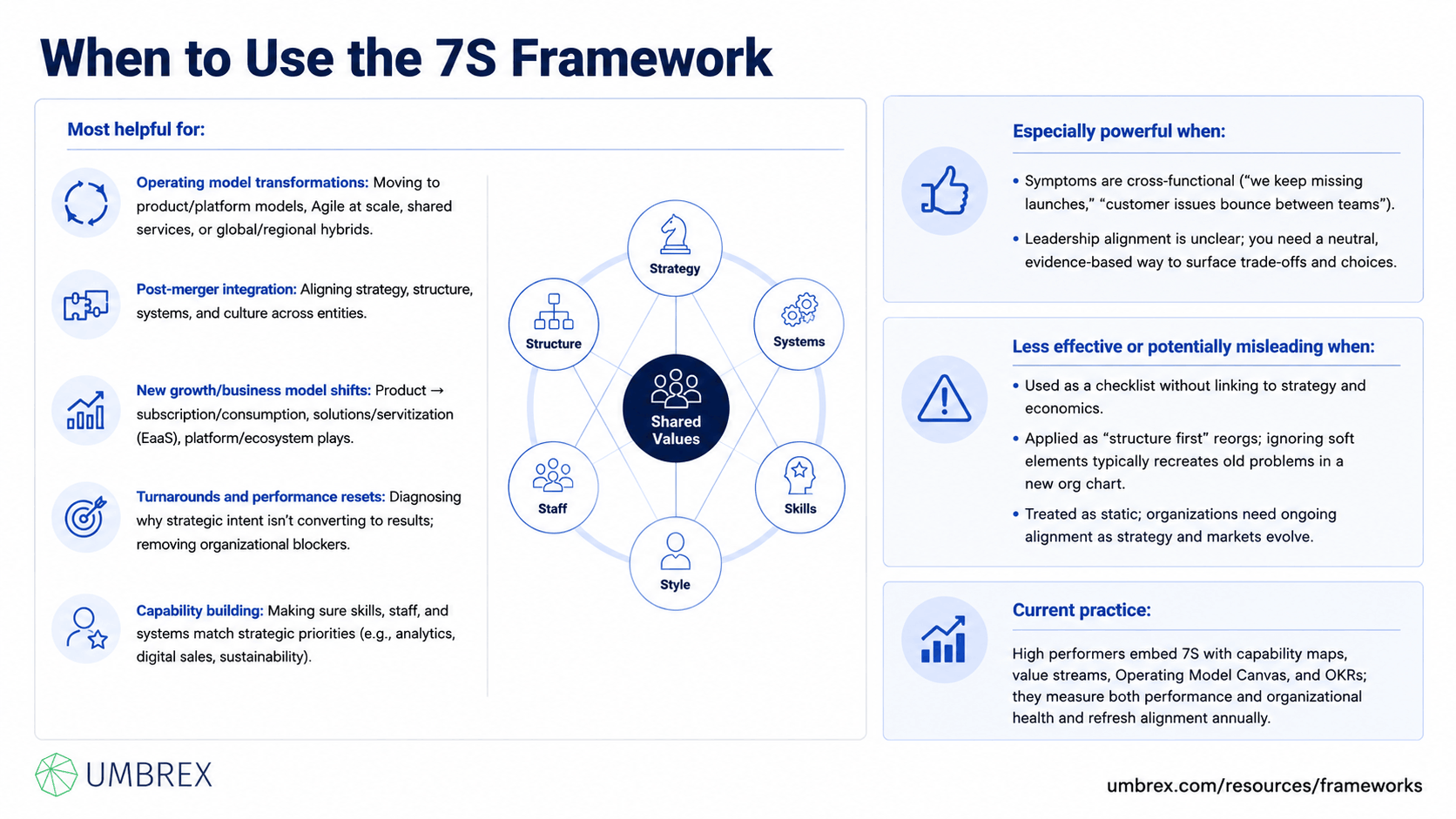
Most helpful for:
- Operating model transformations: Moving to product/platform models, Agile at scale, shared services, or global/regional hybrids.
- Post‑merger integration: Aligning strategy, structure, systems, and culture across entities.
- New growth/business model shifts: Product → subscription/consumption, solutions/servitization (EaaS), platform/ecosystem plays.
- Turnarounds and performance resets: Diagnosing why strategic intent isn’t converting to results; removing organizational blockers.
- Capability building: Making sure skills, staff, and systems match strategic priorities (e.g., analytics, digital sales, sustainability).
Especially powerful when:
- Symptoms are cross‑functional (“we keep missing launches,” “customer issues bounce between teams”).
- Leadership alignment is unclear; you need a neutral, evidence‑based way to surface trade‑offs and choices.
Less effective or potentially misleading when:
- Used as a checklist without linking to strategy and economics.
- Applied as “structure first” reorgs; ignoring soft elements typically recreates old problems in a new org chart.
- Treated as static; organizations need ongoing alignment as strategy and markets evolve.
Current practice: High performers embed 7S with capability maps, value streams, Operating Model Canvas, and OKRs; they measure both performance and organizational health and refresh alignment annually.
5. How to Apply the 7S Framework: Step‑by‑Step

- Frame the ambition and scope
Define the strategic intent (e.g., “grow solutions revenue to 30% and improve NPS by 10 pts in 24 months”), scope (enterprise, business unit, function, or region), and constraints (regulatory, labor, partner commitments). Agree on decision rights and sponsorship.
- Assemble a fact base for the “as‑is”
Combine quantitative and qualitative evidence:
- Performance and process KPIs (growth, margin, cost‑to‑serve, time‑to‑market, quality).
- Org data (spans & layers, FTE mix, attrition, critical roles).
- Systems/process maturity (value streams, IT landscape, planning rhythms).
- Health indicators (engagement, leadership behaviors, NPS/internal service quality).
- Interviews/workshops with leaders and frontline; customer and partner feedback.
- Diagnose misalignments across the seven S’s
For each S, describe the current state and rate its fit to strategy and mutual consistency with the others (simple red/amber/green works). Typical patterns:
- Strategy shifts ahead of structure/systems (e.g., moving to platform but still funding by project).
- Structure contradicts desired ways of working (e.g., functional silos vs. cross‑functional value streams).
- Systems send the wrong signals (e.g., utilization KPIs blocking customer outcomes).
- Skills/staff gaps in critical roles (e.g., data engineers, product managers, solution sellers).
- Style and shared values at odds (e.g., “innovate” message with low tolerance for experiments).
- Design the “to‑be” 7S—coherent choices, not isolated fixes
Start with the strategy and define the necessary implications in the other S’s:
- Structure: Organize around products, geographies, or customer segments; clarify accountability and decision rights (RACI).
- Systems: Establish planning/funding (e.g., product‑based, OKRs), performance management, risk controls, and core process redesign (value streams) aligned to outcomes.
- Shared Values: Refresh purpose and behavioral standards; define “non‑negotiables” that guide trade‑offs (e.g., safety first, customer obsession).
- Skills: Define critical capabilities and skill proficiencies; decide build/borrow/buy; set academies and certification paths.
- Staff: Workforce plan for critical roles; talent pipelines, incentives, diversity & inclusion targets, leadership succession.
- Style: Specify leadership behaviors (e.g., fact‑based decisions, constructive challenge, servant leadership) and embed them in evaluations and rituals.
- Translate into an executable roadmap
Bundle initiatives into waves with clear owners, value cases, and metrics. Examples:
- Wave 1 (0–3 months): decision rights/guardrails, quick process fixes, KPI resets, leadership role‑modeling.
- Wave 2 (3–9 months): org redesign, value stream pilots, new performance system, hiring for critical roles, capability sprints.
- Wave 3 (9–18 months): scale new model, retire legacy processes/systems, embed academies, refine incentives.
Fund via stage‑gates tied to evidence (outcome KPIs and health indicators).
- Install governance and change mechanisms
Set up a transformation office with a cadence (weekly/biweekly) to track both results and organizational health. Use OKRs; measure adoption (new roles staffed, rituals in place), behavior change (360 feedback, pulse surveys), and performance lift. Communicate progress transparently.
- Iterate and recalibrate
Reassess 7S alignment quarterly; adjust as strategy evolves or evidence suggests better patterns. Treat the model as a living operating blueprint, not a one‑off deck.
6. Example: 7S Framework in Action
Context: “HydraFlow,” a $6.5B industrial manufacturer aims to pivot from one‑off equipment sales to Equipment‑as‑a‑Service (EaaS) with remote monitoring and uptime SLAs. Strategy and pricing pilots show promise; execution lags. The CEO asks for an enterprise operating model redesign using 7S.
As‑is diagnosis (selected)
- Strategy: Shift to recurring revenue and outcomes (uptime) is declared but not consistently translated into choices.
- Structure: Legacy regional P&L silos; service fragmented; no owner for lifecycle value.
- Systems: Annual capex project funding; sales incentives tied to hardware bookings; no product usage KPIs; disconnected ERP/IoT data.
- Shared Values: Pride in engineering quality; limited customer success mindset.
- Skills/Staff: Few solution sellers, data scientists, or CS leaders; field techs strong but not trained for predictive maintenance routines.
- Style: Command‑and‑control; low risk tolerance; decisions escalate slowly.
To‑be design (selected)
- Strategy: Prioritize three verticals; target 35% of new bookings as EaaS in 24 months; differentiate on guaranteed uptime and energy efficiency.
- Structure: Create product‑platform and customer success organizations; centralize service operations; appoint general managers for verticals with end‑to‑end P&L accountability.
- Systems: Move to product‑based funding; OKRs focused on uptime, MTTR, NRR; redesign pricing approvals; integrate IoT platform with ERP/CRM; introduce incident‑to‑resolution playbooks.
- Shared Values: Refresh purpose: “We keep our customers’ operations running.” Codify behaviors: safety, customer outcomes, learning from incidents.
- Skills/Staff: Hire 50 solution sellers and 20 data scientists; reskill 500 field techs; launch an EaaS academy; define career pathways for CS roles.
- Style: Shift to fact‑based, fast decisions; weekly operational reviews; leaders model “go to the gemba” (frontline) and celebrate smart risk‑taking.
Roadmap and results (12 months)
- Value stream pilots in two countries; centralized service ops launched; 80% of target critical roles filled; IoT data integrated with ticketing and billing.
- KPI lift: uptime +1.3 pts to 99.6%; MTTR −22%; EaaS bookings 31% of new sales (from 12%); NRR 108% in pilot verticals.
- Health indicators: employee engagement +7 pts in pilot units; leadership behavior shift evident in 360s; voluntary attrition in critical roles stable.
- Financials: service gross margin +4.5 pts; contribution to EBITDA +$68m run‑rate vs. plan.
7. Strengths and Limitations
Strengths
- Forces integrated thinking: no single lever (e.g., structure) is allowed to carry the whole change.
- Equally addresses “hard” (structure/systems) and “soft” (values/style/skills) elements that drive behavior.
- Works at multiple levels—enterprise, BU, function—and creates a common language across leaders.
- Pairs well with operating model and capability tools; easy to codify into a roadmap with metrics.
Limitations
- Can become a checklist if not tied to strategy, economics, and measurable outcomes.
- Soft‑element change (values, style) takes time; impatience risks reversion to old habits.
- Not prescriptive about the right choices—requires judgment and context to design the to‑be.
- Static snapshots miss drift; requires refresh as markets and strategies evolve.
8. Common Pitfalls (and How to Avoid Them)
- Starting with org charts
What goes wrong: “Reorg first” creates new boxes, same outcomes.
How to avoid: Begin with strategy and value streams; align systems, skills, and incentives before locking structure. - Ignoring incentives and KPIs
What goes wrong: Systems reward old behaviors; change stalls.
How to avoid: Reset performance management, funding, and dashboards to reinforce desired outcomes. - Underestimating leadership style
What goes wrong: Leaders say “empower,” act “control”; trust erodes.
How to avoid: Define observable behaviors; build them into 360s and compensation; coach and role‑model visibly. - Vague capability definitions
What goes wrong: “We need digital skills” goes nowhere.
How to avoid: Specify critical skills, proficiency levels, and academies; track certification and on‑the‑job application. - Over‑standardization
What goes wrong: One global design ignores local requirements; shadow structures appear.
How to avoid: Define the “minimum viable bureaucracy” globally; allow local flex with guardrails. - One‑and‑done
What goes wrong: Initial alignment fades; decisions drift.
How to avoid: Quarterly 7S health checks; adjust as strategy and evidence evolve.
9. How 7S Relates to Other Frameworks
- Operating Model Canvas (POLISM): 7S gives the alignment logic; OMC provides a concrete blueprint of processes, organization, locations, information, suppliers, and management system.
- Galbraith Star Model: Complementary lens (Strategy, Structure, Processes, Rewards, People) that emphasizes design trade‑offs and rewards; 7S adds shared values, style, and skills explicitly.
- Burke–Litwin Model: Useful for change causality (external environment to individual needs). 7S is simpler and more action‑oriented; use both for deep transformations.
- Kotter’s 8 Steps / ADKAR: Change process frameworks that pair well with 7S content (what to change vs. how to drive adoption).
- Capability Maps & Value Streams: Use to specify “Skills” and “Systems” needs; align structure and staffing to critical value flows.
- OKRs / Performance Management: Instruments within “Systems” to align execution to strategy and make behavior measurable.
- Target Operating Model (TOM): The TOM describes the “to‑be” operations; 7S ensures the TOM is coherent across hard and soft elements.
10. Key Takeaways
- The McKinsey 7S Framework diagnoses and designs organizational alignment across Strategy, Structure, Systems, Shared Values, Skills, Staff, and Style.
- Performance comes from coherence, not any single lever—treat the seven elements as an integrated system.
- Anchor in strategy and economics; define a clear to‑be 7S and an executable roadmap with owners, metrics, and governance.
- Reset systems and incentives to reinforce desired behaviors; invest in skills and leadership style to make change stick.
- Reassess alignment regularly; organizations and markets evolve—so should your 7S.
11. FAQs About McKinsey 7S Framework
Is the 7S Framework still relevant for digital and Agile transformations?
Yes. In fact, it prevents “Agile theater.” Agile ways of working fail without aligned structure (product/platform), systems (funding, KPIs), skills (product, design, engineering), staff (critical roles), style (servant leadership), and shared values (customer outcomes, learning).
How long does a 7S‑driven operating model change take?
Meaningful change typically unfolds in waves over 6–18 months: quick wins (0–3 months), major systems and structure shifts (3–9 months), and scale/embedding (9–18 months). Leadership behavior and capability building continue beyond.
Can we apply 7S to a function (not the whole company)?
Absolutely. The same logic works for Sales, Finance, IT, or a business unit. Ensure interfaces to the rest of the enterprise are considered—misalignment at boundaries is common.
How do we measure success beyond org charts?
Track outcome KPIs (growth, margin, NPS/NRR, time‑to‑market), adoption metrics (roles staffed, rituals in place), and organizational health (engagement, leadership behaviors). Use OKRs and quarterly 7S health checks.
What’s the difference between “Shared Values” and “Style”?
Shared Values are the core beliefs and purpose that guide trade‑offs (“what we stand for”). Style is how leaders behave and make decisions day‑to‑day (“how we lead”). Values inform style; style signals whether values are real.
Do we need to change all seven S’s at once?
No—but you must understand the interdependencies. Changing structure without adjusting systems, skills, or incentives rarely sticks. Sequence the work, but design it as an integrated package.
How do we avoid 7S becoming a checklist?
Tie it to strategy and value. Start from outcomes, form evidence‑based diagnoses, make explicit design choices, link to KPIs, and govern with a cadence. Treat the framework as a thinking aid, not an end in itself.
