

1. What Is Design Thinking Double Diamond?
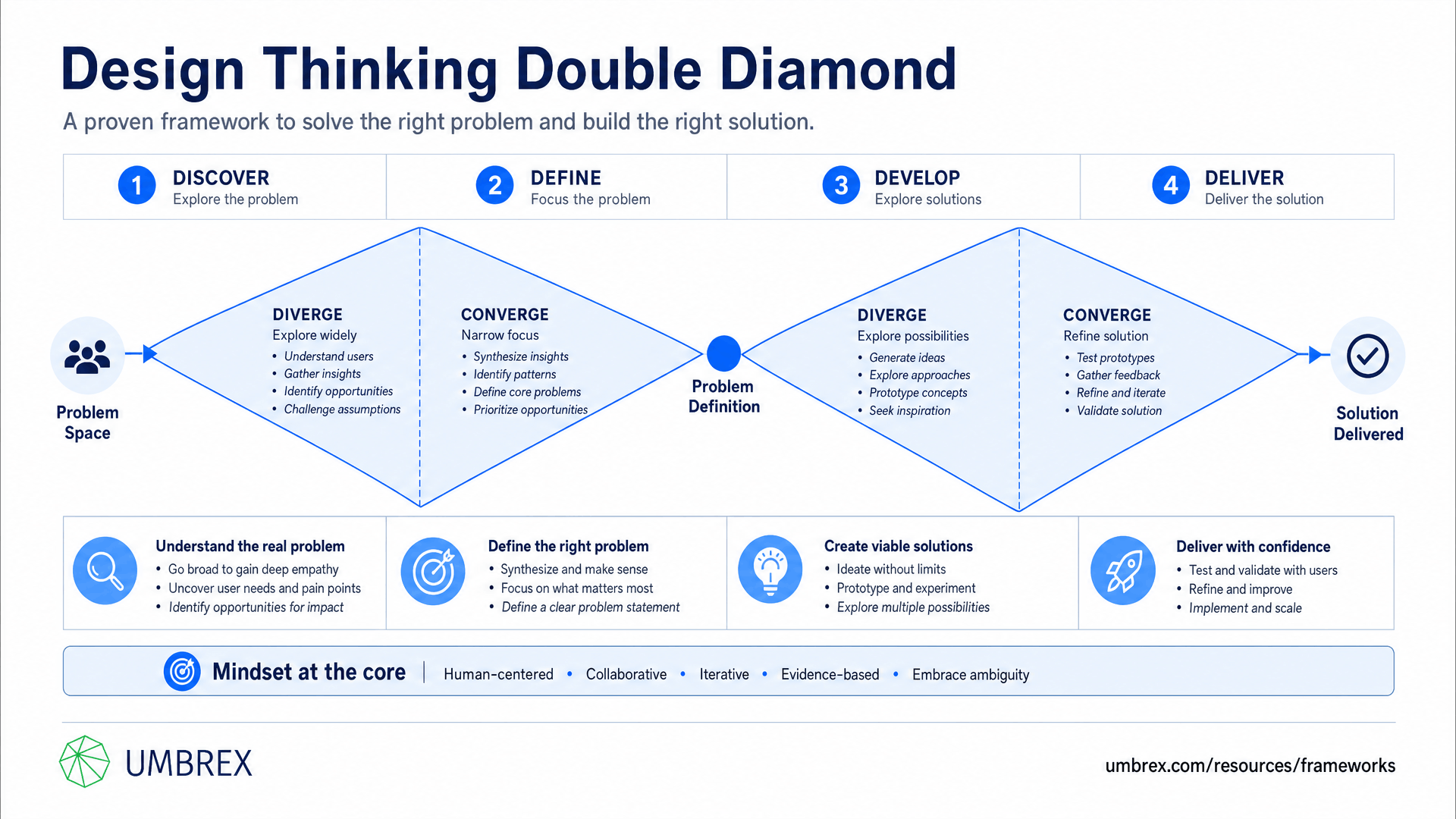
The Design Thinking Double Diamond is a practical framework for solving complex growth and innovation challenges by deliberately alternating between divergent and convergent work—first to define the right problem, then to develop the right solution. It visualizes two adjacent “diamonds,” each with an expand–contract rhythm:
- Diamond 1: Discover (diverge to explore the space) → Define (converge on the precise problem)
- Diamond 2: Develop (diverge to generate options) → Deliver (converge on a solution to pilot/scale)
In plain terms: you resist the impulse to jump to solutions. You first make sure you understand the customer’s job, context, and constraints well enough to frame the right problem. Only then do you create and test multiple solution paths quickly, selecting the best with evidence. The approach reduces rework, anchors investment in real customer value, and pairs naturally with Lean/Agile execution and MVP learning loops.
Consultants and executives use the Double Diamond to de-risk new products, services, and experiences; to fix customer journeys; and to bring cross-functional teams to a shared, evidence-based decision faster than traditional “requirements-first” methods.
2. Origin and Background
The Double Diamond was articulated and popularized by the UK Design Council in 2005 as a clear, teachable model of the design process. It synthesized practices from design disciplines—ethnographic research, synthesis, ideation, prototyping—into the now-familiar twin-diamond diagram.
Why it was created: Organizations were jumping from vague problem statements to detailed solutions without testing assumptions. The Double Diamond provided a simple, universal language to separate problem finding from solution finding, match methods to phases, and institutionalize iteration with stakeholder involvement.
How it became known: Through the Design Council’s publications and toolkits, global design schools, and widespread adoption by product companies and service organizations. It now sits alongside Lean Startup, Agile, and Jobs-to-Be-Done (JTBD) as a cornerstone of modern innovation practice.
3. How the Double Diamond Works

The two diamonds represent alternating divergent and convergent mindsets. Each stage has distinct goals, methods, and outputs.
Diamond 1: Discover → Define
- Discover (diverge): Explore the landscape to understand customers, context, and constraints.
- Methods: Stakeholder interviews, contextual inquiry/ethnography, JTBD interviews, shadowing, data/analytics review, competitive scans, service blueprinting, complaint/voice-of-customer mining.
- Outputs: Insights, personas/segments (need-based), journey maps, opportunity areas, “jobs” and outcome statements.
- Define (converge): Synthesize evidence into a sharp problem statement and design criteria.
- Methods: Affinity mapping, “5 Whys,” tension/opportunity clustering, prioritization matrices, How Might We (HMW) framing, success metrics.
- Outputs: Clear problem statement(s), HMW questions, target segment(s), constraints, success metrics/North Star, hypothesis backlog.
Diamond 2: Develop → Deliver
- Develop (diverge): Generate multiple solution concepts and approaches.
- Methods: Co-creation workshops, sketching, storyboards, Crazy 8s, value proposition canvases, service blueprint refinements, technical spikes.
- Outputs: Concept set, initial feasibility/viability read, prioritization for prototyping.
- Deliver (converge): Prototype, test, iterate, and select a solution to pilot and scale.
- Methods: MVP learning loops (Build–Measure–Learn), usability testing, Wizard-of-Oz/concierge pilots, A/B tests, limited rollouts, business case refinement.
- Outputs: Tested prototype(s), evidence against decision thresholds, refined business model/pricing, scale plan and KPIs.
Two guiding principles cut across stages:
- Evidence over opinion: Each stage produces artifacts and metrics that inform the next (e.g., JTBD insights → HMW → prototypes → behavior data).
- Iteration and loops: You may cycle within each diamond as new insights emerge; fidelity increases as uncertainty decreases.
4. When to Use the Double Diamond
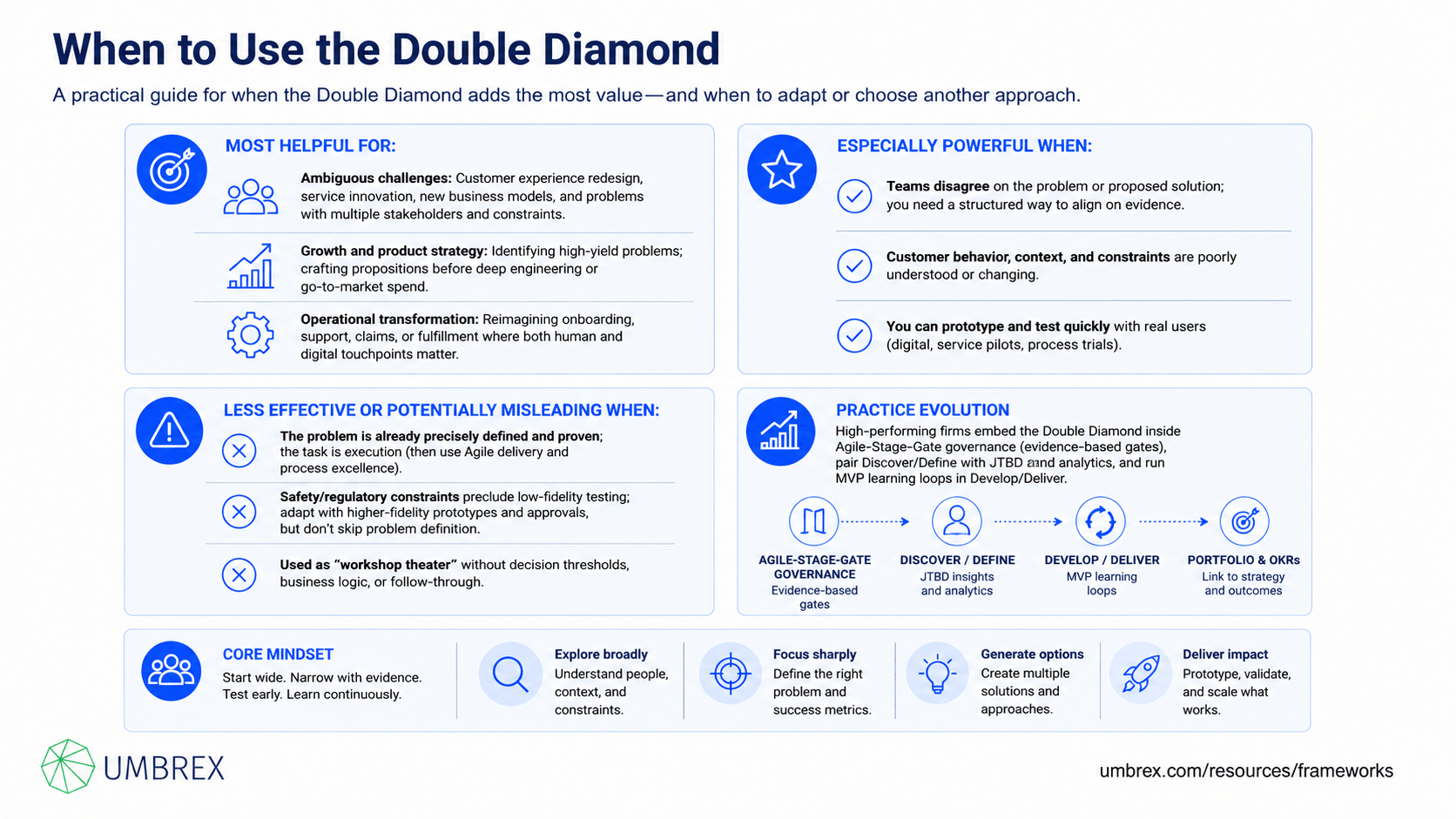
Most helpful for:
- Ambiguous challenges: Customer experience redesign, service innovation, new business models, and problems with multiple stakeholders and constraints.
- Growth and product strategy: Identifying high-yield problems; crafting propositions before deep engineering or go-to-market spend.
- Operational transformation: Reimagining onboarding, support, claims, or fulfillment where both human and digital touchpoints matter.
Especially powerful when:
- Teams disagree on the problem or proposed solution; you need a structured way to align on evidence.
- Customer behavior, context, and constraints are poorly understood or changing.
- You can prototype and test quickly with real users (digital, service pilots, process trials).
Less effective or potentially misleading when:
- The problem is already precisely defined and proven; the task is execution (then use Agile delivery and process excellence).
- Safety/regulatory constraints preclude low-fidelity testing; adapt with higher-fidelity prototypes and approvals, but don’t skip problem definition.
- Used as “workshop theater” without decision thresholds, business logic, or follow-through.
Practice evolution: High-performing firms embed the Double Diamond inside Agile‑Stage‑Gate governance (evidence-based gates), pair Discover/Define with JTBD and analytics, and run MVP learning loops in Develop/Deliver. They connect to portfolio frameworks (Innovation Ambition Matrix, Three Horizons) and OKRs.
5. How to Apply the Double Diamond: Step-by-Step

- Frame the mandate and guardrails
Clarify business objectives (growth targets, NPS, cost, compliance), scope (segments, geographies, journeys), timebox (e.g., 8–12 weeks to a tested concept), and constraints (tech, policy). Define governance: sponsor, core team, decision cadence.
- Discover: Plan research and gather insights
Blend qualitative (10–20 customer/stakeholder interviews; contextual inquiry) and quantitative (journey analytics, support tickets, funnel data). Include edge cases and noncustomers. Capture jobs, desired outcomes, anxieties, and workarounds; map current journeys and service blueprints.
- Define: Synthesize and choose the problem
Run affinity mapping; cluster insights into tensions/opportunities. Draft HMW statements (e.g., “How might we reduce time-to-first-value for SMB admins without increasing support load?”). Prioritize by impact and feasibility. Select a sharp problem statement, success metrics, and criteria (desirability/feasibility/viability).
- Develop: Generate and shortlist solution concepts
Facilitate ideation with cross-functional teams (design, product, engineering, operations, risk/compliance). Use constraints as creativity prompts. Produce multiple concepts (service and digital). Screen with a simple scorecard: customer value, evidence strength, technical risk, time-to-impact, economics.
- Deliver: Prototype, test, and iterate
Choose appropriate fidelity (paper/clickable prototype for UX; concierge/Wizard-of-Oz for service; limited release for ops/policy). Define decision thresholds (e.g., activation +10 pts; handling time −20%; price acceptance ≥ 60%). Run Build–Measure–Learn loops in 2–3 week cycles; iterate or pivot.
- Quantify the business model and operating implications
As evidence strengthens, size the opportunity (TAM/SAM for defined scope), model unit economics (conversion, ARPU, cost-to-serve), identify capability needs (data, integrations, training), and surface risks (security, policy). Draft a scale plan and value case with sensitivity bands.
- Decide and integrate
At the phase gate, decide to scale (fund next tranche), pivot (reframe problem or concept), or stop (document learning). If scaling, set OKRs, embed into Agile delivery, define metrics (AARRR/NSM), and integrate with operating model (process, policy, training).
- Institutionalize the cadence
Create a repeatable toolkit (research guides, synthesis templates, HMW catalog, prototype libraries, learning cards). Train facilitators and product owners. Schedule regular “problem framing” and “concept testing” slots in the portfolio calendar.
6. Example: Double Diamond in Action
Context: A $1.2B digital bank experiences high abandonment (42%) during new-account onboarding and elevated support costs. Goal: lift completion by 15 pts and reduce time-to-first-transaction by 30% within 9 months.
Discover (4 weeks)
- 20 customer interviews; shadowed chat support; analyzed funnel and session replays; benchmarked KYC flows; reviewed fraud policies.
- Insights: Users confused by document requirements; mobile capture failures; unclear progress and approval ETA; fear of “credit check” implications; low perceived value before approval.
Define (2 weeks)
- Problem statement: “Prospects drop or defer due to uncertainty, effort, and low perceived value prior to approval; our fraud/KYC process adds friction without proportional risk reduction.”
- HMW: “How might we enable ‘approval-ready’ onboarding in under 7 minutes with confidence, while keeping fraud under threshold?”
- Success metrics: Completion +15 pts; median time −35%; 7-day activation +10 pts; fraud loss within corridor.
Develop (2 weeks)
- Generated 30 concepts; shortlisted 5: progressive disclosure; real-time doc quality feedback; auto-fill via trusted data sources; pre-approved “lite” wallet; clear progress meter with ETA; human assist at critical steps.
Deliver (6 weeks, 3 MVP loops)
- Prototype 1 (clickable + unmoderated test): Progressive disclosure + progress bar; comprehension and intent ↑; perceived time ↓. Iterated copy and information hierarchy.
- Pilot 1 (feature-flag to 15% traffic): Real-time doc capture feedback + error-handling; completion +8 pts in treatment; support tickets −12% for KYC issues.
- Pilot 2 (to 10% traffic): “Lite” wallet (limited features) post-KYC submission; 7-day activation +11 pts; no increase in fraud signals with targeted limits and monitoring.
Scale decision and outcomes (quarter 2)
- Rolled out improvements; partnered with a data provider for auto-fill (pilot to 5% traffic first). Trained support on proactive guidance scripts.
- Results at 12 weeks: Completion +17 pts (42% → 59%); median time −41% (11:20 → 6:40); 7-day activation +13 pts; support contacts −23% per 1,000 sign-ups; fraud loss unchanged within corridor.
- Value case met; scaled to all markets; codified onboarding design playbook; scheduled periodic Discover sprints for other journeys (dispute resolution, lending pre-approval).
7. Strengths and Limitations
Strengths
- Separates problem finding from solution finding—reduces risk of building the wrong thing well.
- Creates a repeatable, evidence-based rhythm that aligns cross-functional teams and stakeholders.
- Combines qualitative depth with quantitative rigor; supports fast, low-cost learning via prototypes and pilots.
- Pairs naturally with Lean/Agile delivery, MVP loops, and portfolio governance.
Limitations
- Can devolve into workshop theater if not tied to decision thresholds, metrics, and business logic.
- Requires access to users and data; weak recruiting or biased samples can mislead.
- In highly regulated or safety-critical contexts, prototyping requires more fidelity, approvals, and time.
- Not a substitute for structural strategy; poor market attractiveness or economics won’t be solved by better design alone.
8. Common Pitfalls (and How to Avoid Them)
- Jumping to solutions (skipping Discover/Define)
What goes wrong: Teams build to internal assumptions; rework later.
How to avoid: Timebox Discover/Define; require a written problem statement and HMW before funding prototypes. - Linear, one-pass process
What goes wrong: Treating the diamonds as waterfall; learning stalled.
How to avoid: Iterate within each diamond; use MVP loops; adapt fidelity as uncertainty decreases. - Research theater
What goes wrong: Insights without translation to decisions.
How to avoid: Define decision thresholds in Deliver; connect insights to HMW, then to prototypes and KPIs. - Single-lens sampling
What goes wrong: Interviewing only power users or internal stakeholders; bias.
How to avoid: Include nonusers, churned users, edge cases; triangulate qualitative with analytics. - Idea overload without prioritization
What goes wrong: Too many concepts; no focus.
How to avoid: Use a simple scorecard (value, evidence, effort, risk); fund 2–3 concepts to prototype; kill quickly. - Ignoring feasibility/viability
What goes wrong: Desirable but unbuildable or uneconomic ideas.
How to avoid: Involve engineering, risk, finance early; run technical spikes and unit economics estimates alongside desirability tests. - No scale plan
What goes wrong: Good pilot; stalled rollout.
How to avoid: Define integration, training, policy/process changes, and KPIs for scale during Deliver; secure ownership and budgets.
9. How the Double Diamond Relates to Other Frameworks
- Jobs-to-Be-Done (JTBD): Rich input to Discover/Define; clarifies outcomes and constraints. HMW statements often derive from JTBD insights.
- MVP Learning Loop: The engine of the Deliver stage; turns assumptions into Build–Measure–Learn cycles with decision thresholds.
- Agile / Scrum: After Deliver selects a solution, Agile executes increments; discovery work can also run in dual-track Agile (discovery and delivery tracks).
- Agile‑Stage‑Gate: Provides governance—evidence-based gates between Define→Develop and Deliver→Scale.
- Innovation Ambition Matrix / Three Horizons: Place Double Diamond projects by ambition (core, adjacent, transformational); tailor fidelity, risk, and time horizons accordingly.
- Blue Ocean (ERRC) & Strategy Canvas: Use in Develop to reshape value curves (Eliminate/Reduce/Raise/Create) and test propositions before scale.
- AARRR & North Star: Supply success metrics for Deliver and scale (activation, retention, revenue); the North Star aligns the whole effort around delivered value.
- Service Blueprinting & Ecosystem Mapping: Deepen Discover/Define for multi-touchpoint services and partner-intensive contexts.
10. Key Takeaways
- The Double Diamond structures innovation into two expand–contract cycles: Discover/Define the right problem; Develop/Deliver the right solution.
- Anchor Discover/Define in evidence (JTBD, analytics) and Deliver in MVP loops with decision thresholds and KPIs.
- Engage cross-functional teams early (product, design, engineering, operations, risk/finance) to balance desirability, feasibility, and viability.
- Iterate fast; increase fidelity as uncertainty falls; integrate with Agile execution and portfolio governance.
- Avoid theater—tie every stage to a decision and a metric; celebrate smart kills and scale what works.
11. FAQs About Design Thinking Double Diamond
Is the Double Diamond a linear process?
No. It’s an iterative model. You move back and forth within and between diamonds as evidence emerges. The goal is not to follow steps mechanically but to adopt the right mindset (diverge/converge) at the right time.
How is this different from Lean Startup?
Lean emphasizes Build–Measure–Learn loops, primarily in solution testing. The Double Diamond explicitly separates problem discovery/definition from solution development/delivery and brings a broader set of research and synthesis tools to bear. They are complementary—use both.
How long should a Double Diamond cycle take?
For a focused journey or feature: Discover 2–4 weeks, Define 1–2, Develop 2–3, Deliver 2–6—roughly 8–12 weeks to a tested concept. For larger service redesigns, cycles are longer; maintain timeboxes to protect momentum.
Can we use it in B2B and regulated contexts?
Yes. Adapt research methods (e.g., stakeholder councils), ensure compliance involvement early, and use higher-fidelity prototypes/pilots with approvals. The discipline of problem definition is particularly valuable where constraints are real.
Who should be on the team?
A product/design lead, researcher, engineer/architect, data/analytics, and a business owner; pull in risk/compliance and operations as needed. Diversity of perspectives is a feature, not a bug—avoid design-only or engineering-only teams.
How do we know when to stop discovering and start defining?
When you see repeating patterns (insight saturation), have mapped the journey and jobs, and can articulate tensions and opportunity areas credibly. Use a checklist: at least 12–20 interviews, triangulated with analytics; clear HMW framing; prioritized opportunity list.
What artifacts are must-haves?
From Discover: journey map, JTBD outcomes, key insights. From Define: problem statement(s), HMW, success metrics. From Develop/Deliver: concept sketches, prototypes, learning cards with results and a clear decision.
How do we tie this to ROI?
Translate problem metrics (e.g., time-to-first-value, abandonment, support cost) to economic outcomes; set targets pre-Deliver; build a value case with ranges. Use MVP loops to validate drivers (conversion, retention, cost-to-serve) before committing scale capital.
