

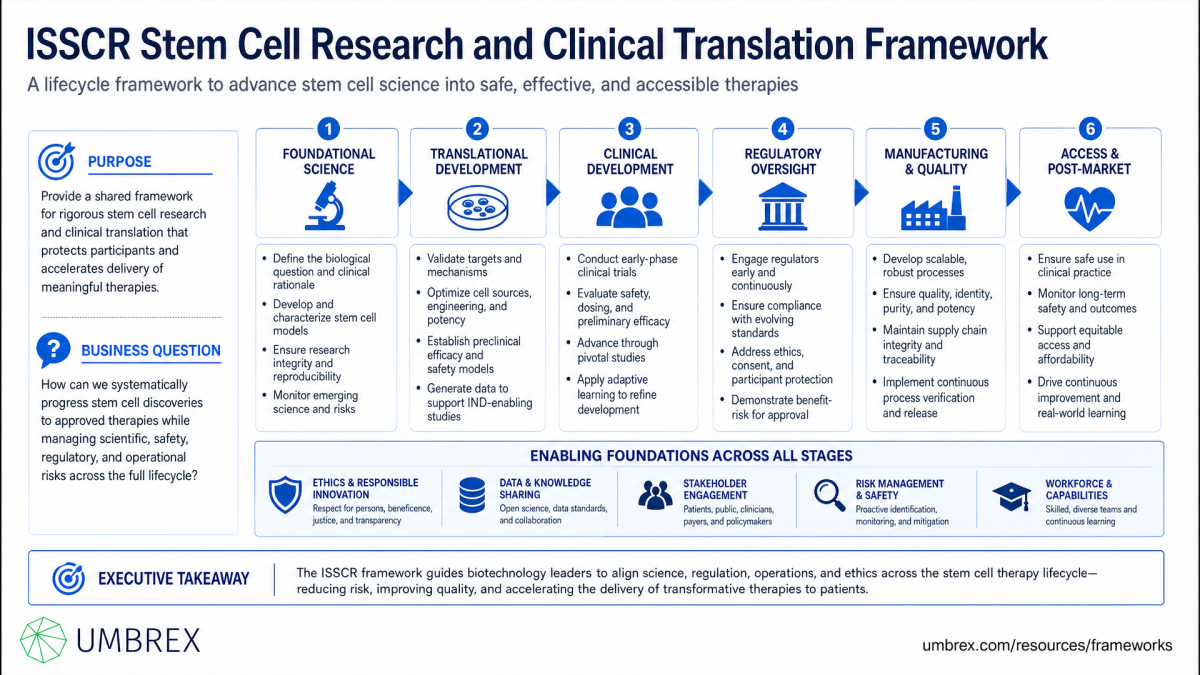
1. What Is ISSCR Stem Cell Research and Clinical Translation Framework?
The ISSCR Stem Cell Research and Clinical Translation Framework is an ethical, scientific, and governance framework for conducting stem cell research and responsibly developing clinical interventions. Its authoritative source is the Guidelines for Stem Cell Research and Clinical Translation. ISSCR stands for the International Society for Stem Cell Research—the issuing organization, not a sequence of management steps. The guidelines complement, but do not replace, applicable laws and regulations.
For executives in biotechnology, the framework structures a consequential question: what evidence, oversight, and operating capabilities should be in place before a stem cell program advances? Consultants can use it to organize readiness reviews, investment decisions, and development governance without treating scientific promise as proof of clinical readiness.
2. Origin and Background
The framework was developed by ISSCR through multidisciplinary expert task forces. Its foundations were the society’s 2006 guidelines for human embryonic stem cell research and its 2008 guidelines for clinical translation. In 2016, ISSCR integrated and expanded these into a single document connecting laboratory research with clinical development. The objective was responsible scientific progress supported by rigorous evidence, ethical oversight, and public confidence.
A comprehensive update followed in 2021. The current published version is version 1.2, dated August 2025. That targeted revision changed guidance on stem cell-based embryo models; the other sections remain as published in 2021. These are evolving professional guidelines, not a consulting firm’s proprietary methodology.
3. How ISSCR Stem Cell Research and Clinical Translation Framework Works
The framework connects ethical boundaries, research oversight, product evidence, clinical evaluation, and communication. It does not prescribe an official readiness score or portfolio matrix. Executives may build those management tools around the guidelines, provided they preserve the distinction between recommendations, legal obligations, and company-specific decision criteria.
Five ethical principles underpin the approach: integrity of the research enterprise, primacy of patient welfare, respect for research subjects, transparency, and social justice. Commercial objectives should operate within these commitments rather than override them.
| Guideline area | Interpretation for a biotechnology developer |
|---|---|
| Fundamental ethical principles | Assess scientific validity, participant protection, conflicts of interest, and fair access—not simply development speed. |
| Laboratory research and oversight | Determine which activities require specialized review, and establish appropriate consent and material provenance. |
| Clinical translation | Connect cell sourcing, manufacturing, preclinical evidence, trial design, and follow-up into a defensible development program. |
| Communications | Keep publications, patient-facing information, and promotional claims aligned with the strength and limitations of the evidence. |
| Standards in stem cell research | Support reproducibility and collaboration through consistent characterization, methods, reporting, and standards development. |
These five areas are the guidelines’ formal structure; the business interpretation above is a management application of that structure.
Research oversight categories
The laboratory section distinguishes Category 1A activities that do not require specialized review, Category 1B activities reportable to the relevant oversight body but not normally requiring further specialized review, and Category 2 activities requiring specialized scientific and ethics review. Category 3A covers research prohibited at present; Category 3B covers prohibited activities for which ISSCR identifies no compelling scientific rationale or ethical justification. Other applicable institutional oversight still matters.
These categories classify research activities, not a company’s commercial maturity. Moreover, the 2025 update replaced the “integrated” versus “non-integrated” embryo-model distinction and calls for appropriate oversight, scientific rationale, and defined endpoints for all three-dimensional stem cell-based embryo models.
4. When to Use ISSCR Stem Cell Research and Clinical Translation Framework
Use the framework when evaluating a stem cell platform license, preparing for first-in-human development, reviewing an acquired program, or assessing whether manufacturing changes undermine existing evidence. It is particularly useful when discovery scientists, clinical leaders, quality teams, and investors disagree about what “ready” means.
Prepare a dossier containing material provenance, consent documentation, cell-bank characterization, manufacturing records, relevant preclinical results, and proposed clinical objectives. Include scientific, medical, regulatory, quality, manufacturing, and ethics expertise. Plan effort around dossier completeness: a workshop can expose disagreements, but it cannot generate missing evidence.
The framework is less suitable for choosing antibody targets, forecasting market share, or valuing a company without a meaningful stem cell component. It can mislead when teams substitute checklist completion for independent scientific judgment or assume that animal findings predict patient outcomes.
Where the executive decision is proceed, defer, redesign, or terminate, structured decision-making support can make alternatives and assumptions explicit. Separate commercial attractiveness from scientific and ethical acceptability.
5. How to Apply ISSCR Stem Cell Research and Clinical Translation Framework: Step-by-Step
- Clarify the decision and scope.
Specify the decision, development milestone, and time horizon. Define the cell source, intended product, indication, delivery route, manufacturing process, and jurisdictions. Distinguish research-tool applications from interventions intended for patients.
- Establish the applicable oversight pathway.
Have qualified experts classify the research activities and identify required institutional reviews. Separately map relevant regulatory requirements. Do not let an internal management committee substitute for independent ethics or regulatory review.
- Gather and reconcile the evidence.
Assemble source documents rather than presentation summaries. Review consent, provenance, cell identity, purity, viability, functional activity, process history, safety findings, and proposed endpoints. Mark missing, contradictory, and unverified information explicitly.
- Define the units of analysis.
Assess a specific product–indication–process combination. Within it, examine cell banks, manufacturing lots, studies, and clinical protocols. Avoid assigning one readiness rating to an entire platform with materially different products.
- Build an evidence-and-oversight map.
For each applicable recommendation, record supporting evidence, reviewer, unresolved issue, decision consequence, and accountable owner. Label this a company-created management artifact—not an official ISSCR certification or scoring system.
- Interpret gaps and set actions.
Distinguish non-negotiable barriers from uncertainties that an appropriately designed next study could address. Assign each gap an action, budget, dependency, completion criterion, and decision owner. Commercial upside must not cancel a critical safety concern.
- Test alternative assumptions.
Ask how conclusions change with a different cell source, process scale, delivery method, patient population, or jurisdiction. Identify which evidence remains relevant and which would require additional justification or bridging work.
- Align reviewers and iterate.
Record disagreements and their scientific basis. Revisit the assessment after consequential process changes, new safety findings, or revised clinical plans. Ensure executives can distinguish completed actions from genuinely resolved uncertainties.
Embed the resulting decisions in development governance, with documented evidence thresholds, review responsibilities, escalation routes, and funded gap-closure plans. Management approval should remain distinct from permission to begin clinical research.
6. Example: ISSCR Stem Cell Research and Clinical Translation Framework in Action
Fictional scenario: HarborStem Therapeutics is developing an allogeneic retinal pigment epithelial cell therapy derived from induced pluripotent stem cells. Its board must decide whether to fund preparations for a first-in-human study or extend development work.
The team applies the framework to one product, one retinal indication, and one intended manufacturing process. It reviews donor documentation, cell-bank records, characterization assays, manufacturing history, preclinical findings, and the proposed clinical protocol. It also checks that the evidence concerns the product the company actually intends to administer—not merely earlier research preparations.
The review identifies two unresolved issues. A higher-yield manufacturing process produces inconsistent functional-assay results, and the safety package does not adequately address residual undifferentiated cells. The team recommends deferring clinical initiation while funding focused characterization and additional safety work. The board authorizes that work, establishes independent review milestones, and revises investor messaging to distinguish a development objective from demonstrated readiness.
For developers of cell and gene therapies, the lesson is practical: the framework should change the workplan and funding sequence, not simply produce another presentation. In this example, the outcome is a more defensible decision—not a prediction of eventual clinical success.
7. Strengths and Limitations
Strengths
- Connects disciplines. It brings research ethics, scientific evidence, manufacturing, and clinical development into one discussion.
- Makes decision barriers visible. It helps executives distinguish promising biology from a justified next development step.
- Supports accountable execution. Translating recommendations into evidence requirements and named owners creates a practical agenda for leadership and partners.
Limitations
- It is not an approval pathway. ISSCR guidance does not supersede local law or determine FDA product classification. U.S. developers must separately assess the applicable regulatory framework.
- It cannot resolve scientific uncertainty. A well-organized dossier does not establish efficacy or eliminate limitations in experimental models.
- It is not a commercial valuation model. Readiness assessment must be supplemented with financing, manufacturing economics, adoption, and access analysis.
8. Common Pitfalls and How to Avoid Them
- Averaging away critical gaps. A composite score can conceal a decisive consent or safety problem. Present blocking issues separately from overall progress.
- Using outdated embryo-model categories. Carrying forward the former integrated/non-integrated distinction can misdirect oversight. Confirm that procedures reflect the August 2025 revision.
- Confusing identity with function. Demonstrating what cells are is not the same as showing relevant biological activity. Specify what each assay supports—and what it does not.
- Ignoring process changes. Manufacturing modifications can alter cellular composition and activity, weakening the relevance of earlier studies. Document changes and assess the need for additional evidence.
- Letting fundraising define readiness. A financing milestone is not an evidence threshold. Set review criteria independently of the investor calendar and communicate unresolved issues plainly.
9. How ISSCR Stem Cell Research and Clinical Translation Framework Relates to Other Frameworks
Use complementary tools for distinct questions rather than forcing the guidelines to answer everything.
- Stage-gate governance: Apply alongside the framework to organize development decisions, funding releases, and accountability. Let the ISSCR assessment inform gate criteria rather than treating passage through an internal gate as regulatory permission.
- Failure mode and effects analysis: FMEA examines specific process failures and their consequences. Use it for manufacturing and delivery risks after establishing the program’s ethical and scientific boundaries; ICH quality risk management guidance recognizes this tool.
- ISSCR translational best practices: The society’s complementary resource for pluripotent stem cell-derived therapies supports more detailed development planning. Use it to deepen implementation rather than replace the overarching guidelines.
10. Key Takeaways
- The framework connects responsible research with defensible clinical development.
- Assess specific products, indications, and processes—not an undifferentiated platform.
- Separate ethical acceptability, scientific readiness, regulatory permission, and commercial value.
- Use evidence gaps to determine actions, owners, and funding priorities.
- A checklist or internal score cannot substitute for expert review.
11. FAQs About ISSCR Stem Cell Research and Clinical Translation Framework
Does following ISSCR guidelines mean a therapy is approved?
No. The guidelines are professional guidance, not regulatory authorization or product certification. Applicable legal requirements and regulator decisions remain separate.
Which version should development teams use?
The current published guidelines are version 1.2, dated August 2025. The targeted update concerns stem cell-based embryo models; the other sections retain the 2021 text. Check for subsequent revisions when starting a new review.
Can a small biotechnology developer use the framework?
Yes. Start with one product and the next consequential decision. A concise evidence register and focused expert review can be more useful than an elaborate dashboard. Keep oversight independent even when the internal team is small.
How long does an assessment take?
Timing depends on scope, document quality, unresolved scientific questions, and reviewer availability. Distinguish the time needed to assess existing evidence from the time needed to generate missing evidence; the latter may determine the development timetable.
