

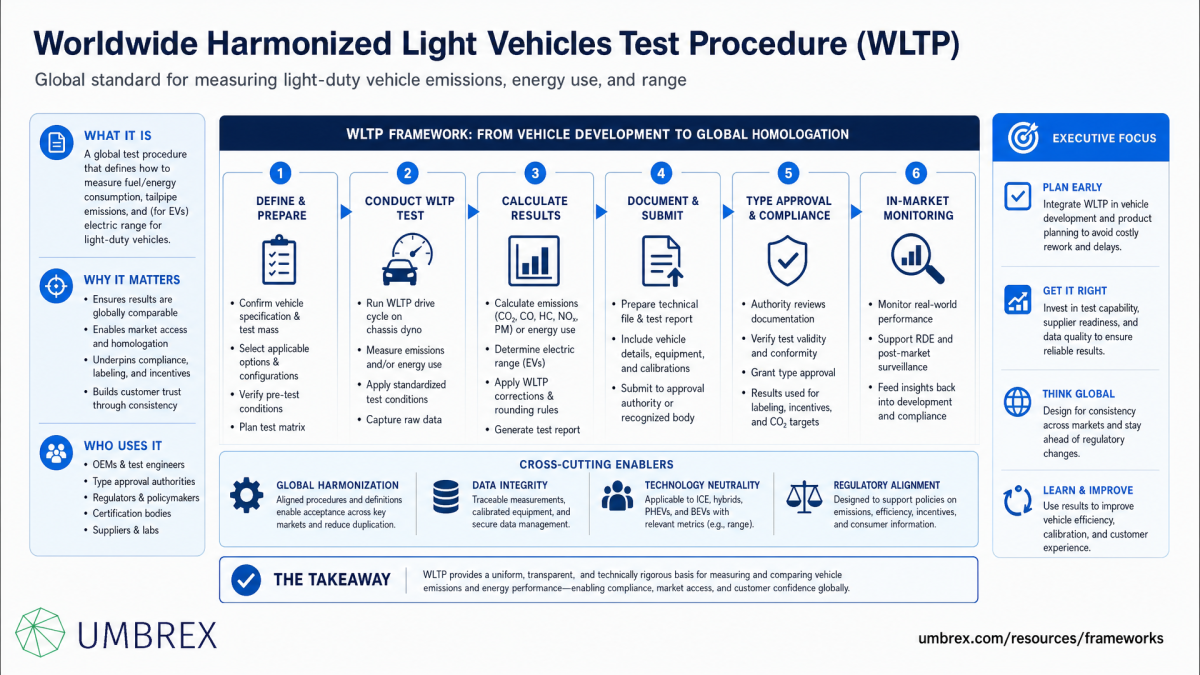
1. What Is Worldwide Harmonized Light Vehicles Test Procedure (WLTP)?
The Worldwide Harmonized Light Vehicles Test Procedure (WLTP) is a standardized regulatory testing procedure for determining light-vehicle pollutant emissions, carbon dioxide emissions, fuel consumption, electrical energy consumption, and electric range, as applicable to the powertrain. Unlike a conventional management framework, it prescribes technical methods rather than offering discretionary analytical categories. It concerns environmental performance—not crashworthiness or the entirety of vehicle homologation.
For passenger vehicle manufacturers, the executive question is which vehicle configurations can be released, with what substantiated performance values, and on what timetable. Consultants should use WLTP to structure engineering priorities, certification readiness, and launch coordination while leaving technical execution and regulatory determinations to qualified specialists.
2. Origin and Background
WLTP was developed through the United Nations Economic Commission for Europe’s World Forum for Harmonization of Vehicle Regulations, working through its pollution and energy activities. Its global technical regulation was adopted in March 2014. The initiative sought a harmonized technical basis and more representative fuel-consumption and emissions information. European implementation began on September 1, 2017, giving the procedure its first legally binding application through regional legislation.
The technical foundation appears in UN Global Technical Regulation No. 15; approval provisions also appear in UN Regulation No. 154. Global harmonization does not create one universally applicable approval certificate: the relevant national or regional implementation remains decisive.
3. How Worldwide Harmonized Light Vehicles Test Procedure (WLTP) Works
The central logic is controlled comparison. A vehicle follows a prescribed speed–time trace on a chassis dynamometer, a laboratory rolling-road rig. Its settings reproduce road load, while vehicle preparation, test mass, temperature, and measurement requirements constrain how the test is conducted. These controls make differences between vehicles more interpretable.
The acronym captures the procedure’s scope:
- W — Worldwide: A harmonized technical foundation, implemented through participating jurisdictions’ rules.
- L — Light vehicles: Passenger cars and eligible light commercial vehicles, subject to the applicable regulatory scope.
- T — Test: Prescribed driving traces, preparation, measurements, and calculations.
- P — Procedure: The complete methodology—not simply the driving cycle.
Distinguish WLTP from the Worldwide harmonized Light vehicles Test Cycle (WLTC), the driving trace used within it. A complete Class 3 cycle contains low-, medium-, high-, and extra-high-speed phases. The unmodified Class 3b trace lasts 30 minutes and covers approximately 23.3 kilometers; that is not the duration of a complete certification program. Cycle selection and permitted adaptations must follow the applicable rules.
Vehicle definition matters. Test mass, tires, aerodynamic characteristics, and relevant equipment affect the inputs. Where regulatory provisions permit, an interpolation family allows configuration-specific values to be calculated using prescribed methods and representative endpoint vehicles. A commercial model name is therefore not a sufficient unit of analysis, and every trim need not necessarily receive a separate physical test.
Powertrain interpretation also differs. Combustion vehicles produce emissions and fuel-consumption results; battery-electric vehicles produce electrical-consumption and range results. Plug-in hybrids require charge-depleting and charge-sustaining testing, with utility factors weighting results according to an assumed share of electrically driven distance. That assumption is not a promise about an individual customer’s charging behavior.
4. When to Use Worldwide Harmonized Light Vehicles Test Procedure (WLTP)
Use WLTP requirements to structure decisions about new-model launches, derivative introductions, efficiency improvements, and changes to already developed configurations. It is particularly powerful when management must reconcile customer-facing range or consumption targets with engineering evidence, configuration complexity, and approval readiness.
The management analysis requires input from homologation, powertrain engineering, vehicle integration, testing, product planning, and commercial-data owners. Its assumptions should include a defined destination market, applicable regulatory version, approval timetable, and sufficiently stable production-intent specifications. A workshop can expose gaps; it cannot create missing certification evidence.
Do not use WLTP alone to choose vehicles for a particular delivery route, predict winter motorway range, or calculate lifecycle carbon emissions. Its controlled conditions serve comparison and regulatory assessment, not every operating situation. Fleet-specific decisions require additional operating evidence.
For a multi-model launch, program management support can connect laboratory reservations, prototype availability, engineering freezes, approval submissions, and commercial-data release into one dependency-based plan.
5. How to Apply Worldwide Harmonized Light Vehicles Test Procedure (WLTP): Step-by-Step
- Clarify the decision and scope.
Specify whether the decision concerns launch release, configuration selection, engineering improvement, or a change to an existing vehicle. Define markets, powertrains, orderable derivatives, and the approval horizon. Separate regulatory requirements from internal marketing targets.
- Gather controlled inputs.
Assemble vehicle specifications, mass and equipment records, tire data, road-load evidence, software and calibration identifiers, existing test reports, and applicable requirements. Record each input’s owner, revision, and maturity. Include laboratory capacity and prototype availability in the planning baseline.
- Define the units of analysis.
Start with orderable configurations and have homologation specialists establish the legally permissible family structure and representative test vehicles. Keep commercial trim labels distinct from regulatory classifications. Identify configurations whose evidence depends on unresolved hardware or software choices.
- Build the test-coverage artifact.
Create a configuration-to-evidence matrix showing family membership, required tests, representative vehicles, controlled inputs, report status, calculated values, and release owners. This matrix manages WLTP execution; it is not a substitute for the prescribed procedure or approval documentation.
- Execute and validate the evidence.
Have qualified specialists conduct testing and check preparation, equipment status, test validity, calculations, and traceability. Compare results with applicable emissions limits and separately with internal efficiency targets. Do not treat engineering simulations as approved results without a permitted regulatory basis.
- Translate findings into actions.
Decide whether to improve efficiency, modify equipment packages, commission additional evidence, or postpone a derivative. Assign owners, budgets, and deadlines. Reconcile approved values with order codes, customer configurators, dealer information, and release documentation.
- Test sensitivities without changing the official method.
Explore how uncertain mass, component choices, or engineering estimates could affect readiness and performance. Assess customer-use scenarios separately. Sensitivity analysis informs business decisions; it does not authorize replacing prescribed certification conditions with more favorable assumptions.
- Align stakeholders and maintain change control.
Review unresolved issues with engineering, homologation, quality, product planning, and commercial teams. Require impact assessment before changing relevant hardware, software, or configuration data. Track closure through production release and subsequent changes, rather than ending governance when testing finishes.
Where configuration records and reports repeatedly disagree, a focused quality control improvement project should establish validation checks, exception handling, document control, and clear responsibility for releasing customer-facing values.
6. Example: Worldwide Harmonized Light Vehicles Test Procedure (WLTP) in Action
Fictional example: Arden Mobility is preparing a European battery-electric crossover launch with two battery sizes and three wheel packages. Management wants the long-range version to support a 500-kilometer positioning claim. All figures below are illustrative development results, not industry benchmarks or approved claims.
The team maps each orderable battery-and-wheel combination to its production-intent mass, road-load evidence, software build, and test coverage. Homologation specialists confirm permissible family groupings and representative vehicles rather than assuming that one result covers the entire model range.
Development testing indicates 508 kilometers for the long-range configuration with efficiency-oriented wheels, but 476 kilometers with the sport package. The sport derivative misses the commercial target; this is not, by itself, evidence of a regulatory failure.
Management retains the sport package because its customer proposition does not depend on maximum range, but abandons the universal 500-kilometer claim. Engineers investigate tire and aerodynamic improvements without delaying the base vehicle unnecessarily. The program reserves additional testing capacity, completes the required approval evidence, and releases configuration-specific values to the customer configurator.
The lesson is to connect technical measurements to explicit product choices—not to optimize one headline number while ignoring the configurations customers actually purchase.
7. Strengths and Limitations
Strengths
- A common decision baseline: Give engineering, product planning, and commercial teams a consistent basis for discussing efficiency and range.
- Visible trade-offs: Evaluate equipment choices against performance targets, customer value, cost, and evidence requirements.
- Traceable release decisions: Connect each offered configuration with its supporting technical evidence and accountable owner.
Limitations
Standardized laboratory results cannot capture every combination of temperature, route, payload, driving behavior, or charging practice. European real-world monitoring has demonstrated gaps between WLTP and actual fuel consumption, particularly for plug-in hybrids. The procedure also does not constitute a lifecycle environmental assessment or complete safety validation.
In fleet leasing, use WLTP as a comparison baseline, then supplement it with route-specific consumption, charging access, seasonal performance, and operating-cost scenarios before committing capital.
8. Common Pitfalls and How to Avoid Them
- Using the model badge as the unit: One commercial name can conceal materially different configurations. Maintain an order-code-level view and an independently confirmed regulatory family map.
- Confusing targets with limits: Missing a marketed range target is different from failing an emissions requirement. Show regulatory compliance and commercial performance separately.
- Ignoring late changes: A revised component, calibration, or equipment package may affect existing evidence. Require homologation impact assessment before approving the change.
- Overextending family coverage: Do not assume that shared architecture automatically permits shared results. Document the basis for each configuration’s evidence coverage.
- Releasing inconsistent values: Engineering reports, approval records, and sales systems should not have competing baselines. Establish one controlled release record with reconciliation checks.
- Stopping at the test report: Convert findings into derivative choices, engineering actions, and release decisions. Measure unresolved evidence gaps and decision closure, not merely tests completed.
9. How Worldwide Harmonized Light Vehicles Test Procedure (WLTP) Relates to Other Frameworks
Real Driving Emissions testing
Real Driving Emissions (RDE) testing adds on-road pollutant-emissions assessment alongside laboratory testing. It complements WLTP rather than replacing it. Plan the two evidence streams together where required; a laboratory result does not eliminate the separate on-road requirements.
United States testing and labeling systems
United States Environmental Protection Agency procedures use their own test cycles, calculations, and labeling methods. For a transatlantic launch, build parallel market-specific evidence plans. Do not convert a WLTP electric-range figure into an EPA label value using an assumed universal percentage.
Total cost of ownership
After establishing the technical baseline, use a total cost of ownership analysis to evaluate procurement or product-positioning choices. Combine consumption scenarios with annual distance, fuel or electricity prices, charging availability, maintenance, and financing. Prefer this analysis when the decision concerns fleet economics rather than regulatory measurement.
10. Key Takeaways
- WLTP is a prescribed environmental-performance procedure, not a strategy matrix or complete safety standard.
- Manage configurations and permissible regulatory families—not just commercial model names.
- Distinguish legal compliance, internal efficiency targets, and customer operating expectations.
- Connect test evidence to engineering changes, launch gates, and commercial-data release.
- Supplement standardized results with market-specific requirements and real-world operating scenarios.
11. FAQs About Worldwide Harmonized Light Vehicles Test Procedure (WLTP)
Is WLTP a vehicle safety standard?
No. Its scope concerns emissions, consumption, and electric range. Crashworthiness and other vehicle safety requirements require separate assessment within the wider homologation program.
Does WLTP predict real-world electric vehicle range?
It provides a standardized comparison under prescribed conditions, not a guaranteed trip distance. Temperature and operating demands affect energy use, so route planning should incorporate additional evidence appropriate to the intended duty cycle.
Are WLTP and EPA figures interchangeable?
No. EPA labeling uses different testing and adjustment methods. Compare vehicles using the same measurement system and obtain the required market-specific evidence rather than applying a blanket conversion factor.
How long does WLTP testing take?
The unmodified Class 3b driving trace lasts 30 minutes. A complete program also needs preparation, road-load work, applicable powertrain testing, analysis, documentation, and approval coordination. Plan its duration from the evidence requirements and resource schedule—not from the driving trace alone.
