

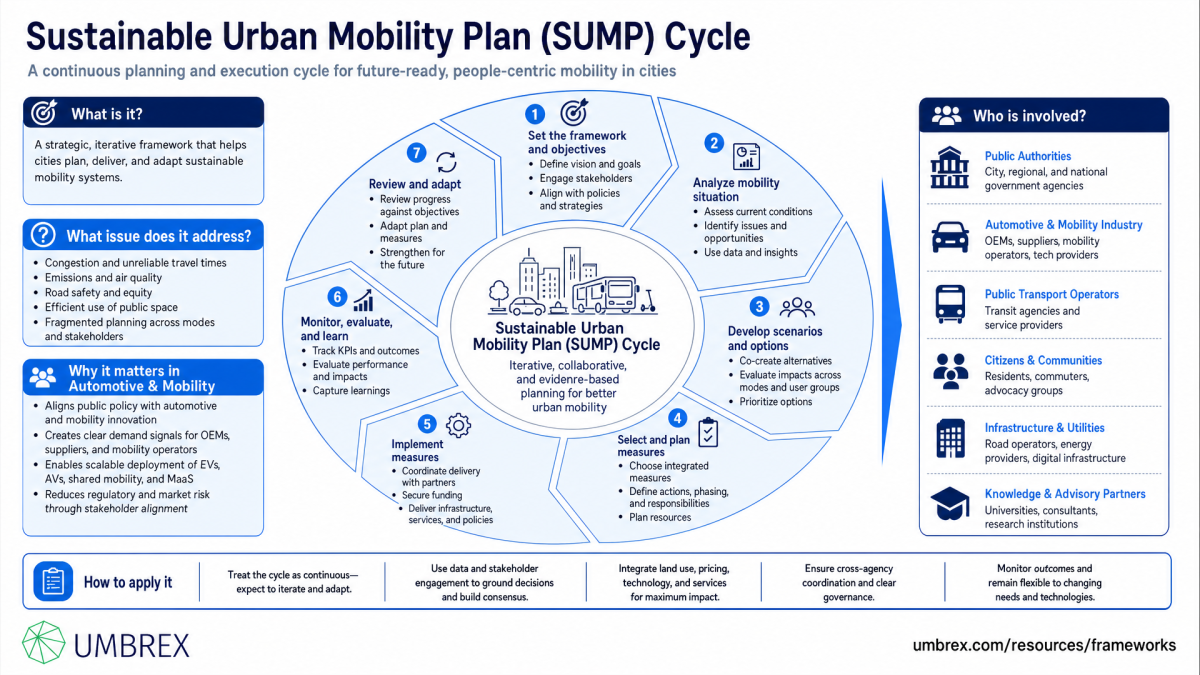
1. What Is Sustainable Urban Mobility Plan (SUMP) Cycle?
The Sustainable Urban Mobility Plan (SUMP) Cycle is a strategic planning and implementation framework for improving how people and goods move through a city and its surrounding travel area. It connects diagnosis, shared objectives, investment choices, delivery, and evaluation. Its purpose is better accessibility and quality of life—not simply faster vehicle movement.
For automotive and mobility businesses, the cycle provides a way to evaluate fleet deployments, shared services, charging infrastructure, and public-sector partnerships against citywide needs. Consultants can use it to structure decisions involving several organizations whose investments must work together.
The distinction is important: a SUMP is an authority-led urban mobility plan, not a corporate product strategy. Operators and bus manufacturers should use its objectives to shape service proposals and vehicle requirements, rather than assume that selling more vehicles constitutes better mobility.
2. Origin and Background
The framework emerged from European Commission-supported projects and accumulated transport-planning practice, rather than one identifiable inventor. The Commission’s 2013 Urban Mobility Package promoted SUMPs as an integrated alternative to fragmented planning. Rupprecht Consult subsequently edited the guidelines that codify the planning cycle. The original problem was coordinating transport, land use, environmental objectives, and public participation.
The second-edition guidelines, released in October 2019, incorporated experience from cities and mobility practitioners. A third edition was published on June 8, 2026; the underlying methodology remained unchanged. The cycle therefore remains relevant as a planning process, while its guidance evolves with policy and mobility developments.
3. How Sustainable Urban Mobility Plan (SUMP) Cycle Works
The cycle moves from understanding mobility needs to agreeing outcomes, selecting interventions, implementing them, and learning from results. Its established structure comprises four phases, twelve steps, and thirty-two supporting activities. These organize the work; they do not mechanically determine which transport solution should win.
What the acronym means
- S — Sustainable: Balance environmental, social, and economic outcomes over time.
- U — Urban: Address the city and surrounding areas connected by everyday travel.
- M — Mobility: Consider people, goods, accessibility, and the interaction between transport modes.
- P — Plan: Translate objectives into measures, responsibilities, resources, and evaluation.
These words describe the plan’s intent, rather than four additional stages. The practical sequence is summarized below.
| Phase | Three steps, summarized |
|---|---|
| Preparation and analysis | 1. Establish working and participation arrangements. 2. Define the planning framework and boundaries. 3. Diagnose mobility patterns, problems, and opportunities. |
| Strategy development | 4. Compare future scenarios jointly. 5. Agree a vision and objectives with stakeholders. 6. Establish measurable targets and indicators. |
| Measure planning | 7. Select coordinated intervention packages. 8. Allocate actions and responsibilities. 9. Prepare financing and plan adoption. |
| Implementation and monitoring | 10. Deliver agreed actions. 11. Monitor progress, adapt, and communicate. 12. Evaluate results and carry lessons into the next cycle. |
Milestones mark agreement on the diagnosis, vision and targets, plan adoption, and evaluation. Activities can overlap and require feedback loops; the cycle is not a rigid waterfall process.
For industry participants, useful units include travel corridors, passenger groups, service zones, interchange locations, and fleet duty cycles. Assess an electric feeder service as part of a complete journey, including walking access, waiting, transfers, and affordability. Evaluate automated shuttles against the same outcomes—not a separate standard that rewards novelty.
4. When to Use Sustainable Urban Mobility Plan (SUMP) Cycle
The cycle is especially powerful when fleet, infrastructure, street-management, and service decisions are interdependent. Relevant questions include:
- Should shared vehicles feed public transport or provide independent door-to-door services?
- Which corridors justify larger buses, smaller vehicles, or demand-responsive operations?
- How should charging, depots, interchange facilities, and service launches be sequenced?
- Would automation improve accessibility without increasing unnecessary vehicle travel?
European companion guidance explicitly addresses shared mobility and electrification within SUMP planning. For providers of charging and energy services, the practical implication is to test infrastructure against intended fleet operations and public mobility objectives—not vehicle counts alone.
Useful inputs include origin–destination patterns, service reliability, accessibility gaps, traffic and safety data, fleet utilization, operating costs, infrastructure constraints, and resident research. Authorities, operators, utilities, employers, disability representatives, and neighboring municipalities should contribute.
A workshop can establish scope, but a complete plan requires evidence gathering, participation, appraisal, and formal decisions. Effort depends on existing data and governance complexity. The process assumes a credible public sponsor and meaningful cooperation across boundaries. It is not a good substitute for vehicle certification, detailed engineering, or a standalone investment valuation. Weak participation or unrealistic demand assumptions can make an apparently coherent plan misleading.
5. How to Apply Sustainable Urban Mobility Plan (SUMP) Cycle: Step-by-Step
The following working sequence translates the official cycle into an executive-led engagement; it does not replace its twelve steps.
- Clarify the decision and mandate.
Define the mobility outcomes, planning horizon, geographic boundaries, and authority responsible for adoption. For a commercial participant, specify which decisions it controls—fleet commitments, service design, or partner agreements—and which remain public decisions.
- Build a common evidence baseline.
Combine travel surveys, service schedules, ticketing information, traffic counts, operator records, and interviews. Identify underserved trips and populations. Record data permissions, missing information, seasonal effects, and inconsistent definitions before comparing alternatives.
- Define comparable units.
Segment corridors, trip purposes, operating periods, and passenger needs. Compare complete service packages serving equivalent needs. A peak commuter corridor and a dispersed evening service should not be judged using identical occupancy expectations.
- Construct the planning artifacts.
Create a diagnosis, scenario comparison, objectives-and-indicators register, intervention portfolio, and delivery roadmap. Map dependencies between routes, vehicles, charging, curb access, digital integration, and funding. Include walking, cycling, public transport, and freight where relevant to the decision.
- Interpret results against shared objectives.
Assess accessibility, safety, affordability, emissions, reliability, and financial feasibility. Separate public benefits from operator returns. Challenge proposals that improve fleet utilization while worsening transfers, excluding non-digital users, or shifting costs to another organization.
- Translate priorities into commitments.
Assign owners, budgets, procurement actions, operating responsibilities, and decision gates. Distinguish capital expenditure from recurring service funding. Specify who carries demand risk, maintains chargers, supplies accessible vehicles, and resolves passenger problems across providers.
- Stress-test assumptions.
Vary ridership, occupancy, empty running, energy prices, connection delays, and service subsidies. For automated operations, examine restricted operating conditions, supervision requirements, and fallback arrangements. Favor investments that remain useful if technology deployment is delayed.
- Align, implement, and iterate.
Resolve disagreements with documented evidence and explicit trade-offs. Agree monitoring responsibilities before launch. Compare outcomes with the baseline, communicate findings, adjust underperforming measures, and retain lessons for the next planning cycle.
For operators, these decisions often require a detailed service delivery model covering dispatch, depot operations, maintenance, passenger support, and contractual interfaces. The plan establishes direction; operating design makes that direction deliverable.
6. Example: Sustainable Urban Mobility Plan (SUMP) Cycle in Action
Fictional example: Meridian Mobility operates electric minibuses and wants to expand into a suburban employment district. Its initial proposal is a door-to-door service. The regional authority invites Meridian into a workstream of its wider SUMP, alongside the rail operator, neighboring municipalities, residents, and the electricity utility.
Preparation and strategy: The team examines three travel corridors using employee travel surveys, rail timetables, road conditions, and Meridian’s duty-cycle costs. It finds that missed connections and limited evening coverage matter more than the absence of another booking application. Stakeholders prioritize reliable access to jobs, affordability, and accessible boarding.
Measure planning: The team compares additional conventional buses, unrestricted door-to-door minibuses, and timed rail feeders with limited demand-responsive evening coverage. Under its stated assumptions, the feeder package better addresses the access gap. Unrestricted service creates too much empty running, while an immediate automated launch introduces unnecessary delivery uncertainty.
Implementation and learning: The authority adopts the wider plan; Meridian commits vehicles only after depot power and service funding are confirmed. Partners agree transfer coordination, accessible booking options, and performance reporting. Monitoring reveals weak late-evening connections, prompting a timetable adjustment rather than automatic fleet expansion.
The delivery team uses program management support to coordinate charger commissioning, vehicle deliveries, interchange changes, and launch readiness. The result is a coordinated service commitment—not merely an attractive pilot proposal.
7. Strengths and Limitations
Strengths
- System-level thinking: Connects vehicles, infrastructure, street space, and passenger journeys.
- Explicit trade-offs: Makes public objectives and commercial interests visible.
- Delivery discipline: Links intervention choices to owners, resources, and monitoring.
- Technology neutrality: Provides a basis for comparing automation with simpler alternatives.
Limitations
The cycle structures decisions but does not supply a demand model, safety assessment, or financial answer. Its effectiveness depends on evidence, institutional capacity, and willingness to act. Participation can expose conflicts without resolving them, while long-lived assets can outlast assumptions about technology and demand.
Use additional technical and commercial analysis before committing fleets or infrastructure. In particular, do not treat SUMP adoption as permission to operate automated vehicles or as proof that a service is financially sustainable.
8. Common Pitfalls and How to Avoid Them
- Starting with the vehicle: A preferred shuttle or fleet technology narrows the options prematurely. Define the accessibility problem before selecting equipment.
- Stopping at municipal boundaries: Excluding suburban travel can distort demand and coverage. Use actual journey patterns and cross-boundary agreements.
- Counting bookings as benefits: Trips may replace walking or public transport rather than car use. Investigate the previous mode and include empty kilometers.
- Ignoring recurring funding: Capital funding does not pay for ongoing drivers, maintenance, energy, or supervision. Identify operating support and revenue responsibilities.
- Consulting only existing customers: Operator data omits people unable to use the service. Include disabled travelers, non-users, and residents without smartphones.
- Declaring success at launch: Vehicles deployed are outputs, not mobility outcomes. Track access, reliability, safety, affordability, and service continuity.
9. How Sustainable Urban Mobility Plan (SUMP) Cycle Relates to Other Frameworks
Scenario planning belongs inside strategy development. Use it to explore alternative demand, land-use, policy, and technology conditions before choosing measures. The SUMP Cycle supplies the broader process that connects those scenarios to public objectives and implementation.
Stakeholder mapping is useful during preparation and throughout delivery. Map decision authority, affected groups, resources, and dependencies. For mobility partnerships, distinguish the vehicle supplier, service operator, street authority, transport agency, and utility rather than treating them as one stakeholder.
Multi-criteria appraisal and financial business cases should support measure selection. Use the former to make trade-offs across outcomes explicit and the latter to test affordability and commercial viability. Prefer a standalone business case for a narrowly bounded depot investment; use the SUMP Cycle when that investment forms part of a wider mobility-system decision.
10. Key Takeaways
- SUMP is a planning-and-delivery cycle, not a vehicle-selection formula.
- Start with accessibility and complete journeys, not technology deployment.
- Evaluate coordinated packages across services, fleets, infrastructure, and funding.
- Keep public benefits and operator economics distinct but connected.
- Monitor outcomes and adapt; plan adoption is not the finish line.
11. FAQs About Sustainable Urban Mobility Plan (SUMP) Cycle
Can an automotive company develop its own SUMP?
A company can apply the cycle’s logic to its proposals, but that does not make its corporate plan a city SUMP. Participate in the authority-led process and distinguish commercial commitments from public decisions.
How should the cycle accommodate automated mobility?
Treat automation as one delivery option. Compare accessibility, occupancy, empty running, supervision, operating restrictions, and fallback arrangements. Keep deployment approvals and safety assurance separate from mobility planning.
Can smaller mobility operators use the framework?
Yes. Begin with a clearly bounded service question, a credible baseline, stakeholder interviews, and a small set of outcome measures. Scale the analytical effort to the decision, while preserving coordination and evaluation.
What is the minimum useful data?
Start with who needs to travel, where and when they travel, existing service performance, accessibility gaps, delivery costs, and infrastructure constraints. Add surveys or modeling when uncertainty could change the decision materially.
