

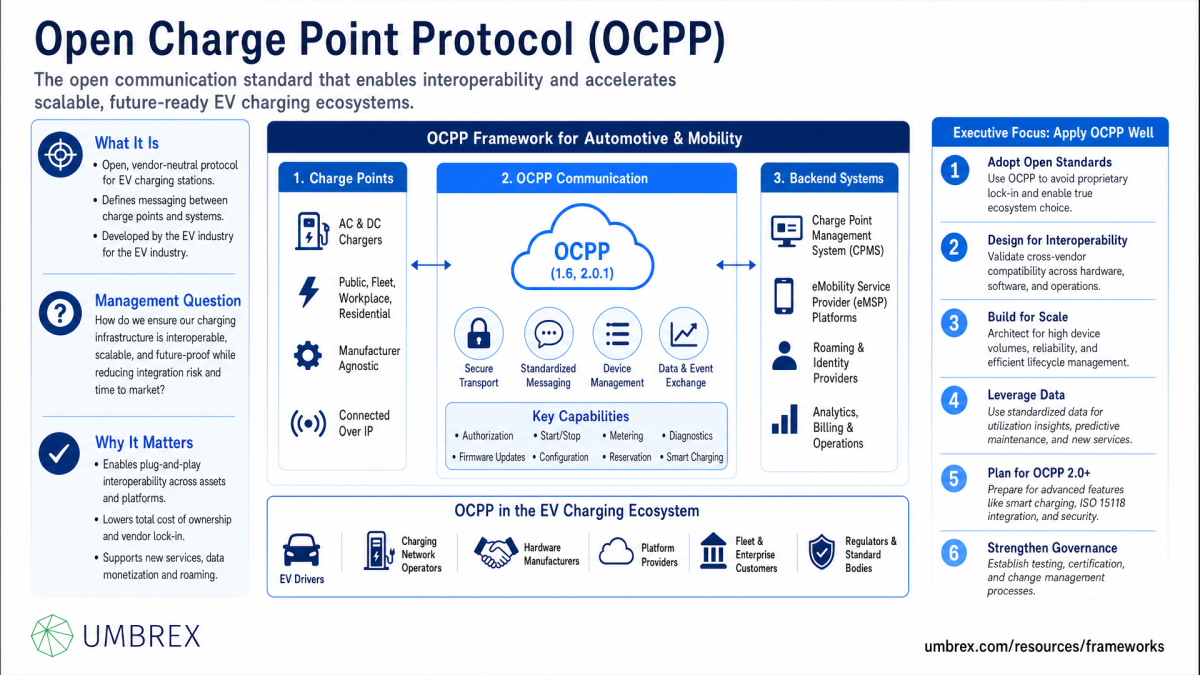
1. What Is Open Charge Point Protocol (OCPP)?
The Open Charge Point Protocol (OCPP) is an open communication standard connecting electric vehicle charging stations with a charging station management system (CSMS), the software used to supervise their operation. Strictly speaking, it is a technical protocol, not a management framework. Its business purpose is to support interoperability and reduce dependence on proprietary station-to-backend connections.
For executives evaluating charging and energy services, OCPP helps structure equipment procurement, platform selection, and migration decisions. The important question is not simply whether a charger “supports OCPP,” but whether the proposed hardware, software, and operating processes work together under real conditions.
2. Origin and Background
OCPP originated with ElaadNL in the Netherlands in 2009. The organization, established by Dutch electricity distribution system operators, needed a standardized way to manage charging stations purchased from different suppliers. The first published version, OCPP 1.0, appeared in 2010. Responsibility transferred to the Open Charge Alliance (OCA) in 2014.
The original procurement problem remains relevant: charging equipment and its management platform should not require a proprietary pairing. Subsequent development expanded the protocol’s capabilities beyond basic station management to include richer monitoring, security, and charging-control functions.
3. How Open Charge Point Protocol (OCPP) Works
OCPP defines messages and interaction rules between a station and its backend. Operational exchanges include station registration, authorization, configuration, transaction reporting, and remote control. These exchanges allow the backend to supervise charging activity without using a different proprietary interface for every equipment supplier.
Understanding the name
- Open: A shared specification; this does not mean every implementation is open-source software.
- Charge: The electric vehicle charging activity being managed.
- Point: The charging equipment participating in that communication.
- Protocol: Agreed rules governing messages and responses.
Translate functions into operating requirements
For management purposes, assess the following functional areas. These are practical groupings, not an additional framework embedded in the standard:
- Authorization and transactions: Establish who may charge and record session activity.
- Monitoring and device management: Obtain equipment information, identify problems, and manage configurations.
- Remote maintenance: Support diagnostic and firmware-management workflows.
- Smart charging: Communicate supported charging limits or schedules.
- Security: Evaluate secure communications, credentials, security events, and update mechanisms. Coverage depends on the version and implemented capabilities.
Version choice matters
OCPP 1.6 was released in 2015, OCPP 2.0.1 in 2020, and OCPP 2.1 in 2025. Version 2.0.1 added or improved device management, transaction handling, security, smart charging, and ISO 15118 support. Version 2.1 adds capabilities including bidirectional charging and distributed energy resource control.
OCPP 1.6 and 2.0.1 are not compatible. Although 2.1 builds on 2.0.1 application logic, procurement teams should verify the exact version, edition, features, and implementation rather than assume interchangeability. A mixed estate requires a backend supporting the relevant protocol versions or a separately validated integration approach.
Smart charging also requires a distinction between communication and optimization: use an energy-management application to determine allocations, then supported OCPP functions to communicate them. Do not treat the protocol itself as the scheduling algorithm.
4. When to Use Open Charge Point Protocol (OCPP)
An OCPP assessment is especially useful when procuring networked chargers, consolidating multiple equipment suppliers, changing management platforms, or reviewing an acquired charging estate. For fleet management, equipment portability should be evaluated alongside charging windows, vehicle energy requirements, and operational continuity. The U.S. Department of Energy identifies OCPP-capable equipment as an enabler of switching charging networks without necessarily replacing the equipment.
Start with equipment and firmware inventories, protocol versions, certificates, session logs, contracts, site constraints, and required workflows. Include charging operations, technology, cybersecurity, energy management, procurement, and customer support. Separate a requirements workshop from laboratory testing and field validation; effort depends primarily on the number of combinations and failure scenarios.
The approach is powerful when independently sourced stations and software must function as one service. It is not a substitute for assessing location economics, grid capacity, electrical safety, or battery performance. Conclusions become misleading when advertised support is treated as demonstrated compatibility, or when optional capabilities are assumed to exist across the entire estate.
5. How to Apply Open Charge Point Protocol (OCPP): Step-by-Step
- Clarify the decision and scope.
Specify whether the project concerns new procurement, backend migration, fleet charging control, or operational improvement. Define sites, equipment families, charging use cases, asset life, and unacceptable service interruptions.
- Gather implementation evidence.
Collect hardware models, firmware releases, backend versions, certificates, configurations, logs, and supplier commitments. Record ownership of credentials, station settings, historical data, and migration responsibilities.
- Define the units of analysis.
Assess charger model–firmware–backend combinations, not supplier names alone. Distinguish stations from individual charging ports. Separate depot, workplace, and public-charging workflows where their requirements differ.
- Construct a requirements-and-evidence matrix.
List required workflows as rows and equipment/backend combinations as columns. Record protocol support, optional features, test evidence, unresolved gaps, responsible suppliers, and acceptance criteria. Treat this matrix as a project artifact, not an official OCPP component.
- Test and interpret results.
Validate authorization, session records, meter reconciliation, remote actions, and charging limits. Exercise communications loss, power interruption, reboot, and recovery. Investigate whether failures originate in protocol handling, firmware, connectivity, or another system.
- Translate findings into actions.
Decide which assets to retain, update, replace, or exclude. Specify backend requirements and remediation obligations. For migrations, establish data reconciliation, endpoint changes, credential provisioning, rollback procedures, and operational acceptance gates.
- Test alternative assumptions.
Repeat critical scenarios under weaker connectivity, increased station counts, simultaneous vehicle arrivals, and tighter site limits. Check how conclusions change if planned firmware features arrive late or a supplier withdraws support.
- Align stakeholders and iterate.
Review exceptions with technology and operations leaders. Assign owners for incidents and unresolved defects. Revalidate affected combinations after material software changes, rather than assuming a previous test covers every subsequent release.
For a multisite deployment, program management support can coordinate supplier fixes, site access, testing, training, and cutover decisions. The deliverable should be an executable rollout plan, not simply a compatibility assessment.
6. Example: Open Charge Point Protocol (OCPP) in Action
Fictional example: Northline Mobility manages 60 electric delivery vans across three depots. Its chargers come from two manufacturers, each tied operationally to a separate management platform. The company wants one operating dashboard and consistent charging controls without unnecessarily replacing serviceable equipment.
The team evaluates charger model–firmware–backend combinations. Its requirements matrix covers driver authorization, session reporting, charging limits, remote diagnostics, and operation during connectivity interruptions. Departure schedules and required vehicle energy are supplied by fleet systems rather than assumed to be available from every charger.
Testing shows that a candidate backend supports the estate’s OCPP 1.6 and 2.0.1 equipment through separate implementations. However, one charger family loses some session records after a communications outage, while another exposes detailed fault information only through a proprietary extension.
Northline retains equipment that passes the required workflows, makes the recording defect a remediation gate, and documents the proprietary diagnostic dependency. New equipment must demonstrate the selected 2.0.1 capabilities against the actual backend.
The company pilots one depot before authorizing wider migration. Acceptance depends on reconciled energy records, successful charging sessions, departure readiness, and tested rollback—not on the OCPP label alone.
7. Strengths and Limitations
Strengths
- Procurement flexibility: Standardized station-to-backend communications can support independent equipment and platform choices.
- Asset continuity: Compatible equipment may remain useful through a backend change rather than requiring wholesale replacement.
- Clearer requirements: Protocol capabilities provide a concrete basis for specifying transactions, monitoring, charging controls, and maintenance workflows.
Limitations
Protocol conformance is narrower than end-to-end service assurance. Certification identifies tested functionality; it does not establish that every hardware/backend pairing will satisfy an operator’s complete workflow. Inspect the product, software version, configuration, and certified profiles rather than relying on a supplier-level claim.
Security also extends beyond protocol implementation. Credential management, access controls, software maintenance, and operational practices require separate attention. OCA’s Security Operations Guide explicitly addresses questions that a specification alone cannot resolve.
Where the assessment supports a platform change, formalize vendor transition planning. Include contract exits, data exports, credentials, support responsibilities, and rollback; technical connectivity should be only one migration acceptance gate.
8. Common Pitfalls and How to Avoid Them
- Buying the label: “OCPP supported” is too broad for acceptance. Specify versions, capabilities, and evidence for each required workflow.
- Confusing connectivity with charging success: A connected station is not the desired business outcome. Test actual sessions and, for depots, vehicle readiness.
- Ignoring offline behavior: Include authorization, buffering, reconnection, and reconciliation tests. Define acceptable fallback behavior before rollout.
- Accepting inconsistent records: Reconcile meter units, timestamps, identifiers, and session boundaries before using data for billing or fleet cost allocation.
- Leaving security ownership unclear: Assign responsibility for credentials, certificates, access, updates, and incident response. Do not treat protocol support as a security operating model.
- Overstating future capabilities: Make advanced functionality conditional on demonstrated support across vehicles, chargers, software, and the site—not a roadmap promise.
9. How Open Charge Point Protocol (OCPP) Relates to Other Frameworks
Complementary charging standards
ISO 15118 concerns communication between the vehicle and charging station. OCPP addresses the station-to-management-system connection and supports corresponding backend functions. Evaluate both interfaces when specifying features such as Plug & Charge; one does not replace the other.
Open Charge Point Interface (OCPI) supports exchanges between charging ecosystem participants, including roaming services and charging-location information. Prefer an OCPI assessment when the question concerns cross-network access; prefer an OCPP assessment when it concerns station control. A public charging service may need both.
Management tools around implementation
Before selecting an architecture, use total cost of ownership analysis to compare equipment, subscriptions, integration, maintenance, energy, and exit costs. Alongside testing, apply Failure Mode and Effects Analysis (FMEA) to prioritize scenarios that could strand vehicles or interrupt customer charging. After selection, use a responsibility matrix to assign operational ownership.
10. Key Takeaways
- OCPP is a station-to-backend communication standard, not a strategy framework.
- Evaluate exact equipment, firmware, backend, version, and feature combinations.
- Translate protocol capabilities into testable charging workflows.
- Require offline, recovery, reconciliation, and security acceptance tests.
- Use demonstrated interoperability—not a compliance label—as the implementation decision gate.
11. FAQs About Open Charge Point Protocol (OCPP)
Does OCPP certification guarantee interoperability?
No. It validates conformance within the tested scope. Inspect the certificate’s product and functionality details, then validate the actual hardware/backend pairing against your operational requirements.
Which OCPP version should a fleet specify?
Choose from required capabilities and demonstrated supplier support. OCPP 1.6 and 2.0.1 are not compatible, so an existing estate’s migration requirements must inform the decision. Do not select solely by version number.
Can smaller charging operators use OCPP?
Yes. Start with a limited set of requirements: reliable authorization, session records, remote support, acceptable offline behavior, and a practical platform-exit process. Keep testing proportional to operational risk.
What data is needed for an OCPP assessment?
Begin with equipment and firmware inventories, backend details, certificates, configuration records, and representative session logs. Add site power constraints, vehicle charging requirements, incident records, and contracts to evaluate whether technical compatibility delivers the intended operating outcome.
